LEF
~ the last words ~
LEF stood for Levy Front Iskusstv, the Left Front of the Arts, and the journal was that group's argument with itself in public. It set out its job in one of the first issues: to re-examine the ideology and practices of so-called leftist art, and to abandon individualism in order to increase art's value for developing communism. The editors were Osip Brik, a critic out of Russian Formalism, and Vladimir Mayakovsky, who had helped write the 1912 Futurist manifesto that told Pushkin to get off the steamship of modernity.
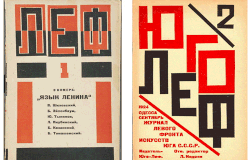
Alexander Rodchenko designed the covers, photomontages at first and then straight photographs, with Varvara Stepanova doing some of them too. Gosizdat, the state publishing house in Moscow, printed it. The copy of the April to May 1923 number cataloged at the Van Abbemuseum is 235 by 160 millimeters with an edition of five thousand, which is the measure of the thing: a pocket-sized object in a print run that a Western little magazine of the same ambition could only dream about, paid for by the state it was arguing with.
What came out in it was not minor. Mayakovsky's long poem About This appeared there first, and so did Sergei Eisenstein's The Montage of Attractions, which is where film theory gets one of its founding essays. Isaac Babel's Red Cavalry ran in it too. Boris Pasternak and Dziga Vertov both turn up in the contributor list. Leon Trotsky discussed the journal critically in Literature and Revolution in 1924, and the criticism was not unsympathetic, which in 1924 still counted as a review rather than a sentence.
~ the record ~
| Born | 1923, Moscow, published by Gosizdat |
|---|---|
| Peak | 5,000 copies of the April to May 1923 number |
| Killed | December 1928, the last issue of Novy LEF |
| Lifespan | six years in two runs, seven issues then a monthly |
| Made by | Vladimir Mayakovsky and Osip Brik, for the Left Front of the Arts |
| Killed by | an editorial split, then the turn against formalism |
~ the lenin number ~
Lenin died on 21 January 1924, and LEF's first issue of that year gave its critical section over to him. Shklovsky had organized the project on his own and brought it to the journal. Six writers contributed, all of them formalists or close to the formalist circles. Shklovsky wrote on Lenin as decanonizer and Yuri Tynyanov on his vocabulary as a polemicist. The articles analyze his rhetoric and barely touch his historical importance.
Mayakovsky wrote the unsigned editorial, which is the part of that issue still worth reading. He attacked the new Soviet habit of canonizing Lenin by mass-producing objects with his face on them, and argued that the practice would cost future generations the man himself. Don't take away his living gait and human traits, he wrote. We need him alive, not dead. The mausoleum opened that same year.
~ literature of fact ~
The second run started in 1927 under the name Novy LEF, with Mayakovsky as editor-in-chief and the playwright and photographer Sergei Tretyakov beside him. Tretyakov's program was factography: photography and film put in the hands of the working class to produce work that answered bourgeois fiction, or as one scholar puts it, reality without realism. The report and the photograph were to replace the novel.
Mayakovsky did not agree, and kept at the Futurist literary project.
In August 1928 the chief editorship passed to Tretyakov. After July that year Nikolai Aseev and Osip Brik stopped appearing in its pages at all, so by autumn the masthead had little left of the group that founded it. The 1928 volume ran to twelve numbers and stopped there. The group reorganized itself as REF the following year, and in 1930 Mayakovsky shot himself.
~ where it surfaced afterwards ~
Tretyakov spent six months in Germany between October 1930 and April 1931, lecturing on Soviet literary practice and collective farm reportage. Walter Benjamin and Bertolt Brecht were in the audience for some of it, and factography went into German left criticism through that door.
Inside the Soviet Union the opposite happened. Avant-garde experiment was reclassified as formalism, and Socialist Realism was institutionalized as the single permitted approach. Tretyakov was arrested in July 1937 and sentenced to death that September. The covers Rodchenko designed for this journal now hang in museums that collect twentieth century graphic design, with no indication that the magazine behind them was arguing about whether it should contain any art at all. Tretyakov was rehabilitated in 1956, nineteen years after the sentence.
~ leave a rose ~
an anonymous tribute. one rose per visitor per day.
@}-->-- ... roses left here
~ leave a wreath ~
a rose fades by morning. a wreath stays on this grave for good, with your name on it.
paid once through stripe. payments are handled by OÜ Lakeview, the small company that keeps rip.so running. the money pays for the hosting and the nightly digging. adopt it and the headstone reads "maintained in memory by" you. the groundskeeper plants new wreaths at the next tending, usually within a day.
» one email a week: new graves and the anniversaries of the dead. subscribe
other phenomena: JenniCam, Galaxy Science Fiction, Jugend, 3D Maze
also died in the pre-1980s: The Century Magazine, The Ladder, VideoBrain Family Computer
~ leave a note ~
visitors before you have left these graveside notes. anonymous welcome.