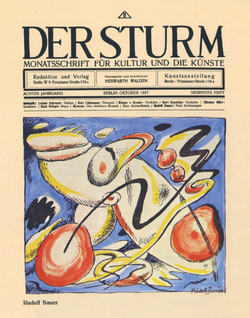
Der Sturm
~ the last words ~
Herwarth Walden was born Georg Lewin in Berlin in 1878, the son of a doctor, and trained as a pianist and composer before deciding that criticism paid better. The name he is filed under was a gift from Else Lasker-Schüler, who built it for him out of Thoreau and who married him in 1903. By then he was running the Verein für Kunst, an organization that put Rilke and the Mann brothers in front of paying Berlin audiences, and handling the German distribution of Karl Kraus's Die Fackel.
The magazine almost had a different name. Halley's comet was due in 1910 and Berlin had comet fever, so the working title was Der Komet. What came out on 3 March 1910 was called Der Sturm, a weekly for culture and art, eight pages of large folio for fifteen Pfennig a copy or five Mark a year. Issue one carried Kraus on operetta and Adolf Loos on the poor rich man.
Oskar Kokoschka came to Berlin at Walden's invitation and gave the first year its face: a series of portrait heads that ran across the title pages, including one of Walden himself, and from 14 July 1910 his play Mörder, Hoffnung der Frauen with his own drawings. Before the war the paper ran a steady traffic between Berlin and Paris, printing Apollinaire and Cendrars in a German weekly as a matter of routine. The war stopped that exchange and the early 1920s restarted it on a much smaller scale.
It did not keep its promised rhythm for long. Weekly until November 1913, then fortnightly in double numbers dated by half-months, then monthly in practice from January 1915, with volume years that ran April to March rather than following the calendar. Princeton's digitized set holds 343 issues while Monoskop counts 336, so the safe figure is somewhere around 340 over twenty two years.
~ the record ~
| Born | 3 March 1910, eight folio pages for fifteen Pfennig |
|---|---|
| Peak | weekly through 1913, claiming readers in 26 countries by 1929 |
| Killed | the third number of 1932, dated by bibliographers to March |
| Lifespan | 22 years, roughly 340 issues |
| Made by | Herwarth Walden, born Georg Lewin |
| Killed by | the Depression, then the politics that drove Walden to Moscow |
~ everything with sturm in the name ~
To mark the hundredth issue Walden opened a gallery, in a Tiergartenstraße villa that was already scheduled for demolition. The first exhibition ran from 12 March to 12 April 1912 and was a touring Blaue Reiter show with Kokoschka attached. The Italian Futurists opened there on the day it closed, and the surviving catalog is marked as the seventh and eighth thousand printed, which tells you how many people came through.
From there the brand multiplied. There was a publishing house behind it, issuing the Sturm-Bücher along with art postcards after Marc and Münter. An art school followed in 1916 under Georg Muche, with Klee and Campendonk teaching painting, then a bookshop in 1917 and an expressionist theater society in 1918. The Wednesday evenings in the gallery started at a quarter to eight and ran from September to April. Before it was over the gallery had exhibited more than thirty women painters and sculptors, which no other gallery of the period came close to.
From June 1913 the whole operation sat at Potsdamer Straße 134a. In 1928 Walden gave up those rooms for money reasons and moved what was left to Bayreuther Straße 39.
~ the herbstsalon ~
The largest thing Der Sturm ever did was the Erster Deutscher Herbstsalon, which opened on 20 September 1913 and closed on 1 December. Walden rented 1,200 square meters on the third floor of a building on Potsdamer Straße and filled it with 366 works by 90 artists. August Macke and Franz Marc did the hanging. The collector Bernhard Koehler underwrote it with 4,000 Mark.
Klee showed twenty two works and Sonia Delaunay twenty six. One room was given over to twenty one pictures by the late Henri Rousseau. The following year the gallery gave Marc Chagall his first solo exhibition.
~ the friedmann-mittel ~
The twentieth volume, covering 1929 and 1930, managed nine numbers in twenty one months and stopped in December 1930. Then nothing came out for over a year. Volume twenty one consisted of three issues, all in 1932, none of them carrying a printed date at all, which is why the final number is cited as March 1932 on a bibliographer's reconstruction rather than on anything the cover says.
Those three issues are not really about art. They are largely a campaign for the Friedmann-Mittel, a disputed tuberculosis remedy, running pieces headed Für das Friedmann-Mittel and Die Patienten melden sich. The journal that brought Futurism into Germany went out arguing for a TB cure.
~ saratov ~
Walden had joined the KPD in 1918, and Nell Walden, his second wife, divorced him in 1924 specifically because she could not live with the turn. In June 1932 he left Germany with his fourth wife, the translator Ellen Bork, and settled in Moscow to teach and publish. His taste in painting was exactly the taste the Soviet cultural authorities were in the process of criminalizing, and he spent years defending himself against the charge that the avant-garde and fascism were the same thing.
He was arrested in Moscow on 13 March 1941 on a pretext of espionage. His wife and daughter got into the German embassy and went back to Berlin. Walden died on 31 October 1941 in Soviet custody near Saratov, in a labor camp infirmary. His daughter did not find out the date until 1966, which was also the year he was rehabilitated.
The full run is digitized and free, at Princeton and at the Mainz academy's source edition. The domain der-sturm.de belongs to a German photo booth rental business and redirects to its Instagram.
~ leave a rose ~
an anonymous tribute. one rose per visitor per day.
@}-->-- ... roses left here
~ leave a wreath ~
a rose fades by morning. a wreath stays on this grave for good, with your name on it.
paid once through stripe. payments are handled by OÜ Lakeview, the small company that keeps rip.so running. the money pays for the hosting and the nightly digging. adopt it and the headstone reads "maintained in memory by" you. the groundskeeper plants new wreaths at the next tending, usually within a day.
» one email a week: new graves and the anniversaries of the dead. subscribe
other phenomena: BlogShares, Time Cube, MotiFake, Instagram NFTs
also died in the pre-1980s: Compatible Time-Sharing System, Kenbak-1, Service Bureau Corporation
~ leave a note ~
visitors before you have left these graveside notes. anonymous welcome.