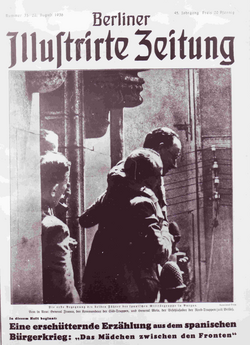
Berliner Illustrirte Zeitung
~ the obit ~
It was founded in November 1891 by a Silesian businessman named Hepner and published out of Berlin by Otto Eysler, who also put out a humor sheet called Lustige Blätter. The first issue is dated 4 January 1892. Its cover was a group portrait of officers who had drowned in a shipwreck, and it created a sensation on the first try.
The formula had two halves. First, no subscription stood in the way: the Berliner Illustrirte was sold off the newsstand to anybody walking past it, which rearranged the German magazine market around the question of what a cover looked like. The second was technical. From 1901 it was possible to print photographs on the inside pages, not just engravings copied from them, and Leopold Ullstein's house pushed that capability until the thing it produced was recognizably a modern news magazine.
The numbers that followed were enormous for Europe. A million copies a week by 1914, about 1.8 million as the 1920s closed, and 1,950,000 in 1931, which was the only German circulation anywhere near the big American weeklies. Between 1926 and 1931 the German news weeklies ran their own aircraft to get copies into remote towns before the news went stale, and Luft Hansa eventually took the job over.
~ the rap sheet ~
| Born | 4 January 1892, Berlin, published by Otto Eysler |
|---|---|
| Peak | 1,950,000 copies a week in 1931 |
| Killed | 22 April 1945, during the battle for Berlin |
| Lifespan | 53 years, 3 months |
| Made by | Ullstein Verlag, owner from 1894 |
| Killed by | the fall of Berlin |
~ the picture machine ~
What made it work was an apparatus nobody else had built yet: a picture department with its own production unit, and a standing library of images to pull from when a story broke. In 1895 an engineer sent in a photograph he had taken at a fire, the magazine asked him for more, and a few weeks later he had founded the photography firm Zander & Labisch. In April 1912 the presses were stopped mid-run when the Titanic news came through, and a half-page photograph of the Acropolis was pulled out for one of the ship. The cover of the 23 April issue was an allegorical drawing of the iceberg as death.
It also understood the lighter end of its own job. Vicki Baum's novel about the new working woman was serialized through 1928 and the print runs had to be raised repeatedly until they passed two million. E. O. Plauen's wordless strip Vater und Sohn was the most popular cartoon in Germany in the 1930s. In the summer of 1928 the magazine ran a competition offering prizes to readers who could guess the sex of six photographed young people.
~ when the state moved in ~
Under the Propaganda Ministry the magazine lost its independence a piece at a time. The 25 March 1934 issue began serializing Hermann Göring's memoirs, ghostwritten, and had to withdraw them because Goebbels objected to the arrangement. A few months later the Ullstein family business was taken from them under the aryanization laws, and a weekly that had been pointedly non-political for forty years became an organ of the state. From the outbreak of war in 1939 it ran German victories.
The copy on Wikimedia Commons is number 35, dated 27 August 1936. It cost 20 Pfennig, it is marked as the 45th year of publication, and the front page sells a story out of the Spanish Civil War about a girl caught between the lines. In 1941 the archaic spelling in the masthead, the Illustrirte that had been left alone when the rest of the nameplate was modernized around 1900, finally became Illustrierte. By 1944 it was the last survivor of the twelve independent illustrated weeklies Germany had in 1939, and five of the dead ones were still appearing as covers wrapped around its contents.
~ the last press run ~
The Soviet encirclement of Berlin closed around 25 April 1945. Three days before that, on 22 April, the last copies of the Berliner Illustrirte came off the press, and an SS detachment moved into the printing house to defend it from the people who were about to take the city. The end came from outside the building rather than from any decision inside it. The machines ran until the week ran out.
Fifty-three years of weekly photographs end there, and much of what the twentieth century looks like in a textbook came out of that building. The candid news picture and the photo story told in sequence were worked out here and in two or three contemporaries, the Münchner Illustrierte Presse in Munich and Vu in Paris, and both ideas were being copied in New York well before the building fell.
~ the masthead after 1945 ~
The Ullsteins got their company back after the war and sold it to Axel Springer in pieces from 1956. Springer printed the name twice as a special edition. The strange one came first: a 1961 issue mailed free to influential Americans around John Kennedy's Berlin visit, which picked up its page numbering exactly where the last wartime edition had stopped, as though the intervening sixteen years were a gap in the pagination. The second marked the fall of the Wall in 1989. Since 18 March 1984 the title has belonged to the Sunday supplement of the Berliner Morgenpost, where it still runs, attached to a newspaper rather than a magazine.
~ leave a rose ~
an anonymous tribute. one rose per visitor per day.
@}-->-- ... roses left here
~ leave a wreath ~
a rose fades by morning. a wreath stays on this grave for good, with your name on it.
paid once through stripe. payments are handled by OÜ Lakeview, the small company that keeps rip.so running. the money pays for the hosting and the nightly digging. adopt it and the headstone reads "maintained in memory by" you. the groundskeeper plants new wreaths at the next tending, usually within a day.
» one email a week: new graves and the anniversaries of the dead. subscribe
other news: joinDOTA, Brill's Content, RIA FAN, Electric Word
also died in the pre-1980s: Ramparts, Go-Set, Victor Talking Machine Company
~ leave a note ~
visitors before you have left these graveside notes. anonymous welcome.