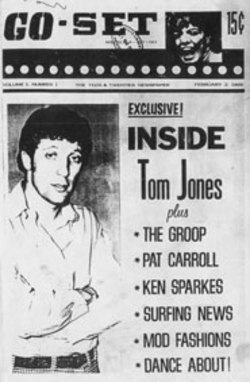
Go-Set
~ the obituary ~
Volume 1, Number 1 carries the date 2 February 1966 and a cover price of 15 cents, which was printed twelve days before Australia switched to decimal currency on 14 February. It was assembled in a house at 4 Grace Street, Malvern, in Melbourne. Under the masthead it billed itself as The Teen & Twenties Newspaper, and the front page promised an exclusive on Tom Jones; accounts of the launch give the full title as Go-Set Weekly-A-Go-Go, though the cover of issue one simply says GO-SET. Phillip Frazer and Tony Schauble had been editing Monash University's student paper, Lot's Wife, and wanted a pop paper instead, with Peter Raphael named alongside them as the third founder. Waverley Press agreed to print the thing on credit, without which issue one would not exist. Early sales ran somewhere between three and five thousand copies a week.
In October 1966 it printed a national Top 40, and Australia had not had one before. There were charts kept by individual states and charts kept by individual radio stations. Nothing claimed the country. From February 1967 the chart was compiled by Ed Nimmervoll, who was studying architecture at the time and stayed with the paper for most of its life. Circulation peaked at 72,000 copies a week in the second half of 1970, a figure carried by a single source and never audited anywhere I can find.
Read the staff list and the paper stops looking like a student project. Ian Meldrum, not yet called Molly by anybody, got his first front page in the issue of 27 July 1966 and was writing a weekly column from August. Lily Brett was the star reporter and Colin Beard took the pictures. In January 1967 the paper put both of them on a plane to London for four months, to file on the British scene directly instead of rewriting the English weeklies. Stan Rofe wrote a column called Stan Rofe's Tonic from April 1967 to March 1971 under a swap deal with the radio station 3UZ.
Frazer left to start a counterculture paper called Revolution, which turned into the first Australian edition of Rolling Stone at the end of 1972. The magazine that eventually took its place in the record-company advertising budget was started by Go-Set's own founder.
~ the case file ~
| Born | 2 February 1966, fifteen cents, from a house in Malvern |
|---|---|
| Peak | 72,000 copies a week between June and December 1970 |
| Killed | 24 August 1974 |
| Lifespan | 8 years, 6 months |
| Made by | Phillip Frazer and Tony Schauble, with Peter Raphael |
| Killed by | A hiring freeze at a parent company nobody could name |
~ the pop poll ~
The same month the chart arrived, Go-Set ran a readers' poll, and the winners of the first one were Normie Rowe and Lynne Randell. Rowe was crowned King of Pop on television, on The Go!! Show, so the result of a newspaper vote was handed over in front of a national audience. The poll ran annually afterward and the titles stuck to people for years.
The paper also coordinated the 1966 Battle of the Sounds, the national band competition won that year by The Twilights. Meldrum was given a pin-up magazine of his own to edit, Gas, from late 1968. Two years after the printer had taken a chance on it, a weekly paper with five figures of circulation was functioning as the organizing body for Australian pop.
~ sold twice in fourteen months ~
Frazer sold out to Waverley Offset at the end of 1972, and the title went on to the Sydney publisher Sungravure. The date of that second sale is not settled: the standard account of the paper's death puts it in February 1973, the Wikipedia article says December 1973, and the issue of 29 December 1973 is the one that announced the move to Sydney. Nimmervoll wrote that editorial.
The people who worked there disagree about who owned Go-Set at the very end. Michele Williams believed she was employed by IPC, the British publisher. A journalist who covered the scene believed it was still Sungravure. Frazer thought IPC had bought Sungravure partly as a way of getting rid of Go-Set. Nobody in the record is certain, and the uncertainty is itself a measure of how little attention the owner was paying.
The ending itself is small and procedural. Williams left around the first week of August 1974, and the policy at the parent company was that departing staff were not replaced. That left nobody to put the paper out. The last issue is dated 24 August 1974, and no closure notice was ever printed in it.
~ who got the readers ~
Sungravure launched RAM about six months later, and most accounts treat that as the succession, though Nimmervoll thought the readers actually went to Dolly. Nimmervoll started his own paper, Juke, in 1975. Meldrum became Countdown's talent coordinator that November, and did on television for the next decade what he had been doing in print.
What survives is microfilm and a fan archive. The National Library of Australia holds the run from volume 1 number 1 to the final issue on film, the State Library of Victoria's set is incomplete, and a chart site maintained by enthusiasts has the weekly Top 40s page by page. Australia's pop press of the sixties exists today because somebody photographed it before the paper went brown.
~ leave a rose ~
an anonymous tribute. one rose per visitor per day.
@}-->-- ... roses left here
~ leave a wreath ~
a rose fades by morning. a wreath stays on this grave for good, with your name on it.
paid once through stripe. payments are handled by OÜ Lakeview, the small company that keeps rip.so running. the money pays for the hosting and the nightly digging. adopt it and the headstone reads "maintained in memory by" you. the groundskeeper plants new wreaths at the next tending, usually within a day.
» one email a week: new graves and the anniversaries of the dead. subscribe
other media music: Victor Talking Machine Company, MTV Brasil, BurnLounge, Legitmix
also died in the pre-1980s: Victor Talking Machine Company, Ramparts, Coronet Camera Company
~ leave a note ~
visitors before you have left these graveside notes. anonymous welcome.