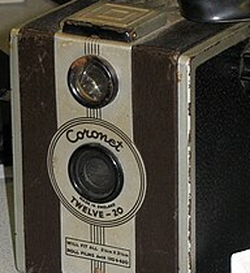
Coronet Camera Company
~ the eulogy ~
48 Great Hampton Street, Aston, Birmingham. That is where Frederick Pettifer started the Coronet Camera Company in 1926, in the part of the city that made its living turning metal and later plastic into small objects. Coronet cameras were not good. They were cheap, which between the wars was a different and considerably more useful property.
The method was volume and the arithmetic was ruthless. Coronet bought lenses from the British Optical Lens Company and had bodies molded by Edwin Elliott's plastics firm a short distance away, and when rebadging somebody else's finished camera cost less than building one, it did that instead. The catalogs did the selling. By 1933 the record says 510,000 cameras had left the works.
In 1946 the company reorganized as Coronet Ltd and moved around the corner to Summer Lane, and after the war it committed properly to Bakelite. The Cub and the Cadet are molded plastic things that cost almost nothing and took a perfectly reasonable snapshot. I was born seventeen years after the works closed and the nearest I have come to one is a photograph of one, which is true of most people now, because what Coronet sold was an everyday object and everyday objects are not the ones that get kept.
~ the dossier ~
| Born | 1926, at 48 Great Hampton Street, Aston, Birmingham |
|---|---|
| Peak | 510,000 cameras sold by 1933 |
| Killed | 1967 |
| Lifespan | 41 years |
| Made by | Frederick W. Pettifer |
| Killed by | ceased operations, with no sale and no successor recorded |
~ what else was in the box ~
Coronet sold more than cameras. There were Coro-flash units and filters, and the company put out its own film under the Corochrome name in 120 and 127 sizes alongside a Coronet Panchromatic black and white stock. A customer could therefore buy the camera and the film it took from the same Birmingham firm without ever touching a brand anyone would call prestigious, and that was the entire proposition. The Coronet Midget, the subminiature, is the one collectors chase today, which would have amused anyone pricing it at the time.
~ the french workaround ~
France put up import restrictions after the war, so Coronet partnered with Tiranty of Paris. Parts came from Birmingham, lenses came from the French side, and the finished cameras were sold as French products with French text printed on the instruction plates. Models like the Lux and Le Polo exist only in that arrangement. Eastman Kodak was working the same loophole for the same reason, which put a small Aston firm and the largest photographic company on earth on identical terms with the French customs regime.
The end is not dramatic and is not really documented. The company ceased operations in 1967 after forty-one years, with no acquirer recorded and nothing shipping under the name afterward. Standard Cameras Ltd had already gone in 1955, a few streets away on Mott Street, selling a box camera that was very nearly the same object. By the end of the 1960s a cheap camera usually meant an Instamatic cartridge or a Japanese import, neither of which came out of a works in Aston.
~ leave a rose ~
an anonymous tribute. one rose per visitor per day.
@}-->-- ... roses left here
~ leave a wreath ~
a rose fades by morning. a wreath stays on this grave for good, with your name on it.
paid once through stripe. payments are handled by OÜ Lakeview, the small company that keeps rip.so running. the money pays for the hosting and the nightly digging. adopt it and the headstone reads "maintained in memory by" you. the groundskeeper plants new wreaths at the next tending, usually within a day.
» one email a week: new graves and the anniversaries of the dead. subscribe
other gadgets: Looxcie, Micropolis, Belkin Wemo (cloud), QuickCam
also died in the pre-1980s: Victor Talking Machine Company, Fawcett Comics, Sabamobil
~ leave a note ~
visitors before you have left these graveside notes. anonymous welcome.