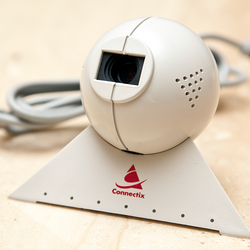
QuickCam
» see connectix.com as it lived, on the wayback machine
~ the obit ~
the quickcam was on every desk that had a webcam at all, in the years when having a webcam was a decision rather than a default. in turkey that window is roughly 2002 to 2008, the msn years, and the logitech quickcam was the brand people meant when they said the word. it was not a thing everybody owned. it was the thing the one person in a group who owned one had bought.
the first one was older and american and had nothing to do with any of that. connectix released it in 1994 for a hundred dollars, a small round camera that plugged into a macintosh serial port because usb did not exist yet. it produced sixteen shades of gray at 320 by 240 pixels. about fifteen frames a second, when the mac had the cycles to spare.
the shape is the part people remember. an off-white sphere roughly the size of a golf ball, sitting in a shallow triangular stand with the connectix logo printed on it, pointed at your face from the top of a monitor that was deeper than it was wide. the color model arrived in 1996 at a hundred and ninety-nine dollars and brought a windows version with it. between the two platforms it sold five hundred thousand units in three years, which for a category that had not previously existed is a real number.
~ the rap sheet ~
| Born | 1994, $100, serial port, Macintosh only |
|---|---|
| Peak | 500,000 units between 1994 and 1997 |
| Killed | 2009, when Logitech dropped the name |
| Lifespan | fifteen years |
| Made by | Connectix, then Logitech from August 1998 |
| Killed by | the camera built into the laptop lid |
~ what it was actually for ~
in 1994 there was almost nothing to point a camera at. video calling did not work over a modem and would not for years. what the quickcam got used for instead was the still image uploaded on a timer, which is the entire architecture of the early webcam page. you pointed the thing at a coffee pot or at your own desk and had a script push a jpeg to a server every few minutes, and strangers refreshed the page.
that is the lineage worth tracing. the personal-broadcast web of the late nineties ran on cheap cameras and a refresh interval, and the line from there to lifecasting and eventually to streaming is unbroken. what sits at the end of it is a generation who assume a camera is aimed at them by default. cu-seeme was doing the moving-picture version at the same time and needed a university connection to be usable. the quickcam needed a hundred dollars.
~ the msn years ~
logitech bought the product line in august 1998 and this is where it became a mass-market object. through the 2000s the quickcam name covered a whole shelf, from a twenty-dollar plastic thing that clipped onto a crt to the pro models with carl zeiss glass and autofocus. the driver software was its own kind of famous, a bundled suite that installed a tray icon and a set of face-tracking effects almost nobody used deliberately.
the demand came from messengers. everyone in turkey was on msn and msn had video calling, so a webcam became the accessory that turned a text conversation into something else. internet cafes started keeping one at the counter. the quality was terrible in a specific way that people found acceptable, low light and heavy compression over an adsl uplink, and nobody expected better because there was no better to expect.
~ the long tail ~
what killed the name was not a competitor. apple put a camera in the imac bezel in 2005 and every laptop maker followed within a couple of years, so the default state of a computer changed from having no camera to having one. a separate device became something you bought only if you wanted better than the built-in, which is a much smaller market than everybody who wanted a camera at all.
logitech let the branding go around 2009. the quickcam pro 9000 came back as the webcam pro 9000, and by 2010 the whole range had moved to c-numbers with hd in the name. connectix itself had already gone: it sold virtual pc to microsoft in 2003 and wound up. in october 2010 time put the original quickcam on a list of the hundred best gadgets ever made, which is the kind of honor a product only receives once it is safely dead.
~ leave a rose ~
an anonymous tribute. one rose per visitor per day.
@}-->-- ... roses left here
~ leave a wreath ~
a rose fades by morning. a wreath stays on this grave for good, with your name on it.
from $1, paid once through stripe. it keeps the graveyard running: the hosting and the nightly digging. adopt it and the headstone reads "maintained in memory by" you. the groundskeeper plants new wreaths at the next tending, usually within a day.
» one email a week: new graves and the anniversaries of the dead. subscribe
other gadgets: Belkin Wemo (cloud), Micropolis, Looxcie, Microsoft UltimateTV
also died in the 2000s: Adobe Ultra, Tribal Voice PowWow, Helio
~ leave a note ~
visitors before you have left these graveside notes. anonymous welcome.