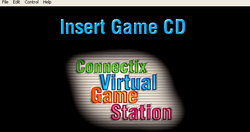
Connectix Virtual Game Station
» see connectix.com as it lived, on the wayback machine
~ the eulogy ~
Software almost never gets a date of death written into a contract while it is still selling. Virtual Game Station got one. When Sony and Connectix settled on 15 March 2001, the terms allowed sales to continue until 30 June, after which every asset belonged to Sony. For three and a half months you could walk into a store and buy a program with an expiry date already agreed by the company that wanted it gone.
It went on sale on 5 January 1999 for forty-nine dollars, written by Aaron Giles with the recompiling processor emulator by Eric Traut. Steve Jobs put it on stage at Macworld Expo that month, which is how most Mac owners first heard of it. A 233 MHz iMac ran a great many PlayStation titles at full speed, off the same discs the console read, region lock and all. There was nothing to configure and nothing to acquire. You put the disc in the drive.
Sony filed on 27 January 1999, three weeks after release, and got an injunction out of the district court that stopped sales while the case ran. That is the part worth holding onto. The product spent a large share of its short commercial life forbidden from being sold. It won the right to exist back on appeal, and then had that right bought out from under it.
The distance from here was the machine. In 1999 a Macintosh in Turkey lived in a print shop or an advertising office, not in a house. The home computer was a beige PC with a modem attached, and the question of whether an emulator was legal to buy never came up, because nobody was buying software in the first place. A boxed program that let you play your own PlayStation discs was solving a problem in a shape this country did not have.
~ the dossier ~
| Born | 5 january 1999, at forty-nine dollars |
|---|---|
| Peak | the eighteen months when a legal playstation emulator sat on a shop shelf |
| Killed | 30 june 2001, the last day of sales permitted by the settlement |
| Lifespan | two and a half years |
| Made by | Connectix Corporation of San Mateo |
| Killed by | the company that lost the lawsuit, buying the product afterward |
~ what the court actually said ~
On 10 February 2000 the Ninth Circuit reversed the injunction and held that the intermediate copies Connectix made of the PlayStation BIOS while working out how it behaved were fair use. The reasoning followed the Sega and Accolade line from 1992: if the only way to understand a program is to copy it into memory and watch, then forbidding that copy would hand the copyright holder control over the functional ideas underneath. Sony asked the Supreme Court to look at it. The Supreme Court declined.
That ruling is why this grave matters more than the product it belongs to. Every clean-room emulator written since in the United States stands on it. The case is still taught, and it is still the first answer anybody gives when a console maker claims that emulation is theft by definition.
~ the postmortem ~
Sony lost on appeal in February 2000 and lost again when the Supreme Court declined to hear it. Then it did the thing money can do when law cannot. On 15 March 2001, days before a scheduled trial on the remaining claims, the two companies settled and Sony took ownership of Virtual Game Station. Roy McDonald of Connectix said the agreement gave them resources to move into new applications for their emulation technology, which is the language a company uses when it has been paid to stop.
Sales ran to 30 June 2001. Sony never shipped another copy and never explained what it planned to do with an emulator it had spent two years calling an instrument of piracy. The last public version was 1.4.1, from October 2000. What Sony bought was the absence of the product.
~ the inheritance ~
Connectix survived it by two years. The company's other famous work was Virtual PC, which Microsoft bought in 2003 along with most of the engineering team, and the QuickCam, which went to Logitech in the nineties. Aaron Giles went on to years of work on MAME. Eric Traut ended up at Microsoft demonstrating a Mac running Windows inside a virtual machine, which is the same trick pointed the other way.
The product is unobtainable now in every legitimate sense, and the thing it proved is permanent. That is an unusual ratio. Most software leaves behind users who miss it. This one left behind a precedent that protects programs whose authors were in primary school when it was decided.
~ leave a rose ~
an anonymous tribute. one rose per visitor per day.
@}-->-- ... roses left here
~ leave a wreath ~
a rose fades by morning. a wreath stays on this grave for good, with your name on it.
from $1, paid once through stripe. it keeps the graveyard running: the hosting and the nightly digging. adopt it and the headstone reads "maintained in memory by" you. the groundskeeper plants new wreaths at the next tending, usually within a day.
» one email a week: new graves and the anniversaries of the dead. subscribe
other software: Panels (MKBHD), Award Software, WSO2 Mashup Server, Citra
also died in the 2000s: Quantex, Castlewood Orb, Winstar Communications
~ leave a note ~
visitors before you have left these graveside notes. anonymous welcome.