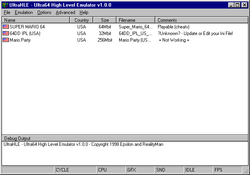
UltraHLE
» see ultrahle.com as it lived, on the wayback machine
~ the obituary ~
In january 1999 the download was not the problem. UltraHLE was a small file, small enough that a 33.6k line at home handed it over in a few minutes rather than overnight. What you could not download was a 3dfx Voodoo card. The emulator talked to Glide, which was 3dfx's own graphics interface and nobody else's, so the requirement was one specific piece of silicon in one specific slot. In Ankara that year the card cost more than the argument was worth to most people, so this one reached me as news before it ever reached me as software.
And the news was that somebody had done the thing the scene had agreed could not be done yet. The Nintendo 64 was three years old and still on shelves. Emulating a console that is currently selling was a theoretical exercise, the sort of thing people posted about in the future tense. On 28 january 1999 two authors put out version 1.0.0 of a program that ran The Legend of Zelda: Ocarina of Time on an ordinary Pentium II, at a speed you could call playable without being generous about it.
They went by RealityMan and Epsilon and that is close to the whole record. no interviews under real names, and nothing to serve papers on except two handles and a website. It spread the way things spread in 1999, which is to say it was mirrored everywhere within a day and there was no putting it back.
~ the case file ~
| Born | 28 january 1999, version 1.0.0 |
|---|---|
| Peak | around twenty commercial N64 games playable on a Pentium II |
| Killed | 5 march 1999, RealityMan's final statement |
| Lifespan | thirty six days |
| Made by | RealityMan and Epsilon |
| Killed by | a Nintendo lawsuit that never had to be filed |
~ the trick ~
The name carries the method. HLE is high level emulation. in those days. Every emulator before it had gone the honest route, reading the console's instructions one at a time and reproducing what the hardware would have done with each one, which is accurate and costs you roughly everything in performance. UltraHLE went around it. N64 games did their graphics and audio through a standard library Nintendo shipped to developers, so rather than simulate the chips underneath, it watched for calls into that library and answered them with native PC code written to do the same job.
Which is a shortcut with a bill attached. It only works for games that use the library the way the emulator expects, so the compatibility list at release ran to about twenty titles and every one of them had needed specific attention. the accuracy people hated it on principle and they were not wrong about the principle. But the technique did not go away. Dolphin later used HLE variants for GameCube and Wii audio, and the argument between accuracy and speed that UltraHLE started is one the emulation scene is still having.
~ the postmortem ~
Nintendo began putting a lawsuit together in february 1999, aimed at the authors and at the site distributing the thing. Beth Llewellyn speaking for the company said Nintendo was very disturbed that RealityMan and Epsilon had widely distributed a product designed solely to play infringing copies. that was the position, and it was the position because the emulator on its own does nothing. You need the ROM, and in 1999 essentially nobody had a legal one.
The authors pulled it from distribution almost immediately and it made no difference, the file was already gone into the world. On 5 march 1999 RealityMan posted a final statement: UltraHLE was dead and buried, he was deleting the source along with the ROMs he had beside it, and the pseudonym was finished as of that message. He added that the legal threat was not the only reason, that he wanted to work on something outside emulation. Both things can be true. Nintendo never had to file anything.
~ the funny part ~
The project died and the program did not. The source leaked in 2002 and an OpenGL build called UltraHLE 2064 turned up afterward, arriving into a world that already had better emulators and getting the reception you would expect. Meanwhile the original binary kept working, because a compiled executable does not care that its authors have stopped existing.
so the thing Nintendo went after is still one search away, twenty seven years later, and the two people who wrote it have never surfaced under any name. What actually got buried on 5 march 1999 was not the software. it was two identities, deleted by the people who had built them, to avoid a lawsuit that was never served.
~ leave a rose ~
an anonymous tribute. one rose per visitor per day.
@}-->-- ... roses left here
~ leave a wreath ~
a rose fades by morning. a wreath stays on this grave for good, with your name on it.
from $1, paid once through stripe. it keeps the graveyard running: the hosting and the nightly digging. adopt it and the headstone reads "maintained in memory by" you. the groundskeeper plants new wreaths at the next tending, usually within a day.
» one email a week: new graves and the anniversaries of the dead. subscribe
other software: Timeworks Publisher, FlashGet, Sony Sketch, Adobe Photoshop Touch
also died in the 1990s: StarText, Timeworks Publisher, Sharp X68000
~ leave a note ~
visitors before you have left these graveside notes. anonymous welcome.