Sabamobil
~ the last words ~
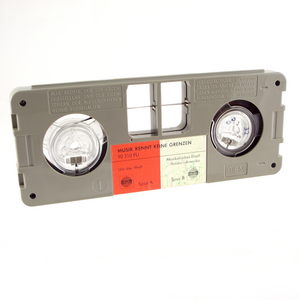
SABA showed the Sabamobil at the Hannover trade fair in the spring of 1964, twenty years before I was born and on the other side of a continent. This is a grave for a tape cartridge made for German car radios, finished before the decade it launched in was over.
The cartridge held two three-inch reels of ordinary quarter-inch tape, 170 meters of the thin triple-play stock. It ran at 9.5 centimeters a second across four mono tracks. A lever on the machine picked which pair you were on, marked red and green. The German accounts give four times thirty minutes, so two hours a cartridge; the Museum of Obsolete Media says up to ninety. Nothing reconciles the two figures and I am not going to pretend otherwise.
The engineering that mattered was where the parts sat. The head and the capstan were placed between the reels rather than off to one side, which meant the whole cartridge could be pushed into the slot with one hand by someone whose other hand was on a steering wheel. That was the brief. It could not record, and there was no fast forward or rewind, because a driver was not going to be doing either.
~ the record ~
| Born | 1964, shown at the Hannover trade fair |
|---|---|
| Peak | One player, the TK-R15, at 423 marks, with Ariola pressing the tapes |
| Killed | Around 1968, when the player went out of production |
| Lifespan | Four years |
| Made by | SABA of Villingen, in the Black Forest |
| Killed by | The Compact Cassette, cheaper and licensed to everybody |
~ the machine ~
Exactly one player was ever built for the format. It was a portable radio with the cartridge mechanism in the top, twelve transistors, a medium wave AM tuner and six watts pushed through a speaker almost eight inches across. It ran off five D cells or a mains adapter, and a car bracket took either 6 or 12 volts while feeding the car antenna in through a seven pin socket. A note on the model number, because the sources disagree: both Wikipedias call it the TK-R12, while radiomuseum says no TK-R12 appears in any wholesale catalog or SABA service record and the machine is the TK-R15. The service records win.
It cost 423 marks in 1964, with the car bracket about seventy more, and it sold in the United States too at $136 with cartridges at $14. The Philips cassette recorder shown the previous autumn was 299 marks. Blank Sabamobil cartridges opened with two metal clips and no tools, so you could drop in your own three-inch reels recorded at home on a proper deck, which was the single concession to the fact that the thing in the car could not record a note.
~ why nobody else made one ~
Philips launched the Compact Cassette at the Berlin radio show on 30 August 1963, a full year before the Sabamobil reached the market, and then licensed it to anyone who wanted it. SABA licensed its format to no one. The account from the German tape museum is that dealers kept asking who else made these cartridges, and the answer was SABA, which is not an answer a dealer can use. Stereo 8 turned up in 1964 as well and took the in-car niche that was the Sabamobil's whole reason for existing.
The trade press spotted the other gap immediately. A 1964 report in the magazine tonband, welcoming the machine warmly enough, added that the Sabamobil would surely one day be set up for tape recording too. It never was. Production of the player is recorded as running from 1964 to 1968, which is also the year the Schwer family sold eighty-five percent of SABA to GTE.
The brand went on without it. GTE passed SABA to Thomson-Brandt in 1980 and Thomson closed the Villingen site in 2007. The name is a licensing asset owned by a Houston company today, still going onto European televisions, and the format it was attached to lasted four years.
~ leave a rose ~
an anonymous tribute. one rose per visitor per day.
@}-->-- ... roses left here
~ leave a wreath ~
a rose fades by morning. a wreath stays on this grave for good, with your name on it.
from $1, paid once through stripe. it keeps the graveyard running: the hosting and the nightly digging. adopt it and the headstone reads "maintained in memory by" you. the groundskeeper plants new wreaths at the next tending, usually within a day.
» one email a week: new graves and the anniversaries of the dead. subscribe
other media formats: CD Video, DVD-Audio, SDMI, Free Lossless Image Format
also died in the pre-1980s: Fawcett Comics, Stereo-Pak, Processor Technology
~ leave a note ~
visitors before you have left these graveside notes. anonymous welcome.