DC-International
~ the obituary ~
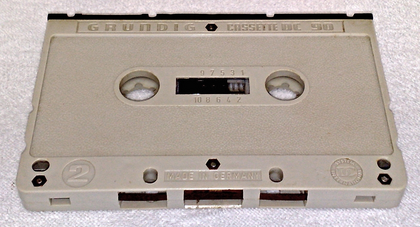
DC stood for Double Cassette, because there were two reels inside the shell. Grundig presented it at the Stuttgart radio exhibition in 1965 as a German standard for German machines, and for about eighteen months it looked like a serious proposition rather than a footnote.
The cassette was 120 by 77 by 12 millimeters and weighed 65 grams, noticeably larger than the Philips design at 100 by 63. It ran at two inches per second against the Compact Cassette's one and seven-eighths, which is not a large difference on paper and is the difference between usable music fidelity and not, on 1965 tape. Four tracks, two programs running in opposite directions, sold as DC 90 and DC 120 depending on how many minutes you wanted. Grundig built the C 100 and the C 110 to play them and Telefunken built the Magnetophon 401, with car units coming from Grundig and from Blaupunkt.
Prerecorded music was the part that needed partners, and Grundig found them. Decca signed on, and so did RCA Victor. For a moment in the middle sixties the German industry had a cassette format with real machines and a real record catalog behind it.
~ the case file ~
| Born | 1965, shown at the Stuttgart radio exhibition |
|---|---|
| Peak | Home and car machines from Grundig, plus a Telefunken deck |
| Killed | 1967, abandoned at the Berlin radio exhibition |
| Lifespan | Two years |
| Made by | Grundig |
| Killed by | The Philips Compact Cassette, licensed royalty free |
~ how it lost ~
The origin of the argument is the part worth knowing. Grundig had been working with Philips, and Philips had been developing its own smaller cassette in Hasselt. Grundig ended up holding construction drawings and Philips ended up choosing its own design, telling Grundig late and offering a role in the pocket recorder as consolation. Grundig declined the consolation and went to market with DC-International instead.
Then Philips did the thing that settled it. Under pressure from Sony it licensed the Compact Cassette to anyone who wanted it, free of charge, which turned a company format into a world standard almost overnight. Nobody licenses the second-place format for money when the first-place one costs nothing. A larger and technically defensible cassette became the one that no machine outside Germany would accept.
~ the surrender ~
The surrender happened in public, at trade shows, in 1967. Telefunken dropped support at the Hannover exhibition. Grundig followed at the Berlin radio exhibition later that year, and what it brought with it was the C 200, its first Compact Cassette recorder. Two years after announcing a standard, the company that announced it turned up selling the rival.
Anyone who had bought a C 100 and a shelf of DC 90s owned a closed system with no future stock. There was no adapter and no conversion path, because the shells are different sizes and the speeds do not match. The tapes still exist in German collections and there are specialists who will transfer them, which is currently the only reason a DC-International cassette ever gets played.
~ from a long way off ~
This happened seventeen years before I was born, in a country I have never lived in, between two companies whose names I knew only from stereo equipment my parents' generation owned. I have no distance to describe honestly here except all of it.
What I do have is the other end of the story. The format that won this fight is the one that furnished my entire childhood in Turkey: cassettes on market stalls, and cassettes recorded off the radio with the hiss left in. That was a Philips standard, and it was a Philips standard everywhere because Philips gave it away. The reason it was the only format on the stall is partly that Grundig lost in Berlin in 1967.
~ leave a rose ~
an anonymous tribute. one rose per visitor per day.
@}-->-- ... roses left here
~ leave a wreath ~
a rose fades by morning. a wreath stays on this grave for good, with your name on it.
from $1, paid once through stripe. it keeps the graveyard running: the hosting and the nightly digging. adopt it and the headstone reads "maintained in memory by" you. the groundskeeper plants new wreaths at the next tending, usually within a day.
» one email a week: new graves and the anniversaries of the dead. subscribe
other media formats: xD-Picture Card, Digital8, Display PostScript, Tefifon
also died in the pre-1980s: Tefifon, Wire Recording, Kenbak-1
~ leave a note ~
visitors before you have left these graveside notes. anonymous welcome.