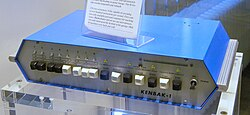
Kenbak-1
~ the eulogy ~
John Blankenbaker designed the Kenbak-1 in 1970 and put it on sale in 1971 for $750. There is no microprocessor in it, because in 1970 there was no microprocessor to buy. Intel's 4004 arrived in November 1971, months after this machine was already shipping, so the arithmetic and the control logic are built out of ordinary small and medium scale integrated circuits on one board, wired together to act like a processor that nobody had manufactured yet.
It had 256 bytes of memory held in shift registers, a row of toggle switches for input and a row of lamps for output. No screen and no keyboard. You entered a program by flipping switches and you read the answer off the lights, which was normal for a laboratory machine in 1970 and completely abnormal for something advertised to households and schools.
That was the market Blankenbaker aimed at, education, and it did not respond. Somewhere between fifty and fifty-two machines were built and forty-four of them sold. For most of the company's three years he was the only employee and the address was his garage in Los Angeles. Kenbak Corporation failed in 1973 and the remaining stock went to CTI Education Products, which renamed the machine the 5050 and sold no more of them under that name than Kenbak had under its own.
Thirteen years later the Computer Museum in Boston ran a contest to decide what the first personal computer had actually been, and the judges landed on the Kenbak-1. The Computer History Museum still says the same thing. So the machine has the title and the company that made it did not live long enough to hear the argument start.
~ the dossier ~
| Born | 1971, out of a garage in Los Angeles |
|---|---|
| Peak | 44 machines sold at $750 each, mostly into schools |
| Killed | 1973 |
| Lifespan | about three years, most of it with one employee |
| Made by | John Blankenbaker, Kenbak Corporation |
| Killed by | a market that had not been invented yet |
~ what was in the box ~
The design is worth looking at even now because of what it does without. There is no chip on that board that knows what an instruction is. Blankenbaker built the instruction set out of the same generic logic anyone could order from a catalog, then used serial shift registers as main memory, which is cheap and slow and means the machine spends much of its time waiting for the bits to come back around.
What you get for $750 in 1971 is a programmable computer on a desk that answers to one person. What you do not get is anything to do with it. There is no language, no storage, no printer, no display. The lamps are the display. A school buying a teaching machine that year could put the same money into a teletype connected to a timesharing service and give a whole classroom something that typed back at them.
~ why nobody bought it ~
Every history of this machine reaches for the phrase "ahead of its time" and that is only half right. It was not ahead of the technology, it was made out of exactly what 1970 could supply. It was ahead of the reason. In 1971 the answer to why a person would want a computer of their own was still four years away, and it turned out to be hobbyists who wanted to build one, not schools that wanted to buy one.
The Altair 8800 landed on the cover of Popular Electronics in January 1975 with a processor inside it and a magazine's worth of people already waiting. Kenbak had no processor to point at, no magazine, and a distribution plan that consisted of one man mailing out advertisements.
~ the long tail ~
Around fourteen originals are known to survive, split between collectors and museums, and they sell at auction for many times what a working example of anything else from that year brings. Replica kits exist for people who want the switches and the lamps without the six-figure problem of owning a real one.
There is no version of this story where I appear in it, and no version where you do either. Forty-four people bought a Kenbak-1. That is a different kind of distance from the usual one on this site, which is a product staying in America or reaching Turkey five years late. This is a machine almost nobody on earth touched while it was for sale. What everybody inherited was the sentence it won in 1986: somebody had already built a computer for one person to own, before anyone had worked out why they would want one.
~ leave a rose ~
an anonymous tribute. one rose per visitor per day.
@}-->-- ... roses left here
~ leave a wreath ~
a rose fades by morning. a wreath stays on this grave for good, with your name on it.
from $1, paid once through stripe. it keeps the graveyard running: the hosting and the nightly digging. adopt it and the headstone reads "maintained in memory by" you. the groundskeeper plants new wreaths at the next tending, usually within a day.
» one email a week: new graves and the anniversaries of the dead. subscribe
other gadgets: Ensoniq, BlackBerry, Priam Corporation, Power Computing
also died in the pre-1980s: Compatible Time-Sharing System, Picture Post, DC-International
~ leave a note ~
visitors before you have left these graveside notes. anonymous welcome.