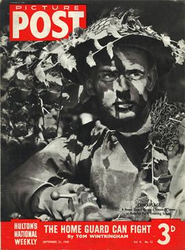
Picture Post
~ the last words ~
Picture Post closed twenty-seven years before I was born, and the product it sold is hard to explain now. For eighteen years it was the fastest route a photograph had into a British living room. One week. That was the offer and it was a strong one, and by the time I was buying magazines in the 1990s a week was a geological interval and the pictures were already on the eight o'clock news.
The first issue came out on 1 October 1938, published by Edward Hulton and edited by Stefan Lorant, a Hungarian who had pioneered the picture story in Germany in the 1920s and had been imprisoned by the Nazis before he got out. It sold a million copies a week inside two months, which in a country of forty-seven million people is a number worth reading twice. By 1943 it was at 1,950,000 a week. Tom Hopkinson took the editorship in 1940 and held it for a decade.
What the magazine did with that circulation was not only photography. In January 1941, with the war going badly, it published a "Plan for Britain" laying out full employment and a national health service, twenty-two months ahead of the Beveridge Report it is usually described as anticipating. Hopkinson's own stated method was simple enough. His photographers were thoroughbreds and the text could always be written after the event, because if they came back without pictures he had nothing to lay out at all.
~ the record ~
| Born | 1 October 1938, first issue, Hulton Press, London |
|---|---|
| Peak | 1,950,000 copies a week in 1943 |
| Killed | 1 June 1957, final issue |
| Lifespan | 18 years, 8 months |
| Made by | Edward Hulton and Stefan Lorant |
| Killed by | television, after a proprietor fired his best editor in 1950 |
~ the spiked story ~
In 1950 Hopkinson sent James Cameron and Bert Hardy to the Korean War, and they filed three picture stories. One of them was about the treatment of political prisoners by the South Korean government, around sixty men and boys, aged fourteen to seventy, held outside Pusan station on suspicion of opposing Syngman Rhee. Hulton, who backed the Conservative Party and had been fighting with his socialist editor for years, read the piece as communist propaganda and had it taken out. Management invited Hopkinson to resign. He refused and went on insisting the story should run, so they sacked him instead.
Hopkinson said afterward that Hardy's photographs from the Inchon landings were the finest he ever had to lay out. He never edited Picture Post again, and neither did anybody for long. The magazine went through editor after editor for the rest of its life, and the copy drifted toward film stars and lighter features while the circulation figures went the other way.
~ the numbers ~
Circulation was 1,422,000 at the end of 1949, still enormous. By June 1952 it was 935,000. At the close it was under 600,000 a week, which would be a triumph for a British magazine today and was a death sentence then, because the cost base assumed two million. Television arrived in the middle of that slide and ITV launched in 1955. The case for waiting seven days to see a photograph got harder to make every year after that.
~ where the pictures went ~
In 1945 Hulton hired Charles Gibbs-Smith of the Victoria and Albert Museum to catalog the magazine's negatives with a keyword and classification scheme. Getty's own account calls it the first indexing system built for pictures, and it was later taken up by the V and A and by parts of the British Museum. The Hulton Press Library was formally established in 1947, which is to say the photographs had been cataloged and set up as a business of their own a full decade before the magazine that produced them went under.
When the title folded, Hulton sold the archive to the BBC in 1957, where it merged with the Radio Times photo library and then absorbed the picture archives of the Daily Express and the Evening Standard. The BBC got rid of it in 1988, selling to Brian Deutsch. In 1996 Getty Investments bought the collection for 8.6 million pounds and began digitizing it in 2000. It sits inside Getty Images today as the Hulton Archive.
So you have seen this magazine's work without knowing it. Getty holds rights to something like 15 million photographs out of those British press archives, and the Picture Post negatives sit inside that, licensed a few pounds at a time into documentaries and into articles that credit a stock agency rather than a dead weekly. The magazine was worth less than its filing cabinets, and the filing cabinets are still earning.
~ leave a rose ~
an anonymous tribute. one rose per visitor per day.
@}-->-- ... roses left here
~ leave a wreath ~
a rose fades by morning. a wreath stays on this grave for good, with your name on it.
from $1, paid once through stripe. it keeps the graveyard running: the hosting and the nightly digging. adopt it and the headstone reads "maintained in memory by" you. the groundskeeper plants new wreaths at the next tending, usually within a day.
» one email a week: new graves and the anniversaries of the dead. subscribe
other news: paidContent, Crispy Gamer, A Plus, Medical News Network
also died in the pre-1980s: Compatible Time-Sharing System, Kenbak-1, Tefifon
~ leave a note ~
visitors before you have left these graveside notes. anonymous welcome.