Tefifon
~ the goodbye ~
Tefifon lost for a reason that is still killing products. The format held more than anything it competed against and the players worked well enough that plenty of them still run. The catalog was full of people nobody had heard of, because everyone worth hearing was already signed to a label that would not license to it.
Karl Daniel founded Tefi-Apparatebau in 1936 and demonstrated his endless sound tape at the Berlin radio exhibition that same year. The name was a contraction of Telefon and Film. The war and the years after it took the next decade out of the story. The first home players reached German living rooms toward the end of the 1940s, and serial production started in 1951 at a factory in Cologne-Porz.
The medium was a loop of plastic tape with grooves cut helically across its width, coiled inside a cartridge. A stylus rode the groove exactly the way it would on a record, and because the tape was a loop it never ended and never needed rewinding. Capacity scaled with how much tape you could get into the shell, which gave four sizes: four minutes, fifteen minutes, one hour, and four hours. That last number should have won the argument. In 1955 an LP gave you forty minutes and a reel of magnetic tape gave you a threading exercise.
Sales fell away through the early 1960s against the LP on one side and domestic magnetic tape on the other. Production ended in 1965 and Tefi-Apparatebau was liquidated. Neckermann, the mail-order house, bought the rights to the name and sold the remaining stock of cartridges out through its catalog, which is a thin ending for something that had been demonstrated to the German press thirty years earlier.
~ the chronicle ~
| Born | 1936, shown as an endless sound tape at the Berlin radio exhibition |
|---|---|
| Peak | The 1950s, serial production at Cologne-Porz, cartridges running up to four hours |
| Killed | 1965, production halted and Tefi-Apparatebau liquidated |
| Lifespan | 29 years from the first demonstration, 14 in serial production |
| Made by | Dr. Karl Daniel, Tefi-Apparatebau Dr. Daniel KG, Cologne |
| Killed by | Record labels that would not license their artists onto it |
~ the catalog problem ~
Look at what Tefifon actually released and the shape of the failure is obvious: compilations of popular hits played by studio orchestras, and operas and operettas performed by singers whose names meant nothing outside Cologne. No title on the shelf was one a buyer walked into a shop asking for by name.
Deutsche Grammophon and the other majors had their artists under exclusive contract and no reason at all to open a second format for a company in Porz with a few hundred thousand players in the field. The medium that gets the catalog wins, whatever the specification sheet says, and the format war twenty years later between VHS and Betamax was decided by exactly the same arithmetic.
~ the machines ~
The players were furniture. Tefi sold standalone units, and through the 1950s it sold radio combinations like the T 573, where the tape transport sat in the same wooden cabinet as the radio dial and the loudspeaker cloth. They were built heavily and a surprising number of them still work, which is the main reason a small German collector scene keeps the format alive at all. Cartridges still turn up at Rhineland flea markets.
~ the leftovers ~
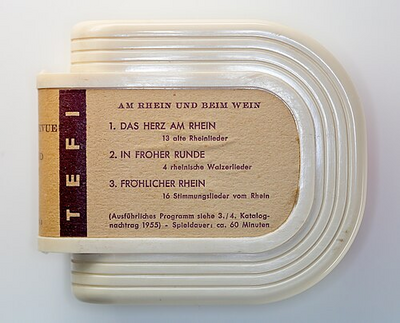
The Deutsches Museum holds a T 573 in its collection. Photographs of the cartridges survive in the open archives, and they look like nothing else that was ever sold: a rounded ivory plastic shell with the coiled tape visible through a slot in the side, a paper label promising an hour of Rhine drinking songs, and the word TEFI printed down the spine in white on dark red.
The engineering was ahead of its market by years and it went to a liquidator anyway. A German buyer standing in a shop in 1955 was asking one question, which was whether the music they already knew could be had on it, and for fourteen years running the answer was no.
~ leave a rose ~
an anonymous tribute. one rose per visitor per day.
@}-->-- ... roses left here
~ leave a wreath ~
a rose fades by morning. a wreath stays on this grave for good, with your name on it.
from $1, paid once through stripe. it keeps the graveyard running: the hosting and the nightly digging. adopt it and the headstone reads "maintained in memory by" you. the groundskeeper plants new wreaths at the next tending, usually within a day.
» one email a week: new graves and the anniversaries of the dead. subscribe
other media formats: Photo CD, DVD-RAM, Wire Recording, DC-International
also died in the pre-1980s: Wire Recording, DC-International, Compatible Time-Sharing System
~ leave a note ~
visitors before you have left these graveside notes. anonymous welcome.