Wire Recording
~ the eulogy ~
I have never seen a wire recorder. I have spent an entire working life inside the idea in one. Magnetized particles on a moving medium, read back off a coil, which is what a hard disk is and is also what the cassette in every car in Ankara was. The first machine that ever did it recorded onto bare steel thread, and it was built in 1898.
Valdemar Poulsen was a Danish engineer at the Copenhagen telephone company, and what he was actually trying to solve was the answering machine problem: a telephone call arrives when nobody is there. He ran a steel piano wire past an electromagnet carrying the signal from a microphone, and the wire came out the other side with the magnetic pattern of a voice frozen into it. Run it past a coil again and the voice comes back. He called it the Telegraphone, patented it in the United States in 1900, and won the Grand Prix at the Paris Exposition that same year with a recording of the Emperor of Austria.
Then it did almost nothing for forty years. The American Telegraphone Company put the first commercially available magnetic recorder anywhere on sale in Springfield, Massachusetts in 1903, and sold hardly any. The playback was too quiet to be useful, because nobody had invented an amplifier yet. The idea had to sit and wait for the vacuum tube.
~ the dossier ~
| Born | 1898, valdemar poulsen's telegraphone |
|---|---|
| Peak | 1946 to 1954 in american homes, before tape reached the shops |
| Killed | the early 1950s, effectively gone by 1955 |
| Lifespan | fifty-seven years from patent to obsolescence |
| Made by | american telegraphone, then brush, armour research, webster-chicago and sears |
| Killed by | magnetic tape, which you could edit |
~ what it actually was ~
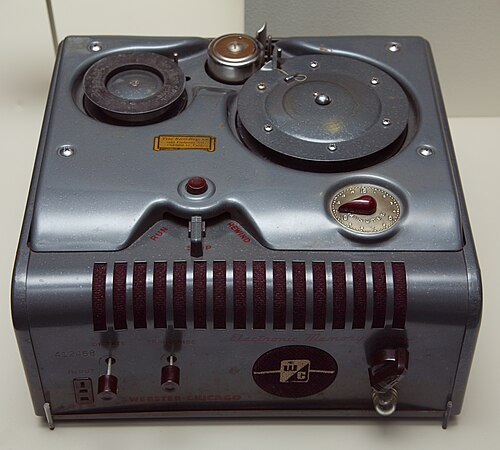
Picture the medium and you understand the format. The wire was carbon or stainless steel, roughly the thickness of a human hair, and an hour of sound needed about two miles of it wound onto a spool. It ran past the head at around two feet per second, which is fast enough that a full spool passing through the machine is genuinely alarming to watch.
Everything difficult about the format follows from that. Wire has no top and no bottom, so if it twists between the spools the recording plays back muffled or backwards for as long as the twist lasts. Let it off the reel and you get a tangle that behaves like fishing line and cannot be untangled. Break it and the repair is a knot, which is audible forever after as a click on every pass. There was no way to edit it and no way to find a spot on it except by running the whole thing and listening.
~ the war ~
The Second World War is what made wire recording briefly important. Marvin Camras at the Armour Research Foundation in Chicago improved the recording head and the biasing enough to make it genuinely usable, and the American military bought it in volume, for portable recorders that went out with combat correspondents and for intelligence work. A wire spool was small, rugged and did not care about being dropped, which is more than the shellac disc could say.
That is why some of the only surviving audio of the war is on wire. Correspondents carried the machines into places no disc lathe was ever going to reach, and what they came back with is the sound of the event rather than a studio reconstruction of it. Archives are still transferring those spools, and the recovery work is difficult for exactly the reasons the format died.
~ what killed it ~
American soldiers found the answer in Germany. The Magnetophon used a coated plastic tape rather than a wire, and by 1948 tape recorders were on sale in the United States. Wire held on for a few years on price alone, through the licensing programs run by Brush Development in Cleveland and Armour Research, with Webster-Chicago, Wilcox-Gay, Air King and Sears all shipping consumer machines into homes between roughly 1946 and 1954.
Then it collapsed, and it collapsed on one feature. Tape can be cut with a razor blade and joined back together with a piece of sticky tape, and the join is inaudible. That single property is what turned recording from a way of capturing a performance into a way of building one, and it is the reason the modern studio exists. Wire could not do it and no amount of engineering was going to make it. By the mid-1950s it was gone from shops, and only Protona's tiny Minifon machines carried it into the 1960s, because for a recorder small enough to hide in a coat there was still nothing better.
~ the next chapter ~
Everything magnetic that came after is Poulsen's patent with a different substrate. The compact cassette and the hard drive in the machine i am writing this on run the same physics, and the only thing that has changed in a hundred and twenty-eight years is what the particles are stuck to and how small they got.
The wire itself is the part that could not be scaled down, and it is worth remembering that this was the state of the art for longer than the compact disc has existed. A voice from 1898 is sitting on a steel thread in a museum drawer somewhere, still legible, because rust is the only thing that erases it.
~ leave a rose ~
an anonymous tribute. one rose per visitor per day.
@}-->-- ... roses left here
~ leave a wreath ~
a rose fades by morning. a wreath stays on this grave for good, with your name on it.
from $1, paid once through stripe. it keeps the graveyard running: the hosting and the nightly digging. adopt it and the headstone reads "maintained in memory by" you. the groundskeeper plants new wreaths at the next tending, usually within a day.
» one email a week: new graves and the anniversaries of the dead. subscribe
other media formats: DVD-RAM, Photo CD, Tefifon, Display PostScript
also died in the pre-1980s: Tefifon, DC-International, Compatible Time-Sharing System
~ leave a note ~
visitors before you have left these graveside notes. anonymous welcome.