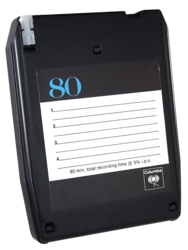
8-Track Cartridge
~ the obit ~
Every 8-track had a moment where the sound stopped for about a second, something moved inside the machine with an audible clunk, and the music came back. That was the head shifting to the next pair of tracks. Four programs had to be roughly equal in length for the format to work, and albums are not written in four equal pieces, so the change landed wherever it landed. Often that was in the middle of a song.
The mechanism explains everything else about it. The tape was one continuous loop, pulled from the center of the reel and wound back onto the outside, so there was no end and therefore no rewind. Eight parallel tracks ran across quarter-inch tape and the head read two of them at once for stereo, which is where the four programs come from. The pinch roller lived inside the cartridge rather than in the player, so the thing that wore out was the tape you owned rather than the machine you had paid for.
None of that was new in 1965. George Eash had built the Fidelipac endless-loop cartridge in 1954 and radio stations were already using it for jingles, and Bernard Cousino had worked out the lubricated-loop mechanics before that. Richard Kraus drew the consumer version at Lear Jet in 1963. What Bill Lear added was a consortium, Ampex and Motorola and RCA Victor and Ford among them, and Ford is the name that mattered. In September 1965 it offered factory-installed and dealer-installed players as an option on three of its 1966 models, and the format was in American dashboards before it was in anybody's living room.
This one is out of reach in two directions at once. It was finished in 1988, a decade before i had a modem, and it was never sold here in any real quantity even at its peak. The 8-track needed a specific world to make sense in. Long distances and a big car with a cavity in the dashboard, sold through a dealer network that treated audio as a line on the order form. Turkey got its portable music from the compact cassette instead, and it got it for a reason that had nothing to do with fidelity. A cassette was something you could record onto. The tape people carried around here was usually one they had made, copied off a record or off somebody else's tape, and there was never a consumer culture of blank 8-tracks to compete with that. A format that only plays what a factory pressed onto it needs a retail economy underneath it, and that economy was in America.
~ the rap sheet ~
| Born | september 1965, a factory option on three ford models |
|---|---|
| Peak | 1978, the last year sales went up |
| Killed | 21 november 1988, the last major-label release on the format |
| Lifespan | twenty-three years, most of them in a car |
| Made by | bill lear's consortium at lear jet, with ampex and ford |
| Killed by | the compact cassette, and a tape you could record on yourself |
~ what the cartridge did to the album ~
Because the running order had to divide into four playable chunks, the record had to bend. Songs were reordered so the breaks fell between them, and when that failed they were faded out at the program change and faded back in afterward, so the listener heard the same track twice with a gap punched through the middle. Some releases dropped a song entirely to make the arithmetic come out. Whole albums exist in an 8-track sequence that no other format ever used.
This is the part that separates it from every format that came after. The cassette and everything since accepted whatever the artist handed over. The 8-track made the artist accept the container.
~ sold with the car ~
Home decks existed and were always an afterthought. The format's home was the dashboard, where its real competitor for years was the radio rather than any other tape, and where its worst properties barely registered. Nobody rewinds in traffic. Nobody minds a program change at sixty miles an hour with the windows down.
That worked until the car stopped being the only place people wanted music. The Walkman went on sale in 1979 and the cassette had already been improving for a decade, cheaper every year and small enough to put in a coat. By 1980 the boom was entirely cassette-shaped, and an 8-track player was a thing built into a car somebody bought before the change.
~ the record clubs held on ~
Retail gave up around 1983. Shops stopped stocking the cartridges and the racks came out, which is normally where a format's story ends. This one kept going for another five years in the mail. Columbia House and the RCA Music Service went on offering 8-tracks to subscribers until late 1988, because a mail-order club has no shelf space to lose and a customer who already owns a player is a customer who will keep ordering.
The title usually named as the last commercial release from a major label is Fleetwood Mac's Greatest Hits, put out by Warner Bros. on 21 November 1988 and sold through Columbia House. By the end of that year both clubs had dropped the format. Radio Shack sold blank cartridges and players into 1990 for the people who still had a machine in the dashboard and nothing else to put in it.
~ leave a rose ~
an anonymous tribute. one rose per visitor per day.
@}-->-- ... roses left here
~ leave a wreath ~
a rose fades by morning. a wreath stays on this grave for good, with your name on it.
from $1, paid once through stripe. it keeps the graveyard running: the hosting and the nightly digging. adopt it and the headstone reads "maintained in memory by" you. the groundskeeper plants new wreaths at the next tending, usually within a day.
» one email a week: new graves and the anniversaries of the dead. subscribe
other media formats: Total Hi Def, DataPlay, HD DVD, Vector Markup Language
also died in the 1980s: Lisp Machines, Inc., VisiCalc, Red Ryder
~ leave a note ~
visitors before you have left these graveside notes. anonymous welcome.