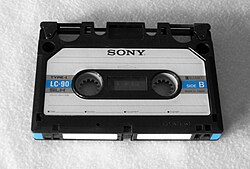
Elcaset
~ the eulogy ~
The Elcaset went on sale in 1976 with nothing recorded on it. No label ever pressed an album to the format, not one, in the whole four years it was in the catalog. Every Elcaset tape that ever played had been recorded by the person listening to it.
The name is a contraction of L-cassette, for large cassette, and large is accurate. The shell runs about three times the volume of a compact cassette and carries quarter-inch tape, twice the width, moving at 3 3/4 inches per second, twice the speed. Sony developed it with Matsushita and Teac specifically so it would arrive as an industry standard rather than as one company's product, which is a lesson somebody at Sony had learned somewhere.
The interesting part is what the deck did with the cassette once you put it in. Rather than read the tape through a window in the shell the way every cassette machine does, the transport pulled the tape out of the case entirely and threaded it across the heads like an open-reel machine, then wound it back inside when you pressed stop. That took out the tracking error the compact cassette shell introduces, and the measurements agreed: wow and flutter came down, and the noise floor dropped with it. Both of them landed nearer to reel-to-reel than to cassette.
There was no cheap way to meet this format, and that is most of why i have no story about it. A tape standard arrives in a country like mine through the stall selling pre-recorded albums, which is how the compact cassette got into every house in Turkey and how it stayed there for the next twenty years. Elcaset had no stall version of itself. The only door in was a deck at over a thousand dollars in 1976 money, bought before you had ever heard the thing play. It also died four years before i was born, which closed the secondhand route too.
~ the dossier ~
| Born | 1976, sony with matsushita and teac |
|---|---|
| Peak | 1977, when three manufacturers had decks in the catalog |
| Killed | 1980, withdrawn with the stock auctioned off |
| Lifespan | four years, two of them already fading |
| Made by | sony, matsushita and teac |
| Killed by | a compact cassette that got good enough, and no album to play |
~ a quarter inch of tape ~
Sony's line ran from the EL-5 up to the EL-7, and Technics and Teac each put out a deck under their own name. The EL-7 opened at around $1,225 and was later cut to $800, which tells you how the first two years went. Tapes came as the LC-60 and the LC-90, thirty and forty-five minutes a side across four tracks.
Everything about the format was aimed at one buyer: somebody recording rather than somebody playing. That person existed. He was taping vinyl before the record wore out, or taping the good FM broadcast, and he cared about the numbers on the back of the box. The problem was never whether he existed. It was how many of him there were.
~ nothing to buy on it ~
A format with no catalog has to be sold entirely on recording quality. The compact cassette had albums on it, the 8-track had albums on it, and both of them could be met for the price of one tape at a counter. Elcaset asked you to commit to the deck first and supply your own music afterward. Nobody at Sony seems to have treated that as the structural problem it was.
Meanwhile the thing it was built to beat kept getting better. Nakamichi had been shipping compact cassette decks since 1973 whose measurements embarrassed the format's own specification, and chromium dioxide tape plus Dolby B closed most of what was left. By 1978 a good cassette deck was good enough at a fraction of the money, and it played tapes you could buy anywhere on earth. The Elcaset started fading that year and never stopped.
~ the finnish auction ~
Sony pulled the format in 1980 and put the remaining stock up for sale. A Finnish company won the auction and moved the machines at clearance prices, bundling each one with twenty-five blank cassettes: 795 markka for an EL-5, 1,295 for an EL-7. About two thousand decks went out that way.
So the format's afterlife happened in one country, at a discount, years after the company that made it had stopped answering questions about it. For a long stretch there were more working Elcaset machines in Finland than in the rest of the world combined, owned by people who had bought a bargain rather than a format. In 2017 a musician named Jeremy Heiden put out an album called Blue Wicked on Elcaset, which made it the first commercially released recording the format ever carried, thirty-seven years after it was discontinued.
~ leave a rose ~
an anonymous tribute. one rose per visitor per day.
@}-->-- ... roses left here
~ leave a wreath ~
a rose fades by morning. a wreath stays on this grave for good, with your name on it.
from $1, paid once through stripe. it keeps the graveyard running: the hosting and the nightly digging. adopt it and the headstone reads "maintained in memory by" you. the groundskeeper plants new wreaths at the next tending, usually within a day.
» one email a week: new graves and the anniversaries of the dead. subscribe
other media formats: Electronic Video Recording, Speex, 3.5" Floppy Disk, Blender
~ leave a note ~
visitors before you have left these graveside notes. anonymous welcome.