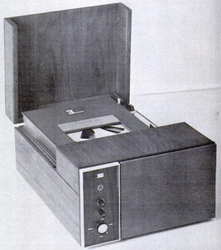
Cantata 700
~ the last words ~
The Cantata 700 was designed so that you would never notice it. 3M introduced it in 1965 as a background music system for commercial spaces, which meant the product was the sound in a supermarket or a hotel lobby, and the hardware was something bolted into a back room where the manager kept the mop.
The cartridges are among the largest ever built. Nearly square, quarter-inch tape wound on a reel-to-reel loop, four mono tracks running at one and seven-eighths inches per second. That slow speed is the whole trick: more than twenty four hours of playback fit inside one shell, so a shop could load a cartridge and leave it alone for a week. Every machine 3M offered was playback only. There was no record head in any of them, because the customer was never supposed to put anything on the tape.
The first two models, the 94BG and the 94BZ, went out in 1965 at $429 with two cartridges of the buyer's choosing. Each had a jack for eight-ohm speakers at six watts and a microphone jack, so the same box that played the music also handled the announcement about the register closing in ten minutes. In 1970 3M added the Cantata 700 Mark II, available only on lease.
~ the record ~
| Born | 1965, models 94BG and 94BZ at $429 with two cartridges |
|---|---|
| Peak | 26 hours per cartridge, four mono tracks at one and seven-eighths inches per second |
| Killed | 1988, when 3M divested the product line |
| Lifespan | Twenty three years |
| Made by | 3M |
| Killed by | Muzak, and the cost of a playback-only tape business |
~ the library ~
3M pressed its own music. Some of it is credited to the in-house 3M Orchestra. The rest is library material, mostly instrumental covers of standards alongside classical pieces rearranged to sit somewhere between light and bright. The cartridges were sold by library name and catalog number, which reads today like a menu written by someone describing moods to a machine: Easy Listening IRL-SO8, Rhythmic Library R-165, Polynesian P-166, Fiesta F-807, Nashville NA-288, Zodiac Z-025, Modified Rock Library 170.
There were two Christmas libraries, one choral and one rhythmic, which is the detail that gives the whole thing away. Somebody at 3M sat down and worked out that a store needs a different twenty six hours in December, and shipped it.
~ who ever saw one ~
There is a kind of dead product you can miss for reasons that have nothing to do with where you lived, and this is one. I was born in 1984, into a country where the background music in a shop came off a radio or off whatever cassette the owner liked, and by the time I was old enough to walk into a hotel lobby and hear a Cantata the format had already been divested. But the honest distance here is bigger than Turkey. Almost nobody anywhere ever saw one of these. It was sold business to business and installed by a technician who then went away, and the music on it was leased rather than owned. Its entire design goal was to produce sound that no listener would ever trace back to a device.
~ how it wound down ~
Muzak, the company whose name became the generic term for the thing 3M was selling, acquired the remaining unsold stock in 1986. The last tapes went out in 1988, and 3M divested all information on the product line the same year. Ask 3M today about the Model 94BG and the answer is that the records went with the divestiture.
Machines kept running long after that. The Museum of Obsolete Media dates the format 1965 to the 1990s, because installed decks stayed in service into the early part of that decade, playing tape libraries that no longer had a manufacturer behind them. A format whose entire purpose was to be ignored got to die the same way.
~ leave a rose ~
an anonymous tribute. one rose per visitor per day.
@}-->-- ... roses left here
~ leave a wreath ~
a rose fades by morning. a wreath stays on this grave for good, with your name on it.
from $1, paid once through stripe. it keeps the graveyard running: the hosting and the nightly digging. adopt it and the headstone reads "maintained in memory by" you. the groundskeeper plants new wreaths at the next tending, usually within a day.
» one email a week: new graves and the anniversaries of the dead. subscribe
other media formats: FlashPix, mp3HD, Canon FD Lens Mount, Digital Compact Cassette
~ leave a note ~
visitors before you have left these graveside notes. anonymous welcome.