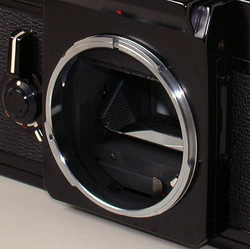
Canon FD Lens Mount
~ the obit ~
In March 1987 Canon shipped the EOS 650, and the lens mount on the front of it would not accept anything Canon had sold since 1971. That was the whole decision, made once, in public. The FD mount had arrived in March 1971 on the Canon F-1, it had carried the company through the years when the AE-1 alone sold more than a million bodies, and in a single product announcement it stopped being a system you could buy into and became a pile of hardware you already happened to own.
FD was a mechanical standard, and that is the key to everything that happened to it. Aperture and metering information moved between body and lens through physical levers and pins pressing on each other. It was backward compatible with Canon's older FL mount, which it had replaced in turn, so an FL lens would still meter on an FD body in stop-down mode. Over twenty-one years of production Canon released 134 different FD lenses running from 7.5mm to 1,200mm, which is about as wide as any manual focus line ever got.
What made EF a break rather than an upgrade is that Canon deliberately put no mechanical linkage in it whatsoever. Focus and aperture both moved to electrical contacts and motors inside the lens barrel, which is why Canon's autofocus was good early and stayed good. There was no engineering path to carrying an FD lens across with full function, and Canon never pretended there was. Nikon hit the same autofocus problem in the same years and kept the F mount, living with the compromises that choice forced on it. Photographers have been arguing about which company was right since 1987.
The last FD body left the price list in 1994, when I was ten and still four years away from my first modem. I came to this mount from the wrong end, the way anyone my age or younger does: as cheap secondhand glass behind a dumb adapter on a mirrorless body, bought because the flange distance happens to work out and the optics hold up fine. Meeting a standard for the first time when it is already dead and already cheap gives you a strange view of it.
~ the rap sheet ~
| Born | March 1971, on the Canon F-1 |
|---|---|
| Peak | 134 FD lenses from 7.5mm to 1,200mm; the AE-1 alone passed a million bodies |
| Killed | 1994, when the New F-1 left the price list |
| Lifespan | 23 years |
| Made by | Canon |
| Killed by | Canon's own EF mount, announced March 1987 |
~ the day the lenses stopped fitting ~
Canon did not kill FD cleanly, which is the part that gets flattened out of the telling. EOS arrived in 1987 and the FD system kept shuffling along beside it for years afterward. The last FD camera Canon introduced was the T60 in 1990, three years into the EOS era, and it was sold only for export. It never went on sale in Canon's home Japanese market at all. It existed for countries where EOS prices were still out of reach and for photography students who wanted something manual and cheap.
Canon did not build it either. The T60 came off Cosina's CT-1 chassis, the same subcontracting arrangement that produced the Nikon FM10 and the Olympus OM2000. The final camera in the system that had made Canon's professional reputation was a rebadged Cosina. The New F-1, the real professional body, outlasted it: the last one is thought to have been assembled in 1992, though it stayed on the price list officially until 1994. Canon kept servicing them until 2004.
~ what got buried with it ~
The breech-lock ring went first, and it went early. FD's original mounting design used a rotating collar that clamped the lens down without rotating the lens barrel itself, so the glass seated flat against the body every single time. Canon replaced it in 1979 with the New FD design, which you twisted like everyone else's lenses, and the EF mount of 1987 kept nothing from either generation.
The larger thing that went was an assumption. FD was the last Canon mount where the camera and the lens communicated by pushing on each other, where you could hold a lens up to a window and watch the aperture blades move when you moved a lever with your thumb. Everything since has been a conversation between two computers that happen to be bolted together.
~ the second life ~
FD glass came back, and the reason is boring geometry. An SLR needs clearance for a swinging mirror, so the mount sits a long way in front of the film. Mirrorless bodies deleted the mirror and moved the sensor much closer, which left physical room between an FD lens and a modern sensor for a passive metal tube. No electronics, no optics, nothing to go wrong. You focus by hand and set the aperture by hand, exactly as the lens was designed to be used.
So a 1970s Canon lens that was commercially worthless for twenty years is now a working piece of equipment again, at prices that have crept up as people worked this out. I spend my working life on cameras that never show a human being an image, where the lens is a component in a computer vision stack and nobody cares what it feels like in the hand. The FD mount is a reminder that optical glass depreciates much more slowly than the bodies and the mounts and the companies attached to it.
~ leave a rose ~
an anonymous tribute. one rose per visitor per day.
@}-->-- ... roses left here
~ leave a wreath ~
a rose fades by morning. a wreath stays on this grave for good, with your name on it.
from $1, paid once through stripe. it keeps the graveyard running: the hosting and the nightly digging. adopt it and the headstone reads "maintained in memory by" you. the groundskeeper plants new wreaths at the next tending, usually within a day.
» one email a week: new graves and the anniversaries of the dead. subscribe
other media formats: Digital Compact Cassette, Digital Audio Tape, mp3HD, FlashPix
also died in the 1990s: Digital Compact Cassette, anon.penet.fi, GameTek
~ leave a note ~
visitors before you have left these graveside notes. anonymous welcome.