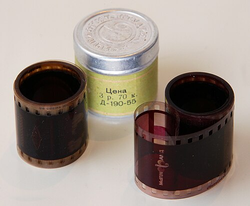
Filmstrip
~ the eulogy ~
Somebody in the room had the job of turning the knob. The record played the narration and at the end of each picture there was a tone, and on the tone you advanced the strip by one frame. Miss it and the class sat looking at a diagram of a volcano while the voice explained wheat farming. Later projectors read an inaudible 50 Hz pulse off the tape and advanced by themselves, which took the job away from the kid and removed most of what anybody actually remembers about the format.
The object is a spool of 35mm positive film carrying somewhere between thirty-two and sixty-four images in fixed order. There is no motor and no continuous run. The strip sits still in front of a lamp until it is moved, which is why a single frame could be left up for ten minutes without cooking, and why the film almost never needed splicing. Depending on the projector the frames ran vertically or horizontally, and two vertical frames took the space of one horizontal one.
It existed for a financial reason rather than an aesthetic one. A 16mm educational film cost real money to buy and needed a projector that cost more. It also broke when handled by a room of eleven year olds. A filmstrip cost a couple of dollars and rewound in seconds, and the canister it lived in was the size of a shot glass. From the 1920s onward it was the way a school district put pictures in front of a class without owning a film library.
This one sits well outside anything I can claim. Its peak was over before I was born and its death came while I was in primary school in Turkey, in a system whose audiovisual equipment was whatever the ministry had bought and whatever the school had inherited. That is the wider distance too: nobody ever bought a filmstrip. There was no consumer market and no shop you walked into. The format traveled through purchasing departments that had already committed to a projector, so its map is the map of institutional budgets, and it reached exactly as far as somebody's line item did.
~ the dossier ~
| Born | the 1920s, in american classrooms, out of the lantern slide |
|---|---|
| Peak | the 1960s and 1970s, when every school had a projector on a cart |
| Killed | the late 1980s |
| Lifespan | about sixty years |
| Made by | society for visual education and coronet films, among dozens |
| Killed by | the video cassette recorder getting cheap |
~ the record and the tone ~
Sound arrived separately, which is the part that dates it hardest. The narration and the music came on a 33 rpm vinyl record in a paper sleeve tucked in with the film, and from the early 1970s onward on a compact cassette instead. The two halves had to be kept together and frequently were not, which is how school cupboards ended up full of strips with no audio and records with no pictures.
Plenty of strips had no sound at all. Those carried captions burned into the frame, or shipped with a printed script the teacher read aloud, which turned the whole thing into a slideshow with homework attached. The Soviet ones were mostly built this way. It also meant the format could be paused indefinitely at any picture, which is a thing film cannot do, and teachers used that constantly.
~ who made them ~
The producers were a real industry. The Society for Visual Education in Chicago, founded at the end of the First World War, sold filmstrips under the Picturol name and by the 1950s was making them for home entertainment as well as school. Coronet Films, Guidance Associates, Warren Schloat Productions and Eye Gate House filled out the catalog through the 1960s, and CBS and the New York Times Company both put their names on titles. Bergwall Productions covered the vocational subjects nobody else wanted.
The catalog is what makes the format worth remembering. There were filmstrips on home economics and on language arts, on career choices and on personal hygiene, all of them narrated in the same steady voice, all of them arriving in a school with an instructor's guide explaining what the class was supposed to conclude. It is a very complete record of what American institutions in a given decade thought a child ought to be told.
~ the soviet strips ~
Filmstrips lasted longer and mattered more in the USSR than in the country that industrialized them. Movie projectors were not common in Soviet homes and video recorders arrived very late, so a strip of film and a lamp remained a plausible way to tell a child a story well into the 1980s. The Diafilm studio produced an enormous number of them, mostly captioned rather than narrated, and a lot of them are fairy tales rather than lessons.
The same pattern ran through Poland and Hungary in the 1950s and 1960s, and Greek children got them from a company called Argo Film that translated the scripts. This is the one part of the format's history where it functioned as entertainment in a home rather than as equipment in a classroom, and it happened because the alternatives were unavailable rather than because the filmstrip was good at it.
~ what the recorder did ~
The National Film Board of Canada gives the cleanest set of numbers on the way out. It had been making filmstrips since 1943 for military training and set up a proper production line in 1946 with twenty black and white titles. Inside two years it had sold 1,100 copies of those twenty to schools and libraries. By the 1950s the studio was putting out sixty to ninety strips a year at a dollar fifty for silent and five fifty with a soundtrack. By 1989 it had stopped entirely and moved to educational video.
That is the shape everywhere. Video cassette recorders came within reach of school budgets during the 1980s, and a tape did everything a filmstrip did while also moving, with the sound already on it and nobody standing at a knob. The producers that were not equipped to shoot video closed or sold up through the early 1990s. A few kept pressing small runs for libraries into the 2000s, which is stock being sold rather than a format still alive.
~ leave a rose ~
an anonymous tribute. one rose per visitor per day.
@}-->-- ... roses left here
~ leave a wreath ~
a rose fades by morning. a wreath stays on this grave for good, with your name on it.
from $1, paid once through stripe. it keeps the graveyard running: the hosting and the nightly digging. adopt it and the headstone reads "maintained in memory by" you. the groundskeeper plants new wreaths at the next tending, usually within a day.
» one email a week: new graves and the anniversaries of the dead. subscribe
other media formats: AOL CDs, Video Cassette Recording, RCA Tape Cartridge, HD VMD
also died in the 1980s: NEC PC-8800 Series, Dragon 32/64, Fairchild Channel F
~ leave a note ~
visitors before you have left these graveside notes. anonymous welcome.