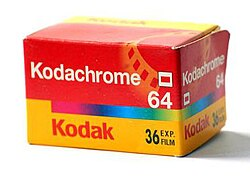
Kodachrome
~ the obituary ~
Kodachrome went on sale in 1935 as 16mm movie film and reached 8mm and 35mm stills the year after. It was worked out by Leopold Godowsky Jr. and Leopold Mannes, two professional musicians who had been experimenting with color since 1917 and who Kodak eventually hired rather than compete with. The company sold it for seventy four years, which is longer than most companies last.
The thing that made it strange is that the film had no color couplers in it. What you exposed was three layers of black and white emulsion, and the dyes were added one layer at a time during development, in a sequence that ended up standardized as K-14 in 1974. Four developers, a room full of machinery, and a technician who knew the machine. Nobody developed Kodachrome in a bathroom. Nobody developed it in a shop.
That cost bought permanence. The dyes went in as finished molecules rather than being built out of chemistry sitting in the emulsion for years, so Kodachrome slides from the 1940s still read correctly while plenty of later film has gone pink. National Geographic ran on it. The Zapruder film is Kodachrome II. Steve McCurry's 1984 portrait of the girl in the refugee camp is Kodachrome. Paul Simon put the name in a song in 1973 without paying Kodak for it.
The end came in pieces. Kodachrome 25 stopped in 2002, the Super 8 stock in June 2005, Kodachrome 200 in November 2006, and on 22 June 2009 Kodak announced that Kodachrome 64, the last one, would not be made again. By then it was a rounding error inside Kodak's film sales, which were themselves a rounding error inside what film had been.
This one was never mine to lose, and the reason is the lab and not the film. Kodachrome could be bought in a lot of countries and developed in very few, and by the time I was old enough to buy film with my own money the number of K-14 lines left on earth was in single figures, none of them here. What Turkey had was the one-hour minilab at the end of the street, which took C-41 print film and handed back a paper envelope the same afternoon. A film you had to post to another continent and wait weeks for was not a format. It was an expedition.
~ the case file ~
| Born | 1935, as 16mm movie film; 8mm and 35mm stills followed in 1936 |
|---|---|
| Peak | the standard for National Geographic and for color slides generally, 1950s to 1970s |
| Killed | 18 January 2011, when the last K-14 line exhausted its chemicals |
| Lifespan | seventy six years |
| Made by | Leopold Godowsky Jr. and Leopold Mannes, for Eastman Kodak |
| Killed by | digital capture, and then by a process no lab could afford to keep running |
~ the day the chemistry ran out ~
Dwayne's Photo in Parsons, Kansas was the last certified Kodachrome lab in the world, a family business in a town of ten thousand people running the final K-14 line on the planet. It announced that it would process anything that reached it by 30 December 2010 and then stop. Rolls came in from everywhere in those last weeks, including film that had been sitting in drawers since the 1960s and had no chance of holding an image.
Steve McCurry asked for and got the last roll Kodak manufactured. He shot thirty six frames on it and Dwayne's developed them in July 2010; the prints sit at the George Eastman House in Rochester. The genuinely final roll to go through the machine belonged to Dwayne Steinle, who owned the shop, and the last frame on it was his staff standing together in front of the building. It came off the processor at 1:36 in the afternoon on 18 January 2011, when the chemicals were finished. Nobody mixed more.
~ what got buried with it ~
Unexposed Kodachrome still turns up in camera bags and estate sales, and it is now a black and white film whether you want it to be or not. Run it through anything currently available and you get a monochrome negative, because the color was never in the roll. There is no home process, no boutique revival, no small lab in Berlin quietly doing it for enthusiasts. The knowledge is written down and the equipment is scrapped, and those two facts together are what a dead format actually looks like.
Kodak brought Ektachrome back in 2018 to a genuinely enthusiastic reception. It did not bring Kodachrome back, and the reason is structural rather than sentimental: E-6 is a process a small lab can run in a back room, and K-14 is a factory. A format that needs a factory dies when the last factory decides it has better things to do, no matter how many people would still buy the film.
~ leave a rose ~
an anonymous tribute. one rose per visitor per day.
@}-->-- ... roses left here
~ leave a wreath ~
a rose fades by morning. a wreath stays on this grave for good, with your name on it.
from $1, paid once through stripe. it keeps the graveyard running: the hosting and the nightly digging. adopt it and the headstone reads "maintained in memory by" you. the groundskeeper plants new wreaths at the next tending, usually within a day.
» one email a week: new graves and the anniversaries of the dead. subscribe
other media formats: Polavision, Constellation 3D, Blender, 3.5" Floppy Disk
also died in 2010-2014: Warhammer Online: Wrath of Heroes, Perian, Qore
~ leave a note ~
visitors before you have left these graveside notes. anonymous welcome.