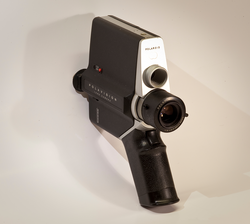
Polavision
» see polaroid.com as it lived, on the wayback machine
~ the obit ~
One hundred and fifty seconds. That is what fit on a Polavision cassette, silent and in color, and ninety seconds after you stopped shooting you could watch it. There was no lab and no envelope, and nobody found out a week later that the whole roll had been underexposed. For a company whose entire identity was the removal of the gap between taking a picture and having one, extending that to moving images was not a diversification. It was the obvious next thing.
The engineering underneath was genuinely clever and it was also the problem. Polavision film is a black-and-white emulsion behind microscopically narrow filter stripes in the three additive primaries, a process descended from Dufaycolor in the 1930s. Color comes from the stripes rather than from dye layers. The cost of that trick is light: every point on the film can only pass one primary, so the stock ran at 40 ASA and the developed image carried a permanent gray veil. Consumer Reports called the pictures murky and dark.
Polaroid built a tabletop player to compensate, a squat unit resembling a small television that rear-projected the cartridge onto a translucent screen, because ordinary projection through film that dense would have looked worse. So the format arrived with a constraint written into it. Your movies existed on a piece of film you could not show on anything except the box Polaroid sold you, unless you destroyed the cartridge and threaded the strip through a Super 8 projector.
This one died before I was born, in a category that never really established itself where I grew up. Home movie film was not a normal object in Turkish households in the late seventies, and by the time recording your own footage became ordinary here it was a VHS camcorder, borrowed for a wedding, with the tape recorded over the following year. Polavision belongs to a specific American living room of 1978 that I know only from photographs of it. The reason to know the name now is that it is the answer to a question the Polaroid story leaves open, which is why Edwin Land left.
~ the rap sheet ~
| Born | 1977, around 699 dollars for the system |
|---|---|
| Peak | 171,000 cameras and 215,000 players built across the whole production run |
| Killed | 1979, remaining stock sold as a job lot |
| Lifespan | two years on sale |
| Made by | Polaroid Corporation, under Edwin H. Land |
| Killed by | videotape, and a format nobody could erase |
~ what it was up against ~
Betamax had launched in 1975 and VHS in 1976. In the pre-camcorder late seventies those systems were bulky and the hardware cost far more up front, which is the case Polaroid made for itself. The case did not survive contact with the specifics. A videocassette held at least an hour at its best quality against Polavision's two and a half minutes. Videotape could be erased and reused, and film cannot. Tape played on a television set the family already owned, at television size, and Polavision played on a small screen in a box. Videotape also had sound. Polavision had none at all.
Polaroid did find one honest niche. Industrial testing wanted footage of a pipe rupturing under pressure available immediately rather than next week, and that market was relatively insensitive to price because waiting cost crew time. A black-and-white analysis cassette stayed in production until 1988 for exactly this reason, and a company called Mekel built a 300-frames-per-second camera around the cartridge in 1985. The format outlived its consumer life by nine years inside laboratories.
~ what got buried with it ~
Roughly 171,000 cameras and 215,000 players were built. In 1979 Polaroid gave up and sold most of the remaining equipment as a job lot, booking a loss of 68.5 million dollars. Edwin Land, who had founded the company in 1937 and invented instant photography because his daughter asked why she could not see a picture right away, resigned as chief executive in 1980. He left Polaroid entirely in 1982, and the New York Times headline on the way out read "Era Ends as Land Leaves Polaroid."
Paul Giambarba, who had done Polaroid's branding work, described the product as an engineering achievement and then said the thing that actually explains it: there simply were not enough customers out there on whom to work the magic. The technology itself did not die. Polaroid rebuilt the additive stripe process as Polachrome in 1983, an instant 35mm slide film that stayed in production for close to twenty years and picked up a following precisely for the muted color and visible line structure that had sunk the movie system.
The other survival is stranger. Because Polavision looked the way it looked, artists used it. Andy Warhol shot on it. So did Stan Brakhage, Charles and Ray Eames, Robert Gardner and Morgan Fisher. A format that failed for being too dark and too short found the one audience for whom dark and short were not defects, and screenings still happen occasionally at places like Anthology Film Archives. Polaroid wanted a format for birthdays. It got an avant-garde medium instead, several years too late to matter to anyone's balance sheet.
~ leave a rose ~
an anonymous tribute. one rose per visitor per day.
@}-->-- ... roses left here
~ leave a wreath ~
a rose fades by morning. a wreath stays on this grave for good, with your name on it.
from $1, paid once through stripe. it keeps the graveyard running: the hosting and the nightly digging. adopt it and the headstone reads "maintained in memory by" you. the groundskeeper plants new wreaths at the next tending, usually within a day.
» one email a week: new graves and the anniversaries of the dead. subscribe
other media formats: Kodachrome, Constellation 3D, Blender, 3.5" Floppy Disk
also died in the pre-1980s: Electronic Video Recording, PlayTape, Sony CV-2000
~ leave a note ~
visitors before you have left these graveside notes. anonymous welcome.