Victor Talking Machine Company
~ the obit ~
Eldridge R. Johnson was a machinist in Camden, New Jersey who fixed a problem nobody else had solved: a spring motor that turned a disc at a steady speed. Emile Berliner had the disc patents and Johnson had the machine that made them usable, and after some expensive litigation over Frank Seaman and the Zonophone, the two positions were combined and reorganized in 1901 as the Victor Talking Machine Company. The first surviving use of the name is on a letterhead dated 28 March 1901.
For the next twenty-five years Victor was the largest maker of records and record players on earth. The Victrola, which hid the horn inside a wooden cabinet and turned the phonograph into furniture, is the product that did it. What you were buying was a piece of the living room with a machine inside it. Camden built them by the hundreds of thousands while the cylinder trade died off around the factory.
Victor moved to electrical recording in 1925 and made a public occasion of it on 2 November, which the company called Victor Day. The following year Johnson, who had turned down several offers already, sold his controlling interest to the New York banking houses of J. W. Seligman and Speyer for 40 million dollars and left the business he had built. He was 59. What was coming for the record industry that year was radio, which handed out music for the one-off price of a receiver and charged nothing per song.
In 1929 the bankers sold Victor to the Radio Corporation of America for 154 million dollars. David Sarnoff got the Camden plant and the back catalog, and he got the dog, which turned out to be the asset with the longest working life of the three. The company that had been the center of recorded sound in America became the RCA Victor Division of somebody else. Within three years of the sale the American record business had lost most of its volume to the Depression and to broadcasting, which means RCA bought the industry leader almost exactly at the top.
~ the rap sheet ~
| Born | 1901, incorporated in Camden, New Jersey |
|---|---|
| Peak | the Victrola and the Red Seal catalog, the biggest record maker in the world |
| Killed | 1929, bought by RCA for $154 million |
| Lifespan | 28 years |
| Made by | Eldridge R. Johnson, on Emile Berliner's patents |
| Killed by | RCA, which wanted the factory and the dog |
~ the dog ~
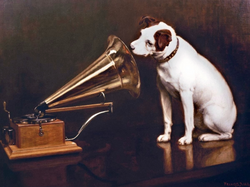
Nipper died in 1895. Francis Barraud, the brother of the dog's original owner, painted him three years later from an old photograph, listening to an Edison-Bell cylinder phonograph. On 31 May 1899 Barraud went to the Gramophone Company's offices in Maiden Lane to borrow a brass horn so he could brighten the picture up, and the manager, William Barry Owen, made him a different offer. Paint out the cylinder machine and put a Berliner disc gramophone in its place, and the company would buy the picture. Barraud did it. The painting and the phrase His Master's Voice went to the Gramophone Company for a hundred pounds, half of that for the copyright, and the dog has spent the last century listening to a machine he was not originally painted with.
~ the red seal ~
Victor's other durable invention was a price tier. Red Seal records cost more than the rest of the catalog and carried opera and orchestral music. They also paid the performer a royalty instead of a flat fee, which is how Enrico Caruso became the first recording artist to get properly rich. A Red Seal disc was the argument that a record could be a serious object and not a novelty, and the company made that argument for twenty years on the strength of one tenor's catalog.
The strategy was also a moat. Anybody could press a dance record, and almost nobody could sign the Metropolitan Opera. When RCA valued Victor at 154 million dollars in 1929, a good share of that figure was the artist contracts and the back catalog rather than the factory.
~ after camden ~
The trademark outran the company and then got carved up geographically. RCA took Nipper and His Master's Voice for the Western Hemisphere in the 1929 purchase, and EMI held the rights across Britain and Europe. In Japan the picture stayed with a subsidiary. The Victor Talking Machine Company of Japan had been set up in 1927 as a branch of the Camden operation and was cut off from its American parent by the war. It survives today as JVC, whose record label is still called Victor Entertainment and still uses the dog.
That subsidiary is the only route by which any of this reached me. I was born fifty-five years after the sale to RCA, in a country where the Camden company had never sold anything, and the first object in my life connected to it was a JVC video deck in a Turkish electronics shop in the 1990s, sitting between the Sony and the Aiwa. Three letters, and the middle one stands for Victor. Nobody explains that on the box.
RCA Victor kept the name on record sleeves into the 1960s and the Camden plant kept working long after the company that built it was a line in a filing. The dog is still on Japanese pressings in 2026, a hundred and twenty-eight years after he was painted, kept in work by a succession of owners across three territories, not one of which is the firm that hired him.
~ leave a rose ~
an anonymous tribute. one rose per visitor per day.
@}-->-- ... roses left here
~ leave a wreath ~
a rose fades by morning. a wreath stays on this grave for good, with your name on it.
from $1, paid once through stripe. it keeps the graveyard running: the hosting and the nightly digging. adopt it and the headstone reads "maintained in memory by" you. the groundskeeper plants new wreaths at the next tending, usually within a day.
» one email a week: new graves and the anniversaries of the dead. subscribe
other media music: BurnLounge, Legitmix, Akazoo, Ritmoteca.com
also died in the pre-1980s: Fawcett Comics, Sabamobil, Atlas/Seaboard Comics
~ leave a note ~
visitors before you have left these graveside notes. anonymous welcome.