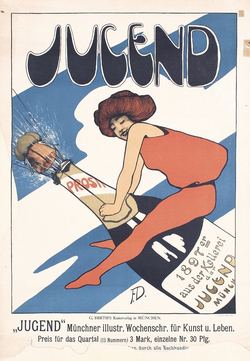
Jugend
~ the goodbye ~
The full title was Jugend, Münchner illustrierte Wochenschrift für Kunst und Leben: Youth, the Munich illustrated weekly for art and life. Georg Hirth founded it in 1896 with the stated intention of starting a cultural renaissance in his city. Publishers announced that sort of ambition constantly in the 1890s and almost none of them delivered on it. He edited the magazine himself for twenty years, until he died in 1916.
His one real production decision was that every issue should look different enough to be worth keeping. Covers were redrawn from scratch rather than dropped into a fixed frame, and the typography was drawn into the illustration rather than set over the top of it. Readers kept the issues instead of discarding them, which was the whole intention. In the first seven volumes Hirth ran more than 250 artists, the large majority of whom nobody had heard of.
German Art Nouveau is what grew out of it, and the German word for German Art Nouveau is Jugendstil, meaning the Jugend style. A magazine gave its name to a movement in architecture and applied design, running from Munich out to the artists' colony at Darmstadt. It reached the industrialists and the aristocrats who actually commissioned buildings, which is how a look that started on paper ended up in stone. The line from there runs forward into the Bauhaus argument about reconciling ornament with function.
It was not only a picture magazine. Jugend ran satire and cultural criticism, aimed mostly at religious authority and at the political right inside the Centre Party. A critic for The Yale Literary Magazine summed up its platform as opposition to everything. Its contribution to literature stayed modest. Albert Langen started Simplicissimus in the same city in 1896 as well, and on writing it beat Jugend badly.
~ the chronicle ~
| Born | 1896 in Munich, as a weekly for art and life |
|---|---|
| Peak | named the Jugendstil movement, over 250 artists in its first seven volumes |
| Killed | 1940, after number 13 of volume 45 |
| Lifespan | 44 years |
| Made by | Georg Hirth, with Fritz von Ostini |
| Killed by | the regime it had already spent seven years accommodating |
~ what hirth was actually selling ~
A fair amount of the artwork in Jugend was never commissioned for it. Hirth bought in pictures by established names like Böcklin and Lenbach, alongside Segantini and Thomas Theodor Heine, and set them next to unknowns. The painters of the Scholle group shaped how the magazine looked well into the 1920s.
The recurring imagery is worth being honest about: nude figures in idealized landscapes, with nymphs and satyrs standing in for nature at its most flattering. The magazine was selling the countryside to readers who had only just left it, in a country whose population was moving into the cities as fast as it could manage. That put it alongside the Lebensreform movement and its campaign for a return to natural living.
~ after 1933 ~
Jugend had drifted German-nationalist and Bavarian-regionalist after the First World War, then opened up again in the mid 1920s to a younger generation, printing George Grosz and running texts by Erich Kästner. Both men were unprintable in Germany within a decade.
After 1933 the magazine adapted to the National Socialist line, and its editorial range narrowed to the neoclassical material the regime approved, the sort of work shown at the Great German Art Exhibition of 1937. That exhibition was staged as a deliberate counterpoint to the Degenerate Art show, which displayed 650 pieces confiscated from German museums, a good number of them by artists Jugend had helped introduce.
~ volume forty five ~
The University of Heidelberg has the whole run scanned, year by year, and the catalog records how it ended without a word of commentary. The 1937 volume: numbers 1 to 52. The 1938 volume: numbers 1 to 52. The 1939 volume: the same. The 1940 volume stops at number 13.
So a weekly that had hit its full count three years running, through the start of the war, got about a quarter of the way into its forty-fifth year and stopped. It had already given the regime what the regime asked for, and was discontinued anyway.
The word it invented is still in every European language that discusses buildings from 1900. The magazine that coined that word closed quietly in a Munich nobody is nostalgic for.
~ leave a rose ~
an anonymous tribute. one rose per visitor per day.
@}-->-- ... roses left here
~ leave a wreath ~
a rose fades by morning. a wreath stays on this grave for good, with your name on it.
paid once through stripe. payments are handled by OÜ Lakeview, the small company that keeps rip.so running. the money pays for the hosting and the nightly digging. adopt it and the headstone reads "maintained in memory by" you. the groundskeeper plants new wreaths at the next tending, usually within a day.
» one email a week: new graves and the anniversaries of the dead. subscribe
other phenomena: Galaxy Science Fiction, COVIDSafe, 3D Maze, JenniCam
also died in the pre-1980s: L'Illustration, VideoBrain Family Computer, The Ladder
~ leave a note ~
visitors before you have left these graveside notes. anonymous welcome.