The Masses
~ the goodbye ~
Piet Vlag was a Dutch socialist who had emigrated to New York and wanted an illustrated socialist monthly run as a cooperative. He got one going in January 1911, with the printing and engraving bills covered by Rufus Weeks, a sympathetic vice president at New York Life. The cooperative part never worked. After twenty issues Vlag gave up and left for Florida, and the magazine stopped in August 1912.
What he left behind was a circle of Greenwich Village artists and writers who did not want to let it die. In August 1912 John Sloan, Art Young, Louis Untermeyer and others mailed a letter to Max Eastman, then working on a doctorate under John Dewey at Columbia. The entire letter read: "You are elected editor of The Masses. No pay." He took the job and the magazine came back in December.
In February 1913 Eastman printed a statement of what it was for. "A revolutionary and not a reform magazine... printing what is too naked or true for a money-making press; a magazine whose final policy is to do as it pleases and conciliate nobody, not even its readers." It was owned by its editors and paid no dividends. Nobody was trying to make money out of it.
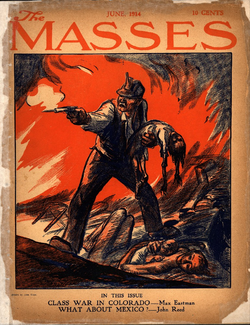
The art is what survives best. Sloan came out of the Ashcan School and so did several of the others, and the house technique was crayon worked straight onto the page, which reads like a sketch made on the spot. Art Young sat on the editorial board for the entire run and is credited with coining the term "ash can art" in 1916. The June 1914 cover is a Sloan drawing of a gunman standing over bodies against a red sky, with the contents line underneath: "CLASS WAR IN COLORADO, Max Eastman" and "WHAT ABOUT MEXICO? John Reed". Ten cents.
It covered the Paterson silk strike and the Ludlow massacre. It argued for birth control and for the vote, which irritated Emma Goldman, who complained in Mother Earth that giving a whole issue over to "Votes for Women" was disappointing. Floyd Dell edited the fiction and pulled Sherwood Anderson out of the unsolicited pile, and the pieces Anderson published there became Winesburg, Ohio.
~ the chronicle ~
| Born | January 1911, New York, founded by Piet Vlag |
|---|---|
| Peak | Max Eastman's editorship, 61 issues from December 1912 |
| Killed | the November/December 1917 double issue was the last |
| Lifespan | 6 years, 79 issues |
| Made by | Piet Vlag, then Max Eastman and a cooperative of its own editors |
| Killed by | the Espionage Act and the US Post Office |
~ poisoned at the source ~
In July 1913 Eastman ran an editorial accusing the Associated Press of suppressing and coloring the news of the West Virginia coal strike in the employers' favor, including the detail that the AP's local correspondent also sat on the military tribunal punishing the strikers. Art Young drew the cartoon that went with it: a figure labeled AP tipping bottles marked Lies and Suppressed Facts into a reservoir of news. It was titled "Poisoned at the Source".
The AP sued for criminal libel. A judge threw it out, so the AP's lawyer went to the district attorney and got a grand jury, which indicted Eastman and Young in December 1913. They were arrested on the 13th and released on $1,000 bail each, facing a year inside. A second charge followed a month later, personal libel against the AP's president, on the grounds that the poisoner in Young's drawing had been given his face. After two years the district attorney's office dropped all of it without explanation.
~ the august issue ~
Distribution went first. By May 1916 two of the big magazine wholesalers had stopped handling it, and it was shut out of the Canadian mails and off the newsstands in the New York subway. The same year the artists revolted. Eastman had started running material without putting it to the editorial board, and he and Dell were writing captions onto drawings without asking the artists who made them. Sloan said the magazine had developed a policy, which to him was the whole problem, and he walked out with several others.
Congress passed the Espionage Act on 15 June 1917. The business manager Merrill Rogers went to the Committee on Public Information for guidance on complying with it, and the Post Office refused the August issue regardless. The magazine sued the New York postmaster, and on 24 July 1917 Judge Learned Hand granted an injunction in an opinion that is still taught, holding that political agitation could not be suppressed unless it directly urged people to break the law. The Second Circuit reversed him on 2 November. Without the mail there was no magazine. The November/December issue, printed as a double, was number 79 and the last.
I came at this the way most people outside the United States do, through the case rather than the magazine. Masses v. Patten gets taught in First Amendment courses a century later. The ten-cent monthly that produced it is mostly looked at now for its drawings.
~ two juries ~
The indictments arrived after the magazine was already dead. Eastman, Dell, Reed, Art Young, Josephine Bell, H. J. Glintenkamp and Merrill Rogers were charged with conspiring to obstruct recruiting, facing twenty years and a $10,000 fine. The first trial opened on 15 April 1918. Outside the courtroom window a band was playing to sell Liberty Bonds, and every time it reached "The Star Spangled Banner" Rogers rose and saluted the flag, which he kept doing until the judge asked him to stop. Reed was in Russia and Glintenkamp was somewhere unknown. The jury could not agree, and eleven of them were angry enough at the lone holdout, a socialist, to propose dragging him into the street.
The second trial ran in the fall of 1918 with Reed back, having smuggled himself into the country to be there. The prosecutor closed on a dead soldier in France: "He died for Max Eastman. He died for John Reed." Art Young, who had slept through most of the proceedings, woke up and said loudly, "What? Didn't he die for me?" Reed told him to cheer up, Jesus died for him. That jury hung too, eight for acquittal. The war ended and the government let the whole thing drop.
Eastman had already built the replacement. The Liberator appeared from March 1918, named after Garrison's abolitionist paper, and New Masses followed in 1926. Fifty years on, Hannah Arendt went looking for something to compare Dwight Macdonald's Politics to and could only come up with the old Masses. The government never did get its conviction, and it never needed one, because it had already taken the mail away.
~ leave a rose ~
an anonymous tribute. one rose per visitor per day.
@}-->-- ... roses left here
~ leave a wreath ~
a rose fades by morning. a wreath stays on this grave for good, with your name on it.
paid once through stripe. payments are handled by OÜ Lakeview, the small company that keeps rip.so running. the money pays for the hosting and the nightly digging. adopt it and the headstone reads "maintained in memory by" you. the groundskeeper plants new wreaths at the next tending, usually within a day.
» one email a week: new graves and the anniversaries of the dead. subscribe
other news: Popular Photography, Atari User, Nibble, Massively
also died in the pre-1980s: Blue Book, Imlac, Two-Fisted Tales
~ leave a note ~
visitors before you have left these graveside notes. anonymous welcome.