The Literary Digest
~ the eulogy ~
Two Lutheran pastors who had gone into publishing dated their first issue 1 March 1890 and sent it out. Isaac Kaufmann Funk and Adam Willis Wagnalls built The Literary Digest as a weekly argument for their house: condensed articles out of the American and European press, arranged so that a reader got both sides of a question within the same column.
The thing ran for forty-seven years. The Digest absorbed two rivals doing the same job, Public Opinion and Current Opinion, and by 1927 it was printing over a million copies a week. The covers tracked the century, from plain type to illustration after 1900, then to full-color reproductions of famous paintings through the 1920s.
From 1916 the magazine polled every presidential election, mailing postcard ballots out by the million and printing the returns as they came back. It had never been wrong. Five elections in a row, 1916 through 1932, and the Digest called the winner in all of them.
The ending came fast once it started. In July 1937 the title was absorbed by the Review of Reviews Corporation and briefly renamed Digest, the old name returned on 13 November 1937, and the last issue is dated 19 February 1938, volume 125, number 8. Time reported that publication was suspended on 24 February, and that May, Time bought the remains. The remains were a subscriber list, and it became Time subscriptions.
~ the dossier ~
| Born | 1 March 1890, New York, a weekly digest of the world's press |
|---|---|
| Peak | over a million copies a week by 1927 |
| Killed | 19 February 1938, volume 125 number 8 |
| Lifespan | 47 years, 11 months |
| Made by | Isaac Kaufmann Funk, at Funk & Wagnalls |
| Killed by | its own 1936 straw poll |
~ the poll ~
The 1936 numbers are still startling. Ten million ballots went out, 2.38 million came back, and that return alone remains an enormous sample by any standard anyone has used since. From that return the Digest published Alfred Landon at 57.08 percent of the popular vote and 370 electoral votes.
Roosevelt took 523 electoral votes to Landon's 8. Landon carried Maine and Vermont. George Gallup, working a sample of 50,000, landed within 6.8 points of the actual result and made his career on the difference.
~ what went wrong in the mail ~
The ballots went first to the magazine's own subscribers, then to two lists that were simply easy to buy in 1936: registered automobile owners and telephone subscribers. In the seventh year of the Depression, every one of those groups was defined by having money, and money was most of what separated a Landon voter from a Roosevelt one. Later work found that the frame was not even the biggest problem. Peverill Squire's 1988 study puts the weight on non-response instead: people who detested Roosevelt mailed the card back, and people who liked him largely did not bother. A sample of 2.38 million that leans is worse than a sample of 50,000 that does not, because the size is exactly what makes everybody believe it.
~ what the last cover carried ~
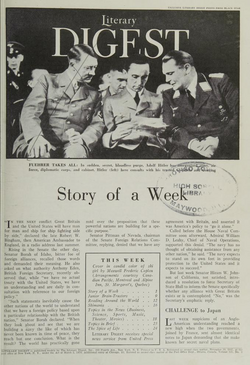
The copy the Internet Archive scanned carries a high school library stamp across the front page. The cover photograph of that final issue is Hitler sitting with Goebbels and Goering, under a caption set in bold capitals reading FUEHRER TAKES ALL, about the February 1938 shake-up that handed him the army and the cabinet. The lead headline underneath is Story of a Week.
Funk & Wagnalls itself kept going as a reference publisher, and its name outlived the magazine by decades on encyclopedia sets sold a volume at a time in American supermarkets. The Digest's own bound volumes went to libraries, which is why the whole run is readable today and why the final issue can be pulled up in a browser in about four seconds.
I met this magazine the way most engineers meet it, as one slide in a lecture on sampling. It is the cautionary example you get shown before anybody lets you near real data: the largest sample anybody had ever gathered, pointed confidently at the wrong man. Nobody mentions that the thing running the poll had been arriving in American mailboxes every week for 47 years, or that its last cover had Hitler on it.
~ leave a rose ~
an anonymous tribute. one rose per visitor per day.
@}-->-- ... roses left here
~ leave a wreath ~
a rose fades by morning. a wreath stays on this grave for good, with your name on it.
paid once through stripe. payments are handled by OÜ Lakeview, the small company that keeps rip.so running. the money pays for the hosting and the nightly digging. adopt it and the headstone reads "maintained in memory by" you. the groundskeeper plants new wreaths at the next tending, usually within a day.
» one email a week: new graves and the anniversaries of the dead. subscribe
other news: gamesTM, NBC Teletext, Taptu, Al-Shorfa
also died in the pre-1980s: Coronet Camera Company, Doc Savage Magazine, Go-Set
~ leave a note ~
visitors before you have left these graveside notes. anonymous welcome.