The American Magazine
~ the eulogy ~
The title is older than the magazine anyone means by it. The volume numbering runs back to Frank Leslie's Popular Monthly in 1876, by way of Leslie's Monthly and the American Illustrated Magazine. The words The American Magazine first appear on the June 1906 issue, under a publisher named Frederick L. Colver. Four months later it belonged to somebody else entirely.
In the spring of 1906 most of the editorial staff of McClure's resigned, including Ida Tarbell, Lincoln Steffens, Ray Stannard Baker and the partner they had actually followed, John S. Phillips. Colver asked Phillips why he did not take the American over. They incorporated a company and raised the purchase money partly from their own pockets and partly from interested friends. Possession passed on 1 July, at an office on Fifth Avenue. The first issue under them is dated October 1906.
Its opening editorial announcement is still readable and still sounds like a staff that has just quit a job. Our associates are known to the public primarily as writers, it says, and then defines them: they are journalists, that is, writers whose work is to find out the significant facts of contemporary life and present them honestly and without fear. The announcement ends on a line of scripture about vision and the people perishing, preceded by three words: so to the adventure.
They sold it five years later. Crowell Publishing bought it in 1911 for forty thousand dollars in cash and three hundred and thirty-four thousand in preferred stock, because Joseph Knapp wanted a men's magazine to sit opposite Woman's Home Companion on his list. Phillips resigned as editor in 1915 and Tarbell went with him, saying there was no place for her type of work on the new American. Steffens resigned over the stock he himself was holding, having worked out that he was being bought off with his own money.
~ the dossier ~
| Born | June 1906, when the American Illustrated Magazine was renamed |
|---|---|
| Peak | 2,682,144 copies in 1956, its best year and its last |
| Killed | August 1956 |
| Lifespan | 50 years under that title, on a volume count going back to 1876 |
| Made by | Ida Tarbell, Lincoln Steffens and John S. Phillips, from July 1906 |
| Killed by | advertising revenue falling by more than half between 1946 and 1955 |
~ the editor had to be edited ~
The reason they all walked out of McClure's in the first place was that S. S. McClure had chartered a new company without telling his partners, one that provided for a universal journal and also for a McClure's bank, a McClure's life insurance company, a McClure's schoolbook publisher and later a McClure's ideal settlement. Tarbell put the disagreement in a sentence: it was not the mission of the McClure crowd to reconstruct the economic life of the country, because they were journalists and not financial reformers. The argument ran six months and neither side moved.
Steffens was blunter about what it was like in the building. Those who had to work with McClure every day were learning to hate him, he wrote, because he would be wild with enthusiasm one day for the greatest scheme ever born in the mind of man and throw it out the next for another. Then the diagnosis: the editor had to be edited.
~ the tariff and the color line ~
Tarbell began The Tariff in Our Times in the December 1906 issue and kept it running on and off for five years. Baker's Following the Color Line ran as a series in 1907 and eight more articles from February to September 1908, and every chapter of the book came out of this magazine except the one on lynching. Finley Peter Dunne took a desk in the office and anchored a department called The Interpreter's House. Baker also wrote for it under the name David Grayson, which was announced in that very first issue as the simple narrative of one who, escaping success, achieved contentment. It also serialized The Secret Garden from November 1910, and printed the poem that gave the labor movement bread and roses in December 1911.
~ horatio alger doesn't work here any more ~
John M. Siddall, who had been Tarbell's research assistant on the Standard Oil series, became editor in 1915 and rebuilt the magazine around one idea he called the personal angle. Policy was victory for the individual over the odds that beset him, he said, and the odds he had in mind were sickness, lack of money, bad habits, any barrier at all. What the magazine did was stand at the hard places in the road and shout that you could come through, that you could win. It worked commercially and it ran until he died of stomach cancer in July 1923.
Merle Crowell held the chair for the next six years and added readers. The audited circulation for the year ending June 1929 was 2,230,056, sixth among all American magazines and still behind both Woman's Home Companion and the Ladies' Home Journal. Then Sumner Blossom took over and marked his arrival with a memo to the staff saying that Horatio Alger did not work there any more.
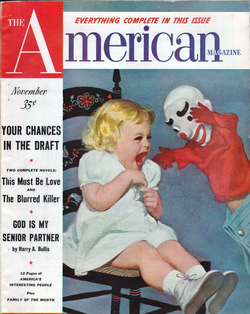
The back half of that arc never stopped. A publication that starts out finding significant facts and ends up telling each reader privately how to beat the odds in front of them is a shape I read several times a week without looking for it. The cover shown here, from November 1952, sits deep in that period: thirty-five cents, two complete novels, your chances in the draft, twelve pages of America's interesting people, and a department called Family of the Month.
~ the least loser ~
Crowell-Collier announced the closure in the first days of July 1956 and the August issue was the last. Sixty-five editorial and advertising staff were affected, with fifty of them to be placed elsewhere in the firm. The magazine was not failing for want of readers. It was selling 2,682,144 copies, the best number in its history, and what had gone was the advertising, from $5.8 million in 1946 to under half that by 1955. The 1,875,000 subscribers were split fifty-fifty between Collier's and Woman's Home Companion, which pushed Collier's circulation up nine percent.
Company president Paul C. Smith called it the odd thing: the least loser was the best one to pick to put out of business. He was right about the arithmetic and wrong about everything downstream of it. On 14 December the same board voted to kill both of the magazines the American had been sacrificed to save. Crowell-Collier also told the press in July that it would keep the American Magazine name for future use, and seventy years later nothing has ever been printed under it again.
~ leave a rose ~
an anonymous tribute. one rose per visitor per day.
@}-->-- ... roses left here
~ leave a wreath ~
a rose fades by morning. a wreath stays on this grave for good, with your name on it.
paid once through stripe. payments are handled by OÜ Lakeview, the small company that keeps rip.so running. the money pays for the hosting and the nightly digging. adopt it and the headstone reads "maintained in memory by" you. the groundskeeper plants new wreaths at the next tending, usually within a day.
» one email a week: new graves and the anniversaries of the dead. subscribe
other news: PC PowerPlay, Sports Plus Network, Narinari.com, 80 Micro
also died in the pre-1980s: Imlac, The Pullman Company, Busicom
~ leave a note ~
visitors before you have left these graveside notes. anonymous welcome.