80 Micro
~ the eulogy ~
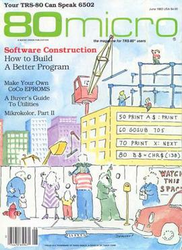
Wayne Green launched 80 Microcomputing out of Peterborough, New Hampshire in January 1980. Green had founded BYTE in 1975 and had not kept it, and he had been running Kilobaud since 1977 as a general microcomputing monthly. 80 Micro was the narrow bet: a magazine about the Radio Shack TRS-80 and nothing else, aimed at the people who had walked into a Tandy store and walked out with a computer.
The bet paid immediately. The name shortened to 80 Micro with issue 30 in the middle of 1982, and by the end of that year it was selling 152,000 copies and carrying more pages of advertising than any magazine in the United States except Vogue and BYTE. The November 1982 issue ran 518 pages. That number is the whole story of the early home computer market in one object: a monthly publication, thicker than a phone book for a small town, devoted entirely to one manufacturer's product line.
CW Communications bought it in May 1983 along with most of Green's other titles. The magazine kept its shape for another few years, printing listings, hardware modifications, reviews of software from companies that advertised four pages later, and letters from people arguing about disk controllers.
A magazine that can only be about one brand of computer requires a world where the brand is the thing you own. I did not get one of those. By 1998, when I first went online from Turkey on a 14.4k modem, the machine under the desk was a beige box assembled from parts, and no publication could have been written about it because it was not a product, it was an inventory list. What 80 Micro sold was the feeling of belonging to a specific machine, and that feeling had already been engineered out of computing by the time it reached me.
~ the dossier ~
| Born | January 1980, Peterborough NH, as 80 Microcomputing |
|---|---|
| Peak | 152,000 copies in 1982, third in the US on ad pages behind Vogue and BYTE |
| Killed | June 1988, issue 101 |
| Lifespan | 8 years |
| Made by | Wayne Green and 1001001 Inc, then CW Communications from May 1983 |
| Killed by | Tandy abandoning the TRS-80 line for PC compatibles |
~ the origin ~
The TRS-80 Model I sold in Radio Shack stores, which meant its owners were not hobbyists who had built something from a kit but ordinary people who had bought a computer at a mall. That audience had no idea what to do next and 80 Micro was there to tell them. The advertising followed the readers, and the advertising was the product: hundreds of pages of small software houses and peripheral makers who had no other way to reach TRS-80 owners at all.
Green ran it with the same instinct he had used on amateur radio publications, which was to fill the book and let the arguments happen in public. The magazine was opinionated about Tandy in a way a vendor-controlled publication could not have been, and Tandy's own relationship with it stayed prickly for years.
~ the postmortem ~
Tandy stopped caring about the TRS-80 line. The company moved to PC compatibles with the Tandy 1000, which sold well and had nothing distinctive about it, because the point of a clone is that it is not distinctive. In January 1988 the magazine gave up and refocused on Tandy's MS-DOS machines.
That killed it inside six months. The readers were there for a computer, not for a company, and a magazine about generic PCs made by Tandy was competing with every other PC magazine on the rack while offering less. Issue 101 shipped in June 1988 and there was no issue 102.
~ the long tail ~
Almost the entire run has been scanned and sits on the Internet Archive, which is where anyone reads it now. The scans are useful in a way the publishers never intended: hold a 1982 issue next to a 1987 one and you can watch the advertising thin out page by page, an entire hardware ecosystem draining away in monthly increments while the editorial copy stays cheerful.
The single-machine magazine did not survive the clone era anywhere. Compute! managed a few more years by covering several platforms at once and died of the same disease in 1994. What replaced them was not a better magazine, it was the newsgroup and then the forum, where the argument about disk controllers could happen without anyone having to sell 518 pages of advertising to pay for it.
~ leave a rose ~
an anonymous tribute. one rose per visitor per day.
@}-->-- ... roses left here
~ leave a wreath ~
a rose fades by morning. a wreath stays on this grave for good, with your name on it.
from $1, paid once through stripe. it keeps the graveyard running: the hosting and the nightly digging. adopt it and the headstone reads "maintained in memory by" you. the groundskeeper plants new wreaths at the next tending, usually within a day.
» one email a week: new graves and the anniversaries of the dead. subscribe
other news: Narinari.com, Mercury Center, HotWired, DeepDotWeb
also died in the 1980s: Atari Program Exchange, Plover-NET, Enterprise 128
~ leave a note ~
visitors before you have left these graveside notes. anonymous welcome.