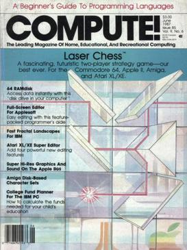
Compute!
~ the last words ~
The premise sounds like a punishment now. You bought a magazine, opened it to a game you wanted, and found several pages of BASIC source code. Then you sat at the machine and typed all of it in, and when it did not run you went back through looking for the character you had gotten wrong. That was the distribution channel. In 1979 there was effectively no other one that a hobbyist could afford.
Robert Lock started it at Small System Services in Greensboro, North Carolina, with a first issue printed in October 1979 and on newsstands by the start of November. It grew out of Len Lindsay's PET Gazette, a newsletter for Commodore PET owners, and it kept that inheritance: a magazine that refused to pick a side in the machine wars and printed versions of the same program for Commodore and Atari and Apple in the same article.
That neutrality is what made it big. ABC Publishing bought the operation in May 1983 for eighteen million dollars in stock, and circulation went from 200,000 to 420,000 inside that year. The Commodore-only spinoff, Compute!'s Gazette, did well enough on its own that the company became one of the largest buyers of 5.25 inch floppy disks in the world, selling the same programs to readers who had run out of patience for typing.
None of this reached me. It was a US newsstand product about machines that were largely gone from the shelves by the time I was old enough to want one, and it printed its last issue in 1994, four years before I first got a modem to connect. My software came down a phone line from the start. The idea that you might obtain a program by reading it off paper is one I understand as history rather than as a thing my hands ever did.
~ the record ~
| Born | Fall 1979, Greensboro North Carolina, founded by Robert Lock at Small System Services |
|---|---|
| Peak | circulation grew from 200,000 to 420,000 in 1983 alone |
| Killed | September 1994, issue 168 |
| Lifespan | 15 years |
| Made by | Small System Services, then ABC Publishing from 1983, then General Media from 1990 |
| Killed by | commercial software on disk, and Ziff-Davis buying the subscriber list |
~ the listings ~
Two utilities carried the whole format. The Automatic Proofreader, introduced in October 1983, made you enter each line and then compared a checksum against the number printed in the margin, so you found your typo on the line where you made it rather than an hour later. MLX did the equivalent job for machine language, where the listing was not readable code at all but columns of decimal numbers, hundreds of rows of them, with no way to spot an error by eye.
The side effect is the reason people are still sentimental about it. Typing a program is an extremely slow way of reading a program, and a slow reading is a thorough one. A generation of people learned what a loop was by transcribing one badly and then having to find out why it broke, which is not a teaching method anyone designed. It fell out of a printing constraint.
~ the fall ~
By the middle of the decade the retail software shelf existed, and a boxed game on a disk beat four hours of typing on every axis except price. The disk subscription that Compute! itself sold was an admission of this. Readers were paying to skip the magazine's main feature.
The redesign in May 1988 dropped the type-in listings altogether and pivoted toward general coverage of the IBM PC world, where the readers had gone. It was the correct commercial call and it removed the only thing the magazine had that nobody else did. What was left was another PC magazine competing against publishers with much larger sales operations.
~ what got buried with it ~
General Media, which is better known for publishing Penthouse, picked it up in 1990 and ran it until 1994. Ziff-Davis then bought the assets and the subscriber list, which in magazine terms is a purchase made to feed an existing title rather than continue the acquired one. Issue 168 in September 1994 was the last.
What ended was not really a magazine. It was a brief window in which the normal way to get software was to receive a human-readable copy of it and modify it if you felt like it, and in which every buyer was by necessity a typist and half of them accidentally became programmers. Software went back to arriving sealed. The listings are all scanned and online now, and the programs still run in emulators, entered by people who no longer have to check the margins.
~ leave a rose ~
an anonymous tribute. one rose per visitor per day.
@}-->-- ... roses left here
~ leave a wreath ~
a rose fades by morning. a wreath stays on this grave for good, with your name on it.
from $1, paid once through stripe. it keeps the graveyard running: the hosting and the nightly digging. adopt it and the headstone reads "maintained in memory by" you. the groundskeeper plants new wreaths at the next tending, usually within a day.
» one email a week: new graves and the anniversaries of the dead. subscribe
other news: Sbectel, AnandTech, Transindex, The Daily
also died in the 1990s: NeXTSTEP, Pathfinder, Apple eMate 300
~ leave a note ~
visitors before you have left these graveside notes. anonymous welcome.