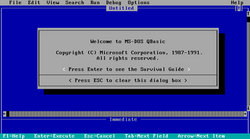
QBasic
~ the eulogy ~
Most people met QBasic by trying to play a game. GORILLA.BAS and NIBBLES.BAS sat in the same directory as QBASIC.EXE, and there was no way to start either one except to load the file into the editor and press F5. The game ran. When it was over you were looking at the thing that had produced it, in a blue full-screen window with the menu bar across the top, and it was text you could edit. Microsoft never described this as a teaching method. It is what the product did for most of a decade anyway.
It came out in June 1991 inside MS-DOS 5.0, replacing GW-BASIC and BASICA, both of which still wanted a line number in front of every statement. QBasic dropped that requirement and kept the structured parts it inherited from QuickBASIC 4.5, named subroutines and functions in place of a wall of line jumps. Microsoft also carved the DOS text editor out of it: EDIT.COM was a small stub that ran QBASIC.EXE with an editor switch, so deleting the interpreter to reclaim disk space also cost you the editor.
The help system was the other half of the product and it is the part that gets undersold. F1 on any keyword opened a page with the syntax and a working example you could copy straight into your own file. The entire language reference was in there, indexed, on a machine that had no network connection and probably no manual next to it either.
The distance here is close to zero, which is rare on this site. QBasic reached machines in Turkey with nothing done to it and nothing decided about it, because it was not a product anyone shipped separately. It was inside MS-DOS, and MS-DOS crossed the border attached to hardware. In a decade when software arrived either with the machine or on a floppy from somebody who already had it, a language that was already on the disk had an advantage nothing sold in a box could match. You did not have to want it first.
~ the dossier ~
| Born | june 1991, bundled with ms-dos 5.0 |
|---|---|
| Peak | the 1990s, on every dos machine whether the owner asked for it or not |
| Killed | 14 september 2000, last shipped in a folder on the windows me disc |
| Lifespan | nine years in the box |
| Made by | microsoft |
| Killed by | windows, and a compiler you had to buy separately |
~ the source was in the folder ~
Four sample programs came with it and two of them were games. Nibbles was a snake that grew as it ate and killed you on your own tail. Gorillas was an artillery duel between two apes lobbing exploding bananas over a city skyline that redrew itself every round, with a wind value across the bottom of the screen that made you miss. The other two examples were deliberately dull: a household budget program called Money Manager, and RemLine, a utility for stripping line numbers out of old GW-BASIC files so you could bring them forward.
What made the games work as an accident of education is that neither one was compiled. There was no binary. A.BAS file is plain text, so playing meant opening the source, and once the source was open on the screen the obvious next move was to change a number and press F5 again. Plenty of people never got further than that. It was still further than any other piece of software on the machine let them go.
~ what it would not do ~
QuickBASIC 4.5 could turn your program into an.EXE. QBasic could not, and this was not an oversight. The compiler was the thing Microsoft sold, so the free interpreter got everything except the exit door. Whatever you wrote lived where QBasic lived, which in fairness was every DOS machine on earth, so programs did travel, as.BAS files that needed the interpreter waiting at the other end.
It meant the language had a ceiling built into it by pricing rather than by design. Anyone who wanted to hand somebody a working program had to leave, first to QuickBASIC and then to Visual Basic. Most of them kept going and were out of BASIC entirely within a few years. The interpreter was a complete beginner's environment that could not produce a beginner's first shipped thing.
~ what came after basic ~
Windows 2000 arrived in February 2000 with no BASIC of any kind and the NT line never carried one again. The DOS line carried it to the end: Windows Me on 14 September 2000, with QBASIC.EXE sitting on the CD in a folder labeled as old MS-DOS tools, which by then was an accurate description. Windows XP closed the DOS line a year later and the question went with it.
Nothing single replaced it. Visual Basic took the name and the beginners and then grew into something a beginner could not start with. Microsoft tried the idea again in 2008 with Small Basic, which is a decent piece of work that almost nobody was handed by default, and the difference is the whole story. QBasic's advantage was never the language, which was mediocre even in 1991. Its advantage was that acquiring it required no decision from anybody. Every replacement since has needed someone to go and install something, and most people never do.
~ leave a rose ~
an anonymous tribute. one rose per visitor per day.
@}-->-- ... roses left here
~ leave a wreath ~
a rose fades by morning. a wreath stays on this grave for good, with your name on it.
from $1, paid once through stripe. it keeps the graveyard running: the hosting and the nightly digging. adopt it and the headstone reads "maintained in memory by" you. the groundskeeper plants new wreaths at the next tending, usually within a day.
» one email a week: new graves and the anniversaries of the dead. subscribe
other software: Comixology, Parsix GNU/Linux, GO Corporation, Berkeley Software Design
also died in the 2000s: Ghostzilla, ThunderHawk, DataPlay
~ leave a note ~
visitors before you have left these graveside notes. anonymous welcome.