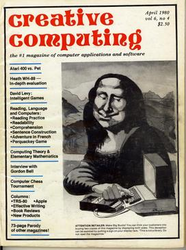
Creative Computing
~ the obituary ~
David Ahl was working at Digital Equipment Corporation, trying to sell computers into schools, when he collected a pile of BASIC programs that teachers and students had written and DEC published them as a book. That book worked better than the sales job did. He left, and in 1974 he started a magazine out of Morristown, New Jersey aimed at the same audience: people who had access to a computer and no idea yet what it was for.
The dating on the first issue is not clean. Wikipedia gives October 1974, and the archives and collector sites generally describe the debut as the November and December 1974 number. Both are repeated widely enough that picking one silently would be dishonest, so this grave carries month precision and says the sources disagree. What nobody disputes is the end, which is the December 1985 issue.
Between those two points it got very large. At its height roughly 500,000 people subscribed, which for a magazine about a hobby that barely existed at the start is an absurd number. Ziff-Davis bought it in 1982 and moved the operation to Los Angeles, with Ahl staying on as editor. That purchase is usually where people locate the beginning of the end, though the actual cause was bigger than any one publisher.
The magazine died in December 1985, when I was one year old, in a country that would not get its first internet connection until 1993. There is no version of my life where I read this thing. What reached me instead, eventually and secondhand, was the habit it created: the idea that a program is something a normal person copies out and changes, rather than something a company sells you sealed.
~ the case file ~
| Born | October 1974, Morristown New Jersey, founded by David H. Ahl after he left DEC |
|---|---|
| Peak | roughly 500,000 subscriptions in the early 1980s |
| Killed | December 1985 |
| Lifespan | 11 years |
| Made by | David H. Ahl; owned by Ziff-Davis from 1982 |
| Killed by | the IBM PC turning computing into a business purchase |
~ what it actually was ~
The core of the product was type-in listings. A game arrived as several pages of BASIC source code, and you sat at the keyboard and entered it by hand, then spent longer than that finding the character you had gotten wrong. This sounds like a hardship and it was the opposite. There was no other distribution channel worth using in 1975, and retyping a program is a very slow way of reading it, which meant a generation learned to program by accident while trying to play something.
That format became a book. BASIC Computer Games came out in 1978 and turned into the first computer book to sell a million copies, with More BASIC Computer Games following in 1979. The magazine also ran a software division and a hardware line called Peripherals Plus, but the listings were the thing. Programs in Creative Computing were written to be portable across whatever incompatible machine you happened to own, which was a real editorial discipline in an era with no standard anything.
~ how it ended ~
The IBM PC arrived in 1981 and the audience split. One half stayed hobbyist and the other half turned into an office with a purchasing department, and the magazine advertising money followed the second group immediately. Larger publishers spent the early 1980s buying up the competing titles, so a magazine that had been an unusual thing in 1975 was one of many by 1984, all of them chasing the same business readers.
Ziff-Davis tried to move the title toward business computing and it did not take, because the whole personality of the magazine was built for someone tinkering at home. The December 1985 issue was the last. The failure was not editorial and it was not really commercial either. The readership it was written for had stopped being the market.
~ the long tail ~
Almost the entire run is scanned and freely readable on the Internet Archive, which is a better afterlife than most dead magazines get. People still occasionally type the listings back in, now into emulators rather than the machine on the desk, and the programs still run because BASIC in 1979 was simple enough to survive being transcribed by strangers forty years later.
The clearest inheritance is not any single program but the assumption underneath the format. If you learned computing from a magazine that handed you the source and expected you to fix the typos yourself, you grew up believing software is editable by default. That belief went on to build a great deal of what came after, and it did not come from a manifesto. It came from pages of numbers a teenager copied out badly.
~ leave a rose ~
an anonymous tribute. one rose per visitor per day.
@}-->-- ... roses left here
~ leave a wreath ~
a rose fades by morning. a wreath stays on this grave for good, with your name on it.
from $1, paid once through stripe. it keeps the graveyard running: the hosting and the nightly digging. adopt it and the headstone reads "maintained in memory by" you. the groundskeeper plants new wreaths at the next tending, usually within a day.
» one email a week: new graves and the anniversaries of the dead. subscribe
other news: NTK, The Boston Phoenix, Gossip Cop, Official Nintendo Magazine
also died in the 1980s: Sirius Software, Viditel, The Source
~ leave a note ~
visitors before you have left these graveside notes. anonymous welcome.