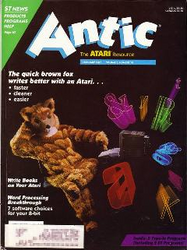
Antic
~ the eulogy ~
Jim Capparell had a programming job at NASA and an Atari at home, and in january 1982 he quit the first to write about the second. Broderbund and Synapse Software agreed to buy advertising before there was a magazine to put it in. His staff handed out the first issue, thirty pages of it, at the West Coast Computer Faire in march 1982, with april on the cover.
It was named after the ANTIC chip, the part of the Atari 8-bit that builds the display in concert with the CTIA or GTIA, which tells you precisely who the magazine expected to be reading it. The bimonthly schedule went monthly inside a year. By christmas 1983 an issue ran 148 pages.
Most of those pages were programs. Type-in listings, usually in Atari BASIC, with one game each month promoted to Game of the Month. Typing a listing meant transcribing a few hundred lines out of a magazine into a machine that had no way to tell you whether you had done it right, so Antic shipped its own answer to that problem. TYPO stood for Type Your Program Once. It generated checksums for portions of the code, which narrowed the search without ending it, and TYPO II replaced it with a two-letter code printed beside every single line, so you could run your finger down the margin and find the one that did not match.
I have never typed a program in from paper. What i ran came down a phone line at 14.4k and then at 33.6k, and when it arrived damaged it said so, with a failed archive rather than a game that worked perfectly until line 4020. The magazines that printed source code were a delivery mechanism for software before there was a network to deliver it on, and the checksum column beside every line is the receipt for how badly that mechanism needed help.
~ the dossier ~
| Born | April 1982, first issue handed out at the March West Coast Computer Faire |
|---|---|
| Peak | 148 pages by Christmas 1983, monthly, with a software catalog bound in |
| Killed | June 1990, with the combined June/July issue, number 88 |
| Lifespan | 8 years |
| Made by | Jim Capparell and Antic Publishing |
| Killed by | the end of the Atari 8-bit line, and the ad pages that went with it |
~ the origin ~
1984 came very close to ending it. Advertising sales dropped by half inside ninety days, which for a magazine that lives on ad pages is a death notice with a delay attached. What saved Antic was not journalism. It was retail: the Antic Software catalog, bound into every issue, selling public domain disks and original titles by mail. After Atari closed the Atari Program Exchange that april, Antic picked up a chunk of the abandoned library and reissued it as APX Classics from Antic, then started taking new submissions of its own.
With the money that brought in, Capparell went spinning off publications. II Computing for the Apple II in 1985. A section called ST Resource the same year for Atari's new 16-bit machine, which grew into STart, its own magazine, in 1986. Antic's Amiga Plus ran from 1989 for the competing platform. Its main rival on the 8-bit side was ANALOG Computing, and the two of them split a readership that COMPUTE! and Family Computing were also serving with type-in listings.
~ the postmortem ~
There is no dramatic closure to point at. The Atari 8-bit line had been effectively over for years, Atari's own attention had moved to the ST and then to survival, and a magazine whose whole proposition is BASIC listings for a discontinued machine runs out of both readers and advertisers at the same time. The last issue of Antic was dated June and July 1990 together, which is what a magazine's final months usually look like from the outside. 88 issues, plus a Best of book.
The name did not vanish immediately. Antic continued as a section inside STart for six more issues, the daughter magazine carrying the parent for about a year before it went too, in april 1991.
~ the long tail ~
Almost the entire run is readable today, scanned and transcribed by people who were not being paid to do it. That is a better fate than most magazines of the period got, and it exists because the material was source code and someone wanted to run it again.
What is gone is the channel rather than the archive. For most of a decade, a distribution method for software was a page of characters that a stranger retyped, and the quality control on it was two letters in the margin. Nothing since has needed anything like that discipline from a reader, which is a straightforward improvement, and it also means nobody now spends an evening on a program before finding out whether it works.
~ leave a rose ~
an anonymous tribute. one rose per visitor per day.
@}-->-- ... roses left here
~ leave a wreath ~
a rose fades by morning. a wreath stays on this grave for good, with your name on it.
from $1, paid once through stripe. it keeps the graveyard running: the hosting and the nightly digging. adopt it and the headstone reads "maintained in memory by" you. the groundskeeper plants new wreaths at the next tending, usually within a day.
» one email a week: new graves and the anniversaries of the dead. subscribe
other news: 4Columns, TechTV, The Fabulous Sports Babe, Digg (the original)
also died in the 1990s: Borland C++, DeluxePaint, Capstone Software
~ leave a note ~
visitors before you have left these graveside notes. anonymous welcome.