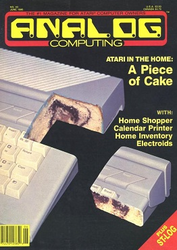
ANALOG Computing
~ the obituary ~
Lee Pappas and Michael DesChesnes met at a Star Trek convention in 1978, and by january 1981 they had an Atari magazine on American newsstands, published out of Worcester, Massachusetts. The first issue carried january and february together on the cover, which is how a bimonthly begins when it is not yet sure of itself.
What separated ANALOG from Antic and COMPUTE!, who were chasing the same readers with the same basic offer, was what the listings were made of. Most magazines printed BASIC, because BASIC is readable and a mistyped line will usually announce itself. ANALOG printed machine language, pages of hexadecimal loaded by a short BASIC stub, with the assembly source running alongside so you could see what you had just spent your evening entering. Almost every issue carried a game built that way.
There was a mail order arm as well, ANALOG Software, selling commercial titles out of the back of its own magazine with several of them written by staff. When the Atari ST arrived the 16-bit coverage got its own section and then its own magazine, ST-Log. In april 1988 the whole operation was bought by L.F.P., Inc., which is Larry Flynt Publications, and moved to North Hollywood.
I have never held a copy and never will. ANALOG exists for me as scans, all seventy nine issues run through somebody's flatbed and posted to the Internet Archive, which is where I read issue 79 to write this. That is a peculiar way to meet a magazine whose whole proposition was that you would keep it open beside a keyboard for two hours at a time. It was built to be used and it survives as something to look at.
~ the case file ~
| Born | January 1981, first issue dated January/February, out of Worcester Massachusetts |
|---|---|
| Peak | monthly, with a machine language game and its assembly listing in almost every issue |
| Killed | December 1989, issue 79, the combined ANALOG and ST-Log |
| Lifespan | 9 years |
| Made by | Lee Pappas and Michael DesChesnes, then Larry Flynt Publications from 1988 |
| Killed by | L.F.P., two issues after it ordered the merger with ST-Log |
~ how it landed ~
A machine language type-in was a demand made of the reader rather than a service offered to them. A BASIC listing you could read and half understand while typing it. A page of hexadecimal you could only transcribe digit by digit, with no idea what any of it meant and no useful complaint from the machine when you got one wrong. ANALOG shipped checksum utilities for the same reason its rivals did, because without them the format was simply unusable.
The payoff was that the games moved properly. Atari BASIC was slow enough that anything printed in it came out visibly worse than what you could buy on a cartridge, and a magazine willing to set assembly could hand its readers something that stood up next to commercial software. That was the entire trade. A harder evening for a better game.
~ the day it died ~
The end came from the publisher rather than the readers. In september 1989 L.F.P. announced that ST-Log would be folded back into ANALOG, reversing the split that had made sense while Atari still had two live product lines. Two issues of the combined magazine appeared. Then L.F.P. shut it down. The final issue is number 79, december 1989, and it is the last of both magazines at once.
The Atari 8-bit had been finished for years by then and the ST was heading the same way, so there is no version of this where the magazine outlives its machine by much. What the Flynt ownership changed was the manner of the ending. A publisher with no attachment to the platform read the numbers, merged two titles into one, gave the result two issues and closed the file.
~ what got buried with it ~
Antic, the rival on the same machine, made it to june 1990 and no further. The type-in era ended for everybody at roughly the same moment, once software on disk cost less than an evening of your own time.
What is gone is not the archive, which came through in better condition than most print of the period. It is the assumption underneath the format, that a reader would accept a program as a picture of itself and do the work of turning the picture back into software. ANALOG asked more of that reader than anyone else did, because it asked for hexadecimal with no comprehension attached. People did it anyway, month after month, for nine years.
~ leave a rose ~
an anonymous tribute. one rose per visitor per day.
@}-->-- ... roses left here
~ leave a wreath ~
a rose fades by morning. a wreath stays on this grave for good, with your name on it.
from $1, paid once through stripe. it keeps the graveyard running: the hosting and the nightly digging. adopt it and the headstone reads "maintained in memory by" you. the groundskeeper plants new wreaths at the next tending, usually within a day.
» one email a week: new graves and the anniversaries of the dead. subscribe
other news: Develop, Videogum, Google Play Newsstand, Sbectel
also died in the 1980s: IVC videotape, Apollo Computer, MacBASIC
~ leave a note ~
visitors before you have left these graveside notes. anonymous welcome.