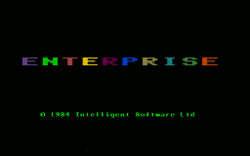
Enterprise 128
~ the eulogy ~
The machine was unveiled to the British press on 14 september 1983 and put on public display three days later. Robert Madge, who ran the company, spoiled the moment in the same breath by explaining that nothing would ship for another seven months. It was a genuinely striking design for the year: a Z80A at 4 MHz with two custom chips built for it, named Nick for graphics and Dave for sound, after the engineers who designed them. Geoff Hollington styled the case around a joystick built into the body, and a word processor sat in ROM.
April 1984 came and went. Custom silicon does not arrive when you ask it to, and the schedule slipped to september, then past it. Pre-production units reached reviewers late in 1984 and full manufacturing started in february 1985. The Enterprise 64 went out at £199 and the 128K model followed in june 1985 at £250, seventeen months after the world had been told about it.
The reviews were the worst kind: admiring. Personal Computer News wrote that a year earlier the Enterprise would have stood out as a market leader and that now it would have a much harder time making an impact, which is a polite way of saying the specification had stopped being an argument. Retailers had already allocated their shelf space to Sinclair and to Amstrad. Terry Blood Distribution dropped the line before the end of 1985. A twenty thousand unit deal with Greens collapsed over pricing.
There is a version of this history where the specification is the story, and that version is wrong. The Enterprise ended up being used seriously, for years, by people in Budapest, because a German subsidiary had stock to shift and Hungarian import rules made a cheap western micro worth the trouble of getting hold of. Nobody at the design stage picked that country. Turkey in 1987 sat right beside that arrangement without being inside it, and the reason has nothing to do with the machine. Where a product finally lives is quite often decided after its company is dead, by whoever is holding the inventory.
~ the dossier ~
| Born | announced 14 september 1983, on sale february 1985 |
|---|---|
| Peak | no more than 25,000 sold in the UK, from a single manufacturing run |
| Killed | liquidation in 1986, debts over 8 million pounds |
| Lifespan | seventeen months from announcement to shelf, about a year on sale |
| Made by | Enterprise Computers, London, with hardware by Intelligent Software under David Levy |
| Killed by | arriving after the market had chosen |
~ six names ~
It was developed under the codename DPC, for damp proof course, which was a joke about the initials of the people involved. After that it was the Samurai, named for the manufacturing company, and then briefly Oscar. Elan lasted until Elan Digital Systems of Crawley objected, at which point somebody noticed that a quantity of printed material saying Elan could be altered into Flan with very little ink, and so for a short and unfortunate period the machine was called Flan. Enterprise was settled on last, for the company as well as the computer.
A product that burns its lead time on branding is telling you something about where its attention was. The Enterprise had roughly a year and a half between announcement and shelf, and it spent that time on names and on chips that were not finished, while Amstrad went from nothing to the CPC464 and into shops in less than that.
~ the actual end ~
The receiver was called in during 1986 with debts above eight million pounds. Intelligent Software, David Levy's outfit, was one of the larger creditors and went down with it. A Z80 successor codenamed Vulcan existed on paper and never got made. There was one manufacturing run of the Enterprise and no second one, and UK sales are generally put at no more than twenty-five thousand.
Both the people at the top landed on their feet elsewhere. Robert Madge founded Madge Networks, which became a serious force in Token Ring hardware through the nineties before that whole category was taken apart by cheap ethernet. Levy went back to computer chess and won the Loebner Prize in 2009.
~ the hungarian afterlife ~
Over twenty thousand machines were shipped east once the UK business had been wound up, principally into Hungary, where they were sold as starter packs through a chain of shops. The German subsidiary kept trading until 1997 on remaining stock, sending boxes to Egypt and Kazakhstan among others. In Hungary the Enterprise stayed on sale until roughly 1992 and picked up the thing it had never managed in Britain, which is users who wrote software for it because they liked it.
That is the only place the machine got judged on what it was rather than on when it turned up. Given a market where nobody had already committed to a Spectrum, the Enterprise did fine. It just needed that market to exist in 1984 in Britain, and the one that existed had made up its mind.
~ leave a rose ~
an anonymous tribute. one rose per visitor per day.
@}-->-- ... roses left here
~ leave a wreath ~
a rose fades by morning. a wreath stays on this grave for good, with your name on it.
from $1, paid once through stripe. it keeps the graveyard running: the hosting and the nightly digging. adopt it and the headstone reads "maintained in memory by" you. the groundskeeper plants new wreaths at the next tending, usually within a day.
» one email a week: new graves and the anniversaries of the dead. subscribe
other gadgets: Toshiba Libretto, 3Com Audrey, Oculus Go, The Panda Project
also died in the 1980s: 80 Micro, Atari Program Exchange, Plover-NET
~ leave a note ~
visitors before you have left these graveside notes. anonymous welcome.