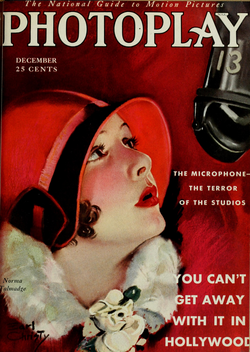
Photoplay
~ the obituary ~
Photoplay started in Chicago in 1911 as a short fiction magazine. It retold the plots of films that were playing, with the characters named and the endings given away, and the studios liked it because it was advertising that readers paid for. For its first four years it carried almost no reporting of its own.
The change came in 1915, when Julian Johnson and James R. Quirk took over as editors. Quirk had been vice president since the magazine started, so he was not a hire so much as a man who finally got his hands on the product. What the two of them built was the format every celebrity magazine has used since: the star photographed at home, and the gossip column with a byline readers trusted more than any studio press release. By 1918 circulation was past 200,000, and the engine driving it was public appetite for what actors did when they were not working.
Macfadden Publications bought it in 1934, by which point the covers were painted portraits by artists like Earl Christy and Charles Sheldon. Color photography caught up around 1937 and the paintings stopped. The writing bench over those years included Louella Parsons, Hedda Hopper, Adela Rogers St. Johns and Walter Winchell, which is most of the people who decided what America thought about Hollywood.
~ the case file ~
| Born | 1911 in Chicago, a magazine of film plot summaries |
|---|---|
| Peak | circulation past 200,000 by 1918 |
| Killed | 15 April 1980, the final issue |
| Lifespan | 69 years |
| Made by | Macfadden Publications from 1934 |
| Killed by | television, and a format older than the studio system |
~ the medal ~
In 1921 Photoplay created the Medal of Honor, an actual medallion made by Tiffany and Co., voted on by readers and handed to the producer of the year's best film. Quirk said the criterion was "the ideals and motives governing its production" and "the worth of its dramatic message." It is the first annual movie award that anyone took seriously, and the Academy, founded in 1927, ended up overlapping with its Best Picture choices for years.
From September 1921 the magazine also named a handful of Best Pictures of the Month, which left behind a monthly record of what contemporary opinion actually was at a time when nobody else was writing it down. The Medal of Honor faded and was discontinued in 1939. A Gold Medal replaced it from 1944 to 1968, polled by George Gallup's Audience Research outfit through the 1950s and then voted on by readers, and in 1948 the awards were broadcast on network television as part of The Steve Allen Plymouth Show. The Academy Awards were not televised until 1953.
~ from a stool at Schwab's ~
Sidney Skolsky, syndicated at the New York Daily News and later the Daily Mirror, wrote a Photoplay column called "From A Stool At Schwab's," named after the Hollywood drugstore he made famous by sitting in it. Sylvia of Hollywood ran health and beauty advice in the same pages and was arguably the first celebrity fitness guru anywhere.
That is the part worth understanding about Photoplay at its height. It worked inside the publicity machine that manufactured stars rather than reporting on it from outside, and the readers knew that and bought it anyway.
~ two women from Dallas ~
The slow end is visible in the mergers. Movie Mirror was absorbed in 1941. TV-Radio Mirror followed in 1977, after which the masthead read Photoplay and TV Mirror, which tells you where the readership had gone. The final issue came out on 15 April 1980, and the cover photograph was of Victoria Principal and Charlene Tilton, two television actresses from Dallas. The six people left on the skeleton staff were all transferred to Us, which Macfadden had recently bought. Macfadden president Peter J. Callahan said the decision was made "very reluctantly" and then said the rest of it flatly, that "the day of the traditional movie magazine is over."
A British Photoplay had launched in March 1950 and ran to a schedule of its own, rebranding as Photoplay: Movies and Video in April 1981 and closing in 1989. The American one was four years dead by the time I was born, and on another continent entirely. I can describe its covers only because the Internet Archive holds scans of roughly half a century of them. The two women on that last cover came from a show that traveled a great deal further than the magazine ever did.
~ leave a rose ~
an anonymous tribute. one rose per visitor per day.
@}-->-- ... roses left here
~ leave a wreath ~
a rose fades by morning. a wreath stays on this grave for good, with your name on it.
paid once through stripe. payments are handled by OÜ Lakeview, the small company that keeps rip.so running. the money pays for the hosting and the nightly digging. adopt it and the headstone reads "maintained in memory by" you. the groundskeeper plants new wreaths at the next tending, usually within a day.
» one email a week: new graves and the anniversaries of the dead. subscribe
other phenomena: Hugo the TV Troll, Stolen!, The Listserve, Psychic Friends Network
also died in the 1980s: IBM MT/ST, Sharp X1, North Star Computers
~ leave a note ~
visitors before you have left these graveside notes. anonymous welcome.