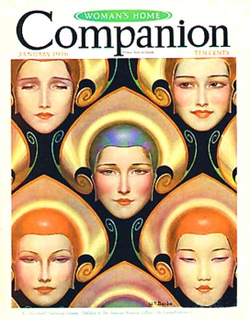
Woman's Home Companion
~ the eulogy ~
Two brothers named Thorpe started it in Cleveland in the 1870s as an eight-page monthly called The Home, printed on cheap paper at fifty cents a year, mostly household articles wrapped around mail-order advertising. It was sold twice in nine years, picked up by Mast, Crowell and Kirkpatrick of Springfield, Ohio in 1883, and renamed often enough to confuse its own bibliography. Ladies' Home Companion from 1886. Woman's Home Companion from 1897, and that one stuck for sixty years.
What turned it into a national magazine was advertising and a widening of its subject. In 1901 it carried twelve pages of advertisements; by 1907 it carried more than seventy-five. Arthur T. Vance edited it toward general interest, which in 1906 and 1907 meant a campaign against child labor, with reporting on children working cotton mills and canning factories, and a January 1907 statement signed by Theodore Roosevelt headed Where I Stand on Child Labor Reform. Jack London published "The Apostate" in it in September 1906, then sailed the South Pacific and filed the voyage as a series.
The circulation numbers from the good years are hard to picture now. Three million copies a month in 1938, four million by 1950. In 1953 a single black and white page sold to advertisers for $12,880. The issues themselves were enormous, 945 pages across the year in 1951, and they were down to 544 pages by 1956.
~ the dossier ~
| Born | 1873 in Cleveland, an eight-page mail-order monthly called The Home |
|---|---|
| Peak | four million circulation by 1950, with a black and white page costing advertisers $12,880 in 1953 |
| Killed | January 1957 |
| Lifespan | 84 years |
| Made by | Crowell-Collier Publishing Company of Springfield, Ohio |
| Killed by | a $3 million annual loss as the advertising went to television |
~ the fighting lady ~
Gertrude Battles Lane edited the Companion from 1911 until a few months before she died in 1941. She had joined Crowell in 1903 at eighteen dollars a week and was earning fifty thousand a year by the end, which in 1941 was an extraordinary salary for an editor of anything. Her stated editorial creed is still the clearest thing anyone wrote about that readership: she is not the woman who wants to do more housework, but the woman who wants to do less housework so that she will have more time for other things.
Under Lane an issue carried two serials, four or five short stories and a stack of monthly departments. Eleanor Roosevelt wrote a page for a while and four presidents contributed occasionally. Not all of it aged well. From 1913 the magazine sent an editor out to sponsor better baby contests at county fairs, a eugenics-era idea borrowed from the way agricultural shows judged livestock, and in 1914 it ran a segregated version in North Carolina.
After Lane died, William A. H. Birnie took over and pointed the magazine at causes, which is when the staff started calling it the fighting lady. One of its campaigns, about children being held in jails with adults, ended in New York state legislation.
~ the december vote ~
Crowell-Collier shut The American Magazine in August 1956, which was the healthier of its three titles, in order to keep Collier's and the Companion alive. It did not work. By July the Companion's annual loss was projected at $3 million, and on 14 December 1956 the board came out of a six-hour meeting having voted to stop both magazines. Two thousand seven hundred and forty jobs went with that vote, most of them printing work in Springfield, and the layoffs came with no severance and no pensions.
The final copies went on sale in the days before Christmas, with serials running inside them that had no remaining issues to finish in. Collier's carries a cover date of 4 January 1957 and the Companion's last is dated January 1957, so both titles are filed under a year they were barely alive for. The company that killed them turned itself into an educational publisher and did well out of it.
~ the cookbook ~
The part of the Companion still in circulation is not the journalism. It is The Woman's Home Companion Cook Book, over 2,600 recipes compiled by the staff and printed in several editions through the 1940s, which is still bought and cooked from by people who have no idea their book is a byproduct of a dead magazine. There was a garden book in 1947 and an anthology of seven short novels in 1949, both of which show up in the same secondhand listings.
Springfield, Ohio is a long way from Ankara and the Companion stopped printing long before I could have read it, so the residue is what I can actually check from here: a cookbook that outlived its own magazine, and a January 1936 cover with a Benda illustration on it, ten cents. A monthly mailed into four million American houses has left a thinner trail online than plenty of websites that lasted eight months.
~ leave a rose ~
an anonymous tribute. one rose per visitor per day.
@}-->-- ... roses left here
~ leave a wreath ~
a rose fades by morning. a wreath stays on this grave for good, with your name on it.
paid once through stripe. payments are handled by OÜ Lakeview, the small company that keeps rip.so running. the money pays for the hosting and the nightly digging. adopt it and the headstone reads "maintained in memory by" you. the groundskeeper plants new wreaths at the next tending, usually within a day.
» one email a week: new graves and the anniversaries of the dead. subscribe
other news: Nintendo la Rivista Ufficiale, PlayStation World, Top Secret, Games-X
also died in the pre-1980s: Simulmatics Corporation, Sabamobil, Fawcett Comics
~ leave a note ~
visitors before you have left these graveside notes. anonymous welcome.