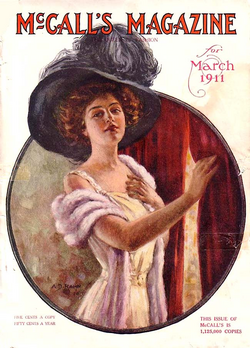
McCall's
» see mccalls.com as it lived, on the wayback machine
~ the obituary ~
James McCall was a Scottish immigrant who started printing his own sewing patterns in 1870, and in 1873 he launched a four-page journal to advertise them. It was called The Queen: Illustrating McCall's Bazaar Glove-Fitting Patterns, which is a title that explains itself. His widow ran the company after he died in 1884. The name became The Queen of Fashion in 1891 and then McCall's Magazine in 1897, by which point it was printing articles on travel and health alongside the pattern listings. For decades afterward the patterns still filled about a fifth of the pages.
What turned it into an institution was Otis Wiese, promoted to editor in 1928 at twenty-three. He was fired at least six times in his first year and rehired every time, on the grounds that there was nobody else around the place with ideas. In 1932 he split the magazine into three sections, each with its own cover and its own advertisers, and called it Three Magazines in One. In 1937 McCall's became the first women's magazine to print a complete novel in a single issue. When Pearl Harbor was attacked on 7 December 1941 he tore up the February 1942 cover, which was a frilly valentine, and replaced it with a woman wearing an "I've Enlisted" consumer pledge button. A hundred and fifty thousand readers signed the pledge coupon within three weeks.
Eleanor Roosevelt wrote a McCall's column called "If You Ask Me" from June 1949 until her death in November 1962. Betsy McCall paper dolls ran in most issues from May 1951 and went on for over forty years, printed to be cut out, with a cardboard version available by mail for a dime. Pauline Kael worked there in 1965 and 1966 and was reportedly fired over a review of The Sound of Music. Under John Mack Carter the circulation hit 8.4 million, second in the United States only to Reader's Digest.
~ the case file ~
| Born | 1873 as The Queen, a four-page catalog for sewing patterns |
|---|---|
| Peak | 8.4 million readers in the early 1960s |
| Killed | March 2001, the last issue to carry the name |
| Lifespan | 128 years, 125 by its own count |
| Made by | the McCall Corporation, latterly Gruner + Jahr |
| Killed by | a rename into a celebrity's first name |
~ the ownership carousel ~
From 1973 the magazine changed hands about as fast as it changed editors. Norton Simon sold it to the Pritzker family that year and kept the pattern business. Time Inc. and Lang Communications bought the publishing company in 1986. The New York Times Company took it in 1989, then the German house Gruner + Jahr moved on the whole magazine portfolio in 1994.
The pattern company went its own way through all of this and the patterns are still on sale. mccall.com resolves to a Simplicity page selling McCall's sewing patterns today. That lineage split off decades before the magazine stopped and passed through owners with no stake in it. That side has had a bad decade of its own: the parent that bought it in 2020 was sold for a dollar in June 2025 and filed Chapter 11 a month later. The patterns have now outlasted the magazine by twenty-five years.
~ time to say goodbye ~
Rosie O'Donnell became editorial director in 2000, and in 2001 Gruner + Jahr renamed the magazine after her. The clean record of what that felt like from inside is still sitting on the magazine's own website, captured on 1 March 2001. Editor-in-chief Sally Koslow's last column is headed "Time to Say Goodbye" and opens by telling readers they have probably already heard: "With this issue of McCall's, an era ends, and the magazine will reappear this May in a new form. Our staff, in fact, will be so busy reinventing McCall's there will be no April issue."
She notes that the word the coverage kept using was "venerable," dates the magazine to 1876 and calls it 125 years, which is a few years short of what the reference books say but is how the house counted. Then the line that does the real work: "I don't think there's a woman in America between the ages of 30 and 60 who didn't play with her Betsy McCall paper doll or who never made a McCall's recipe." Koslow stayed with the company to help develop new titles. The March 2001 issue is the last one that says McCall's on the cover.
Rosie went on sale that April with a May cover date. O'Donnell walked out in September 2002 over editorial control and the final issue came out that December. The lawsuit between her and Gruner + Jahr ended in 2003 with the judge ruling against both sides. Gruner + Jahr left the American magazine business entirely in 2005. A title that had survived two world wars and nine decades of editors lasted twenty months under a first name.
None of this reached Turkey. American women's service monthlies were not imported and were not imitated here, and in March 2001 I was a seventeen-year-old on dial-up in Ankara, with no overlap at all between whatever I was doing online and a 128-year-old monthly about recipes and sewing. I can quote Koslow's last column only because somebody archived the page it sat on.
~ leave a rose ~
an anonymous tribute. one rose per visitor per day.
@}-->-- ... roses left here
~ leave a wreath ~
a rose fades by morning. a wreath stays on this grave for good, with your name on it.
paid once through stripe. payments are handled by OÜ Lakeview, the small company that keeps rip.so running. the money pays for the hosting and the nightly digging. adopt it and the headstone reads "maintained in memory by" you. the groundskeeper plants new wreaths at the next tending, usually within a day.
» one email a week: new graves and the anniversaries of the dead. subscribe
other news: CBS News Radio, Superjuegos, Amiga Survivor, Exaro
also died in the 2000s: BuyMusic, AOL Brasil, Wildfire Communications
~ leave a note ~
visitors before you have left these graveside notes. anonymous welcome.