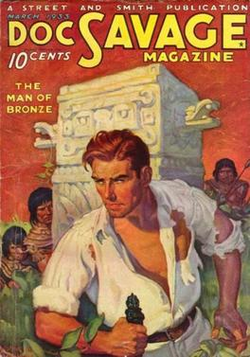
Doc Savage Magazine
~ the eulogy ~
It started with a radio mistake. In 1930 CBS began broadcasting dramatizations out of Street & Smith's Detective Story Magazine, and the narrator introduced himself as The Shadow. Listeners went to the newsstand and asked for the Shadow magazine, which did not exist. Henry Ralston, the company's business manager, built one in 1931, and its success sent the house hunting for more characters to wrap a title around.
The next one was nearly called The Phantom, until a competitor launched The Phantom Detective first. What Ralston built instead was a scientist-adventurer named Doc Savage, the surname borrowed from a real nineteenth-century adventurer. The writing went to Lester Dent, a pulp hand in his twenties with about a dozen published stories, who had been contacted in February 1932 about submitting Shadow novels and ended up with a magazine of his own.
The first issue is dated March 1933 and cost ten cents. Walter Baumhofer painted the cover, a bronze-skinned man in a torn shirt in front of a Mayan stone block, and the lead novel inside was The Man of Bronze, bylined Kenneth Robeson, which was a house name covering Dent and everyone who ghosted for him.
Thirty-five years separate the end of the pulps from my own birth, and all of it happened on a continent I have never lived on, so what came down to me was the inheritance rather than the magazines. Stan Lee named Doc Savage as the forerunner of the modern superhero, and the template is already finished in 1933: an impossible polymath with a fixed crew of specialists who follow him into every story.
~ the dossier ~
| Born | March 1933, ten cents, with The Man of Bronze |
|---|---|
| Peak | 300,000 copies an issue |
| Killed | 9 April 1949 |
| Lifespan | 16 years, 181 issues |
| Made by | Street & Smith, written mostly by Lester Dent |
| Killed by | Street & Smith quitting the pulp business |
~ the formula ~
Clark Savage Jr. was six feet four with a permanent bronze tan, a surgeon and an inventor, trained from childhood on a two-hour exercise routine his father set him. He came with five aides and they never changed: Renny the engineer, Monk the industrial chemist, Ham the lawyer, Long Tom the electrical expert, and Johnny the archaeologist. The first novel gave him a lost Mayan valley full of gold, which conveniently funded sixteen years of adventures.
Dent's range inside that frame was much wider than the covers suggest. Science-fictional gadgets turn up constantly, but so do straight detective plots and westerns, and he worked the stories out with Ralston and the editor John Nanovic rather than alone. The pulp historian Lee Server, describing one 1933 novel, got as far as a hijacked zeppelin and trained vampire bats loose in New York harbor before running out of room.
~ the day the pulps were canceled ~
The physical decline is easy to date because it shows in the object. Doc Savage was pulp-sized until December 1943, shrank to digest format with the January 1944 issue, and stayed small until the September and October number of 1948. Monthly became bimonthly in early 1947. Daisy Bacon became its editor in 1948, argued the magazine back up to full pulp size, and put it on a quarterly schedule, and because she turned down the novel Dent submitted, an issue was skipped and the first quarterly number is dated Winter 1949.
In April 1949 Bacon's management told her to stop buying fiction and art. On the ninth, Street & Smith announced that almost every fiction title it published was finished, which took The Shadow and Western Story down with Doc Savage. The house kept its slick magazines and walked away from the format it had been printing since the dime-novel era. The pulps did not taper off that year. They were canceled in a morning.
The last issue is volume 31, number 1, and the indexes cannot agree whether to call it Summer or Fall 1949. Its lead novel was Up From Earth's Center, which made 181 issues in sixteen years and one month. The slicks the house kept did outlive the pulps by decades: Mademoiselle was sold on to Condé Nast in 1959 and ran until 2001, half a century past the end of the cheap paper side of the business.
~ the afterlife of a character ~
The magazine died and the character did not even slow down. The novels went back into print as paperbacks from 1964 and had sold over twenty million copies by 1979. New novels followed from Philip José Farmer and later from the pulp historian Will Murray, and James Patterson has had a turn with him since.
What is left of the magazine itself is in libraries and in the hands of collectors who index it obsessively. docsavage.org has been running as the Hidalgo Trading Company since 1996, which makes the fan site thirty years old and older than nearly all of the web around it.
~ leave a rose ~
an anonymous tribute. one rose per visitor per day.
@}-->-- ... roses left here
~ leave a wreath ~
a rose fades by morning. a wreath stays on this grave for good, with your name on it.
paid once through stripe. payments are handled by OÜ Lakeview, the small company that keeps rip.so running. the money pays for the hosting and the nightly digging. adopt it and the headstone reads "maintained in memory by" you. the groundskeeper plants new wreaths at the next tending, usually within a day.
» one email a week: new graves and the anniversaries of the dead. subscribe
other phenomena: Piratbyrån, The Psycho Ex-Wife, Assustador, Comedy 23/6
also died in the pre-1980s: The Literary Digest, Coronet Camera Company, Victor Talking Machine Company
~ leave a note ~
visitors before you have left these graveside notes. anonymous welcome.