Argosy
~ the obit ~
The Golden Argosy went on sale dated 9 December 1882, eight pages in a small tabloid format at five cents. It was a weekly story paper for boys, serials in the dime-novel manner, edited by a 28-year-old from Maine named Frank Munsey. The publisher was E. G. Rideout, who went bankrupt the following year. Munsey took the title over against the money he was owed, and the first issue he published himself is dated 8 September 1883.
He shortened the name to The Argosy on 1 December 1888 and pointed it at men as well as boys. In April 1894 he dropped the weekly schedule for a monthly one, which was a retreat: the last weekly issue sold around 9,000 copies, and the monthly settled near 40,000.
What Munsey did instead, in October 1896, was throw out every page that was not fiction. In December he moved the printing onto cheap wood pulp. The Science Fiction Encyclopedia and the pulp historians at pulpmags.org both date the invention of the pulp magazine to those two decisions. Circulation went to roughly 80,000 after the change and 300,000 by 1902. It was half a million by 1907.
The masthead never stopped moving. It was Argosy Weekly from 6 October 1917 and Argosy All-Story Weekly from 24 July 1920, after a merger with another Munsey pulp. Plain Argosy Weekly came back on 5 October 1929. Munsey died in 1925 and the Frank A. Munsey Company was bought by William Dewart, who had worked for him.
~ the rap sheet ~
| Born | 9 December 1882, as The Golden Argosy, eight pages at five cents |
|---|---|
| Peak | 1.25 million copies in 1954 |
| Killed | November-December 1978 |
| Lifespan | 95 years, 11 months |
| Made by | Frank Munsey, then Popular Publications |
| Killed by | A buyer who shut the whole publishing house |
~ what ran in it ~
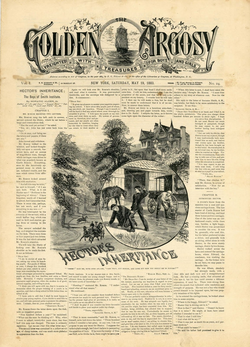
The boys' era published Horatio Alger and Oliver Optic; the surviving front page from 19 May 1883 hands most of its space to a serial called Hector's Inheritance, with a woodcut above it. The all-fiction era produced a reading list instead. Zane Grey and Max Brand ran westerns through it; Edgar Rice Burroughs and Robert E. Howard turned up in the adventure pages. A. Merritt serialized The Metal Monster in 1920 and The Ship of Ishtar in 1924. Wallace Cook had already run a science fiction serial called A Round Trip to the Year 2000 through the magazine between July and November 1903.
It kept buying good fiction long after the pulp era was over. Robert Heinlein's "Gentlemen, Be Seated!" ran in May 1948, in a magazine that by then also ran hunting features.
~ from pulp to slick ~
The transformation took three years and looked like a series of accidents. The trim size went to letter-size pulp on 18 January 1941. The weekly schedule ended on 4 October 1941 and went fortnightly on 1 November, then monthly in May 1942. In between came The New Argosy, from 7 March to July 1942, which cut the all-fiction policy for war articles and got the magazine cited by the Post Office for obscenity. Circulation was down to somewhere between 40,000 and 50,000, and Popular Publications bought it in December 1942.
Popular turned it into a men's magazine, letter-size and semi-slick, from September 1943. That version worked enormously: 600,000 copies in June 1948, and 1.25 million by 1954. It was still over a million in 1973. Its best-known feature was The Court of Last Resort, which Erle Stanley Gardner wrote from September 1948 to October 1958 and which reinvestigated criminal convictions, with NBC making a television series out of it in 1957. A magazine that had invented the cheapest form of print in America was now getting people out of prison.
~ four restarts ~
The Filipacchi Group bought Popular Publications in January 1978 and had shut the house down by December. Lou Sahadi had been editing Argosy since July 1976, and the last regular issue is dated November-December 1978. The magazine had been padding the schedule for a while by then, with around fifty special issues between 1975 and 1978, including a run of Argosy UFO.
Then the reanimations. Lifetime Wholesalers put out four monthly issues from August to November 1979 under an editor named Garrik Roen. Richard Kyle published and edited five or six between 1989 and 1994. The sources disagree about the count and about the start date, because the print runs were small enough that no library kept a complete file. Coppervale managed three between early 2004 and spring 2005, edited by Lou Anders and James A. Owen, in a slipcase with a separately bound novella in each one, and the third was retitled Argosy Quarterly. Altus Press produced a single issue dated Fall 2016, built around a Frederick Nebel western that had sat unpublished in the Popular archives.
Nothing has appeared since. The Munsey and Popular copyrights now belong to Steeger Properties, which sells the old stories back as ten-book sets under the name The Argosy Library. argosymagazine.com redirects to the rights holder's front page, and no issue of any Argosy has appeared since 2016.
~ leave a rose ~
an anonymous tribute. one rose per visitor per day.
@}-->-- ... roses left here
~ leave a wreath ~
a rose fades by morning. a wreath stays on this grave for good, with your name on it.
paid once through stripe. payments are handled by OÜ Lakeview, the small company that keeps rip.so running. the money pays for the hosting and the nightly digging. adopt it and the headstone reads "maintained in memory by" you. the groundskeeper plants new wreaths at the next tending, usually within a day.
» one email a week: new graves and the anniversaries of the dead. subscribe
other phenomena: Domino's App feat. Hatsune Miku, ExitMundi.nl, Rotten.com, Most Awesomest Thing Ever
also died in the pre-1980s: Cartrivision, Television Electronic Disc, IMSAI 8080
~ leave a note ~
visitors before you have left these graveside notes. anonymous welcome.