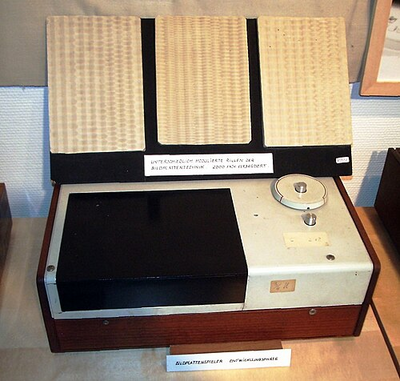
Television Electronic Disc
~ the eulogy ~
Teldec called a press conference in Berlin on 24 June 1970 and showed journalists a videodisc player that worked. In 1970 that was an extraordinary thing to have. Home video did not exist yet in any form a household could buy, and here was a German consortium playing television off a disc in front of the press, five years ahead of everybody.
The engineering was a mechanical trick pushed far past where anyone had taken it before. An audio record carries ten to thirteen grooves per millimeter. Telefunken's disc carried between 130 and 150, cut with a vertical modulation scheme that raised the usable bandwidth from the fifteen kilohertz a record needs to the three megahertz a television picture needs. The pickup was a piezoelectric crystal riding under a pressure foot instead of swinging on an arm.
The disc itself was foil rather than rigid plastic. Eight inches across, thin enough to flex in your hand, spinning at 1,500 revolutions per minute on an air cushion the rotation generated for itself, so the stylus tracked a surface that was effectively floating. Playing time started at five minutes and had been doubled to ten by the autumn of 1972. Players took a stack of discs in a changer, because a film meant a great many changes.
It reached shops in West Germany on 17 March 1975. By then Philips had shown its VCR cassette, Sony was selling Betamax in Japan, and JVC was a year away from VHS. All of those recorded off the television. TED only played, and only for ten minutes at a time, from a catalog that stayed small because no rights holder wanted to cut a feature into nine pieces of foil. Telefunken adopted VHS in 1978 and stopped pretending otherwise.
~ the dossier ~
| Born | 17 March 1975 on sale in West Germany, announced in Berlin on 24 June 1970 |
|---|---|
| Peak | The Telefunken TP 1005 player, against a catalog measured in ten-minute discs |
| Killed | 1978, when Telefunken switched to VHS |
| Lifespan | Three years on sale after five in development |
| Made by | AEG-Telefunken and Teldec |
| Killed by | VHS and Betamax, which ran two hours and recorded |
~ five years between the demo and the shop ~
The gap is the whole story. June 1970, a working prototype in front of the press with no competitor in sight. March 1975, a product on sale into a market that had already reorganized around something else. Telefunken spent those years doubling the playing time and fighting the physics of a stylus dragging across floating foil, and the world did not wait.
Two other companies were spending the same years on the same problem. MCA and Philips were building an optical system with a laser that touched nothing and a disc that held an hour, which arrived as LaserDisc. RCA was building SelectaVision CED, which was also a stylus in a groove and also lost, though it at least got to 1986 before it was canceled. Both of those outlived TED, and the thing that beat all of them was a cassette of magnetic tape.
~ what the foil could not do ~
Wear was the part nobody solved. A stylus in a groove at 1,500 revolutions per minute is doing something violent to a soft plastic surface, and the play counts were low in a way the marketing did not dwell on. Dust mattered more than it does on an LP, because the groove pitch was an order of magnitude finer and a speck sat across several tracks at once. The air cushion that made the whole system possible also meant the disc never sat still against anything.
The catalog problem finished it. Ten minutes a side means a ninety-minute film ships as a boxed stack and interrupts itself eight times, which is not a format a household builds a shelf around. The video rental business that eventually made home video enormous needed one tape per film, and TED could never be that.
~ the museum shelf ~
Teldec carried on as a record label and was absorbed into Warner in the 1980s. Telefunken's consumer electronics business was broken up over roughly the same period and the name passed through several owners. What survives of TED sits in German technical museums, where the players are labeled Bildplattenspieler and the foil discs are stored flat between boards so they do not curl. The 1970 prototype is one of the exhibits.
Telefunken gave up on this six years before I was born, so everything above is reconstruction out of documents and museum labels. By the time home video meant anything to me in Turkey the format was VHS and the machine recorded, which is precisely the thing TED was never able to do.
~ leave a rose ~
an anonymous tribute. one rose per visitor per day.
@}-->-- ... roses left here
~ leave a wreath ~
a rose fades by morning. a wreath stays on this grave for good, with your name on it.
from $1, paid once through stripe. it keeps the graveyard running: the hosting and the nightly digging. adopt it and the headstone reads "maintained in memory by" you. the groundskeeper plants new wreaths at the next tending, usually within a day.
» one email a week: new graves and the anniversaries of the dead. subscribe
other media formats: Cartrivision, ART image file format, Video 2000, VRML
also died in the pre-1980s: Cartrivision, IMSAI 8080, Nutting Associates
~ leave a note ~
visitors before you have left these graveside notes. anonymous welcome.