Video 2000
~ the goodbye ~
Philips and Grundig built the best of the three home video formats and sold it in the fewest countries. That is the whole obituary. Everything after this is detail about how the two facts sat next to each other for nine years without either one changing.
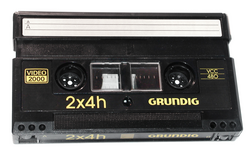
Video 2000 went on sale in 1979, four years after Betamax and three after VHS. The first machine anyone bought was the Philips VR2020; Grundig sold its own under the name Video 2x4, after the two sides of four hours it could hold. The cassette was called a VCC and it was a strange object: half-inch tape like the others, but only 6.25mm of the width used on each pass, so when you reached the end you took it out and turned it over. A VCC 480 gave eight hours on one side and eight on the other, at a time when a VHS tape gave you three.
It never got a foothold. The machines cost more and the prerecorded catalog was thin to the point of not existing in some countries. There was also no North American market at all, which meant no share of the library that was making VHS worth owning anywhere else. And there was a self-inflicted wound at the start: the audio head in the first Philips machine sat 2.5mm away from where Grundig had put it in theirs, so the two flagship products of the same format could not reliably play each other's tapes. For a system whose entire technical pitch was that any tape would play correctly on any machine, that was an awkward first year.
By the time I was old enough to notice what a video shop stocked, the question had one answer and it was VHS, in Turkey and in most other places. Nobody picked a format off the specification sheet. You picked whatever the shop two streets away had on its shelves, and the shop stocked what the distributor sent, and the distributor sent what the studios pressed. Philips lost that chain in every country it entered, including the one it was headquartered in.
~ the chronicle ~
| Born | 1979, the philips vr2020 and the grundig video 2x4 |
|---|---|
| Peak | the early eighties, with a german and dutch home market still worth defending |
| Killed | 1988, when philips and grundig stopped making it |
| Lifespan | nine years on sale |
| Made by | philips and grundig |
| Killed by | vhs, and the rental shop that came with it |
~ what dtf did ~
Dynamic Track Following is the reason engineers still bring this format up. On a VHS machine the video head swept a fixed path and the tape had a separate control track telling it where the picture was; when the alignment drifted you got noise bars and you reached for the tracking dial. Video 2000 mounted the head on a piezoelectric element that bent under voltage, so the head moved during playback to stay centered on the track it was reading.
That removed the control track entirely and it removed the tracking dial from the front panel. It also meant the head could stay locked on a track while the tape ran at the wrong speed or no speed at all, which is why still frame and slow motion on these machines were clean while the competition produced a picture full of interference. The format was solving a problem the market had already decided it could live with.
~ the tape you had to turn over ~
The flip was clever and it was also the mistake. Splitting the tape into two independent halves doubled the running time per cassette and let Philips advertise numbers nobody else could touch, up to nine hours a side on the longest VCC and double that in the extended mode.
For recording off the television that is a real feature. For a rented film it is nothing at all, because a film is ninety minutes and fits on one side, so half of every prerecorded tape is dead weight the distributor pays to manufacture and ship. The format's best trick had no value in the part of the business that decided which format won.
~ what philips did next ~
Philips started manufacturing VHS recorders in 1984, four years before it stopped making Video 2000. There is a period where the company was selling both, on the same shelves, under its own name. The format was formally dropped in 1988 and the machines had already been discounted into irrelevance by then.
Philips kept doing this. It won enormously with the Compact Disc and then spent the next fifteen years losing with CD-i and with the Digital Compact Cassette, both of which were technically defensible and neither of which had anyone waiting for it. Video 2000 is where the pattern is clearest, because the engineering case for it was the strongest and it still made no difference. A format is not a specification. It is an agreement about what the shops will carry.
~ leave a rose ~
an anonymous tribute. one rose per visitor per day.
@}-->-- ... roses left here
~ leave a wreath ~
a rose fades by morning. a wreath stays on this grave for good, with your name on it.
from $1, paid once through stripe. it keeps the graveyard running: the hosting and the nightly digging. adopt it and the headstone reads "maintained in memory by" you. the groundskeeper plants new wreaths at the next tending, usually within a day.
» one email a week: new graves and the anniversaries of the dead. subscribe
other media formats: ART image file format, Television Electronic Disc, Cartrivision, RCA Tape Cartridge
also died in the 1980s: DeLorean Motor Company, Living Videotext, Synapse Software
~ leave a note ~
visitors before you have left these graveside notes. anonymous welcome.