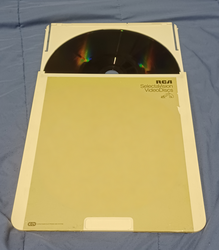
RCA SelectaVision (CED)
~ the obit ~
RCA started work on this in 1964 and put it in shops on 22 March 1981. Seventeen years is long enough for the problem you set out to solve to stop existing. In that window home videotape arrived twice over, from Sony as Betamax and from JVC as VHS, and Philips and Pioneer put out a videodisc that read itself with a laser instead of a needle. RCA arrived last, with the only format of the four that could not record anything.
The engineering was not the failure. A Capacitance Electronic Disc was a vinyl record with video in the groove, spun at 450 rpm under a diamond stylus that read changes in capacitance rather than physical wiggle. It held sixty minutes of color video per side, which is around two orders of magnitude more information than an LP carries, and RCA got there with a team that started at four people. Nobody in 1964 had done anything close.
The projections were the failure. RCA told itself it would sell between five and six million players a year and press hundreds of millions of discs. It expected two hundred thousand players out the door by the end of 1981 and moved about half that. Prices were cut and rebates were offered with free discs thrown in, and 1982 and 1983 came and went without the curve bending. On 4 April 1984 the company announced it was done making players, having sold 550,000 in three years against a plan that called for that many in three months.
I was an infant in Turkey when the players were pulled, and there is a reason this format has no memory here beyond the collector pages. A PAL run existed in Britain and came to about 270 titles against 1,700 in America, which tells you where the format was really sold. The machine also assumed a household that bought films rather than recorded them. What people wanted from a video machine in a country with one state channel was the ability to keep something off the air, and a disc that could only play back had nothing to offer that a tape did not.
~ the rap sheet ~
| Born | 22 march 1981, on sale after seventeen years of development |
|---|---|
| Peak | 1981 to 1983, when rca still expected a player in half of american homes |
| Killed | 27 june 1986, the date on the commemorative disc handed to the staff |
| Lifespan | five years on sale, twenty-two from the first research |
| Made by | rca, under the selectavision brand |
| Killed by | the vcr, which could record |
~ seventeen years in the lab ~
The first prototypes were multi-layered sandwiches of vinyl and nickel under an insulating film, and they wore themselves out. RCA spent years failing to stop the stylus eating the groove before giving up on the layer approach entirely and pressing the whole disc out of PVC blended with carbon so the plastic itself would conduct. The lubricant that made it survive repeat plays was a silicone film about fifty nanometers thick, which the company patented.
By 1972 the team had ten minutes of working color video on a disc, a chunk of a Get Smart episode retitled Lum Fong. That is eight years in for ten minutes, and there were nine more years to go. Internal fights over funding and direction stretched the schedule further, and every year of the stretch was a year in which home videotape got cheaper.
~ what the caddy did ~
You never touched a CED. The disc lived inside a hard plastic caddy, and you pushed the whole caddy into the slot on the player, which gripped the disc and held it while you pulled the empty sleeve back out. Dust and fingerprints were fatal to something read by a needle, so RCA designed the disc to be untouchable by the person who owned it.
Sixty minutes a side meant a feature film stopped in the middle. The player told you to flip the caddy, which was the exact moment a VHS tape did nothing at all. Every advantage the format had, and it did have some, sat inside a design where the movie paused halfway through because of the physics of a groove.
~ what stopped first ~
Players stopped in April 1984 and discs did not. Demand for the discs actually spiked right after the announcement, so RCA told dealers that pressing would continue for at least three more years and new titles would keep coming. Leftover players went out through liquidators for as little as twenty dollars each, which meant the cheapest video machine in America was one that had just been discontinued.
Disc sales fell away inside a year and RCA closed the operation in 1986, two years into a three-year promise. The title usually named as the last production pressing is The Jewel of the Nile from CBS/Fox Video, though only a couple of dozen releases came out in 1985 and the count for 1986 is in single figures. The other disc pressed at the end was Memories of VideoDisc, a commemorative given to the people who had worked on it, carrying a farewell from the vice president who ran the division.
~ what the discs are worth now ~
General Electric bought RCA in 1986 and retired the SelectaVision name from every product that carried it. The brand had also been stuck on RCA's VHS recorders and on a holographic tape prototype from 1969, so the thing that died in the accounts took two other product lines' badges down with it.
What survives is about 1,700 titles, a stack of players that were built solidly enough to still run, and a collector market where the rare pressings go for real money while the common ones sell by the crate. The format is easy to laugh at and the laugh is aimed at the wrong thing. RCA did not fail to build it. RCA failed to notice that finishing it in 1981 meant finishing it too late.
~ leave a rose ~
an anonymous tribute. one rose per visitor per day.
@}-->-- ... roses left here
~ leave a wreath ~
a rose fades by morning. a wreath stays on this grave for good, with your name on it.
from $1, paid once through stripe. it keeps the graveyard running: the hosting and the nightly digging. adopt it and the headstone reads "maintained in memory by" you. the groundskeeper plants new wreaths at the next tending, usually within a day.
» one email a week: new graves and the anniversaries of the dead. subscribe
other media formats: Free Lossless Image Format, SDMI, Dark Horse Digital, Quadruplex Videotape
also died in the 1980s: Convergent Technologies, Starpath, Sperry Corporation
~ leave a note ~
visitors before you have left these graveside notes. anonymous welcome.