Starpath
~ the eulogy ~
The company started in Livermore, California in June 1981 under the name Arcadia Corporation. Alan Bayley and Craig Nelson founded it together with Robert Brown, who would design the hardware it lived on. It changed its name to Starpath almost immediately, because Emerson Radio had put out a console called the Arcadia 2001 and a trademark fight with a consumer electronics company was not the fight a three-person hardware startup wanted.
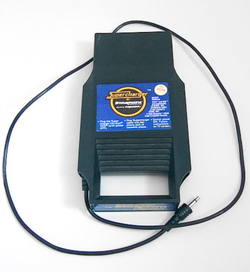
The product was the Supercharger, designed by Bob Brown and released in August 1982 at $69.95 with a game in the box. It plugged into the Atari 2600 cartridge slot like any cartridge, but it held no game. It held memory: 6,272 bytes against the console's native 128, which is forty-nine times what Atari had given the machine. Games arrived on ordinary audio cassettes and loaded in through a cable that ran from the side of the unit into the earphone jack of whatever tape player you already owned.
Ten titles shipped through retail. Phaser Patrol was the pack-in and Dragonstomper was a full role-playing game on a console nobody thought could hold one. Escape from the Mindmaster ran across four separate loads of tape to fit, which meant getting up and working the tape player in the middle of a game. Communist Mutants from Space had a title that would not survive a modern marketing meeting and a difficulty ceiling that would not survive a modern player.
~ the dossier ~
| Born | June 1981, Livermore, California, as Arcadia Corporation |
|---|---|
| Peak | August 1982, the Supercharger at $69.95 with Phaser Patrol in the box |
| Killed | 1984, bought by Epyx |
| Lifespan | 3 years |
| Made by | Alan Bayley, Robert Brown and Craig Nelson |
| Killed by | the 1983 crash, which took the retailers before it took the company |
~ how the supercharger worked ~
The engineering argument was about the cost of silicon. A 2600 cartridge was a ROM chip in a plastic shell, and every kilobyte of that ROM was money on the bill of materials, which is why 2600 games are four kilobytes of the tightest code ever written for a mass market machine. Starpath moved the expensive part into the peripheral, so you paid for the memory once and then bought games on a medium that cost almost nothing to duplicate.
Cassette tape was everywhere by then. Turkey was full of it, pirated albums dubbed on double decks and sold out of shops in the arcade passages of every city, and the physical object the Supercharger needed was probably the single most available consumer good in the country. The reader was the part that never arrived, so the format that made this device cheap in California made it precisely no easier to obtain anywhere else. A tape without the machine that expects it is just a tape.
~ the crash ~
Starpath's timing was exact and terrible. The Supercharger went on sale in August 1982, roughly one Christmas before the North American video game market fell apart. Through 1983 the retailers who had been buying Atari product in bulk stopped buying anything at all and sat on inventory they could not move at any price. An unfamiliar add-on from a small company in Livermore was the last thing a buyer in that position wanted to hear about.
Two more Supercharger games went out by mail order after the money ran out, sold direct because there was no longer a shelf to put them on.
~ what epyx kept ~
Epyx bought the company in 1984. The two firms already shared board members, so the purchase was a formality with a price attached to it. Several Starpath developers carried on at Epyx and switched to writing home computer games, which by then was where the surviving money was.
One unfinished Starpath project came across with them. It was called Sweat! The Decathlon Game, built for a Supercharger-equipped 2600, and at Epyx it was rebuilt for the Commodore 64 and renamed Summer Games. Summer Games shipped in 1984 and became one of the biggest sports franchises of the decade. It is still the thing Epyx is best known for.
The rights to the Starpath catalog moved on again in 1993, when Epyx sold them to Bridgestone Multimedia Group. Twelve games total, counting the mail-order pair.
~ leave a rose ~
an anonymous tribute. one rose per visitor per day.
@}-->-- ... roses left here
~ leave a wreath ~
a rose fades by morning. a wreath stays on this grave for good, with your name on it.
from $1, paid once through stripe. it keeps the graveyard running: the hosting and the nightly digging. adopt it and the headstone reads "maintained in memory by" you. the groundskeeper plants new wreaths at the next tending, usually within a day.
» one email a week: new graves and the anniversaries of the dead. subscribe
other gaming: Team Silent, Nintendo Network, Gundam Evolution, Maxis (Emeryville)
also died in the 1980s: Convergent Technologies, RCA SelectaVision (CED), Sperry Corporation
~ leave a note ~
visitors before you have left these graveside notes. anonymous welcome.