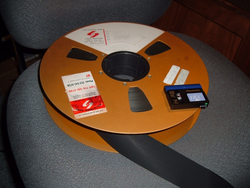
Quadruplex Videotape
~ the goodbye ~
On 14 April 1956, in a hall in Chicago, Ampex switched on a machine that recorded a television picture onto tape and played it back seconds later at full quality, and the room of broadcast engineers watching more or less lost its composure. Within four days Ampex had two million dollars of orders. This was the quadruplex, and it is the reason the phrase live television stopped meaning all television.
Before it, if you wanted to keep a broadcast you pointed a film camera at a monitor and developed the result, a soft gray thing called a kinescope. Tape changed the arithmetic. A network on the east coast could record its evening news and replay it three hours later on the west coast at the right local time, which is exactly what CBS did with Douglas Edwards on 30 November 1956, the first real use on air.
The machines cost around forty-five thousand dollars in 1956, most of the price of a house, and every serious station bought one anyway because the alternative was worse. For the next twenty-odd years nearly everything that was not strictly live reached your set through a quad machine somewhere upstream. It was the world standard, not an American one.
i have no memory of any of this, because it was finished before i started. The format was born twenty-eight years before me and gone from the studios while i was small, and it never lived anywhere a person could stumble on it. It sat in the racks of a television station, in a room you needed a reason to enter, and an engineer's whole job was keeping its picture from tearing. The tape was two inches wide and the reels were the size of a dinner plate. Nothing about it was ever going to reach an apartment in Ankara. i only ever met its grandchildren, the plastic cassettes that came much later.
~ the chronicle ~
| Born | shown 14 april 1956, ampex, first on air 30 november 1956 |
|---|---|
| Peak | the world broadcast standard from 1956 into the 1970s |
| Killed | superseded by one-inch type c through the early 1980s |
| Lifespan | about thirty years |
| Made by | ampex, redwood city, california |
| Killed by | type c videotape, smaller and cheaper to run |
~ four heads on a wheel ~
The trick is in the name. To catch a video signal you need the tape and the head moving past each other very fast, far too fast to drag two inches of tape lengthwise at any sane speed. So Ampex spun four heads on a wheel sideways across the width of the tape while the tape itself crawled the other way. The heads painted the picture in short vertical stripes, hundreds a second. It was a real advance and it is why the picture held together. The price of it was that a quad machine could only play at normal speed. No freeze-frame, no slow motion. Try to pause a quad tape and you got a smear, not an image.
~ what it ended ~
The kinescope died the year quad shipped and never came back. So did the idea that a night of television had to be assembled live by people sweating in a gallery. Tape let a network build an evening out of pieces recorded at different times and stitched together, which is the ordinary shape of television now and was close to science fiction in 1955. The rerun and the whole machinery of a schedule that is not happening in real time, all of it begins at that Ampex machine.
~ what pushed it out ~
In 1976 Ampex and Sony together shipped Type C, one inch wide instead of two, on a single reel, and able to do the thing quad never could, which was freeze a frame and run at odd speeds. It was smaller and cheaper to keep alive, and it had the trick-play a modern control room wanted. Through the early 1980s the two-inch machines came out of the stations one by one. A few hung on into the late eighties as the only way left to read old tapes, which is the job the last survivors still do, sitting in archives, pulling twenty-year-old recordings off a format nobody makes fresh tape for.
~ leave a rose ~
an anonymous tribute. one rose per visitor per day.
@}-->-- ... roses left here
~ leave a wreath ~
a rose fades by morning. a wreath stays on this grave for good, with your name on it.
from $1, paid once through stripe. it keeps the graveyard running: the hosting and the nightly digging. adopt it and the headstone reads "maintained in memory by" you. the groundskeeper plants new wreaths at the next tending, usually within a day.
» one email a week: new graves and the anniversaries of the dead. subscribe
other media formats: Dark Horse Digital, SDMI, Free Lossless Image Format, RCA SelectaVision (CED)
also died in the 1980s: Hitachi Basic Master, Sperry Corporation, Convergent Technologies
~ leave a note ~
visitors before you have left these graveside notes. anonymous welcome.