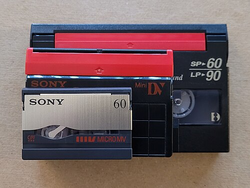
MicroMV
~ the goodbye ~
MicroMV died inside a press release about something else. On 10 November 2015 Sony put out a short Japanese-language notice saying it would end shipments of Betamax video cassettes and micro MV cassettes in March 2016. Every headline that followed was about Betamax, forty years old and by then mostly a punchline about losing a format war. The other name in that sentence was fourteen, and almost nobody noticed it had still been alive to be killed.
MicroMV arrived in October 2001 and it remains the smallest videotape format ever sold. Seventy percent smaller than MiniDV and smaller than an audio microcassette, about the area of two coins laid side by side. Sixty minutes fit on one. It was also the first helical scan tape system to ship with a magnetoresistive read head, which is the piece of engineering that let the tracks get that narrow.
Instead of the DV25 codec that MiniDV and every camera around it used, MicroMV recorded 12 Mbit/s MPEG-2, the same family of compression as a DVD. On paper that is the better decision, and it is roughly what HDV went on to do a few years later. What it meant in a living room was that the data sitting on the tape was not the data every editing program on earth already knew how to open.
i never touched one, and the reason is the shop rather than the camera. A camcorder in Turkey in 2002 was something a family bought once, for a wedding or a first holiday abroad, and it lived in a cupboard between uses. The format question was not settled by a spec sheet. It was settled by whether the photo shop two streets over had a blank tape on the shelf when the old one filled up halfway through the afternoon, and that shelf had MiniDV on it. Nobody was going to order a cassette only Sony made and wait a week for it.
~ the chronicle ~
| Born | october 2001, sony on its own |
|---|---|
| Peak | 2002, four new models in a single year |
| Killed | march 2016, when the last cassettes shipped |
| Lifespan | fifteen years, five of them with a camera to put it in |
| Made by | sony |
| Killed by | a codec nobody else read, and a tape nobody else sold |
~ two coins of tape ~
Seven camcorders were made and Sony made all seven. The DCR-IP7 and IP5 came in 2001 and four more followed in 2002. The last was the DCR-IP1 in 2003, which was also about the smallest camcorder anybody had built to that point, and the bodies were the entire pitch. A MicroMV camera went in a jacket pocket in a year when a MiniDV camera still wanted a bag.
No other manufacturer ever shipped a MicroMV deck or a MicroMV camera, and that is the whole story of the format in one line. A tape standard with a single manufacturer is not a standard, it is a consumable, and the buyer has agreed to keep paying that one company for as long as the footage matters to them.
~ the capture problem ~
Getting video off a MiniDV tape was a cable and any program you liked, because DV over FireWire was published and everyone implemented it. MicroMV shipped with Sony MovieShaker, Windows only, and for a while that was the only road from the cassette to a file on a disk. Adobe Premiere could not open it. Final Cut could not see it.
Support arrived later and unevenly. Ulead's video products and some versions of Pinnacle Studio learned to capture it, and a few freeware tools covered the gaps. iMovie handled it natively from 2008 until Apple dropped it again at version 10. By then the cameras had been out of the catalog for years. The people who needed a capture path were not shoppers anymore, they were somebody sitting with a shoebox of tapes and a machine nobody was writing drivers for.
~ the other name in the notice ~
Sony stopped offering MicroMV camcorders in 2006, five years after launch. The tapes carried on for another ten, which says what the format had become: a supply obligation to people with recordings on a shelf rather than a product with buyers.
The November 2015 notice ended both tape lines at once. Betamax got the obituaries and the retrospectives about a war it lost in the 1980s. MicroMV got a clause. Being remembered as the second item in a list is a strange fate, and it is also the accurate one, because a format built by one company and used by seven cameras was never getting its own paragraph.
~ leave a rose ~
an anonymous tribute. one rose per visitor per day.
@}-->-- ... roses left here
~ leave a wreath ~
a rose fades by morning. a wreath stays on this grave for good, with your name on it.
from $1, paid once through stripe. it keeps the graveyard running: the hosting and the nightly digging. adopt it and the headstone reads "maintained in memory by" you. the groundskeeper plants new wreaths at the next tending, usually within a day.
» one email a week: new graves and the anniversaries of the dead. subscribe
other media formats: VHS, V-Cord, Longitudinal Video Recording, Camera Image File Format
also died in 2015-2019: Nokia Mail, IndieBox, NhacSo.net
~ leave a note ~
visitors before you have left these graveside notes. anonymous welcome.