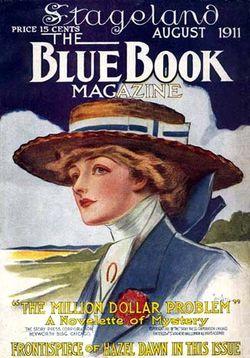
Blue Book
~ the eulogy ~
Louis Eckstein was a Chicago publisher with a color scheme. He had launched Red Book in May 1903, he would launch Green Book in January 1909, and in between came the one that outlived both. Its first issue was cover-dated May 1905, went on sale on 1 April, and was called The Monthly Story Magazine, which tells you how little thought went into the name at the start. It picked up the word Blue in September 1906, became The Blue Book Magazine in May 1907, and kept that for forty-five years.
What it sold was fiction by the pound, in pulp format, aimed at men who wanted adventure and did not want to be talked down to. The Science Fiction Encyclopedia says that by the 1930s it was regarded as the King of the Pulps. Mike Ashley, who wrote the best history of it, calls it a slick in pulp clothing, meaning the paper was cheap and the writing was not. It paid better than its competitors, which is why its contributor list reads like a reading plan: Burroughs, H. Rider Haggard, Agatha Christie, Robert Heinlein, Philip Wylie, and H. Bedford-Jones in every single issue from 1935.
The original magazine ended with the issue dated May 1956 after 613 of them. Nothing collapsed. Circulation was around 300,000 and had never been higher, but Argosy was selling 1,271,000, McCall already owned Redbook, and the man who might have fought for it, the McCall publisher Phillips Wyman, had died in May 1955. Ashley's reading is that the magazine was hovering between two markets and got put down for it. The title was sold off four years later and the thing that came back wearing it is a separate story, filed at the bottom of this page.
~ the dossier ~
| Born | cover-dated May 1905, on sale 1 April, as The Monthly Story Magazine |
|---|---|
| Peak | 223,577 average in 1923, a record it only beat in the early fifties when it passed 300,000 |
| Killed | 1975, with the month disputed between January and May |
| Lifespan | 70 years across two magazines, 613 issues in the first one |
| Made by | Louis Eckstein's Story-Press Corporation in Chicago, then McCall |
| Killed by | being caught between the pulps and the slicks in 1956, then by nothing anybody recorded |
~ king of the pulps ~
Donald Kennicott is the reason it had a sensibility. He was formally editor from December 1929 and stood down in January 1952, and the Encyclopedia says he had effectively been running the magazine since at least 1916, which puts his hand on it for thirty-six years. Before him Ray Long had the chair through the 1910s and left for Hearst. After him came Maxwell Hamilton, who relaunched the February 1952 issue as a men's service magazine with a slick cover over pulp paper, on sale 27 January, and drove circulation past 300,000 for the first time in the magazine's life. He did that four years before it closed.
The numbers are a decent proxy for the whole American pulp industry. Two hundred thousand in 1909. A 223,577 average in 1923, which stood as the record for three decades. Down to 189,386 in 1930 and then 102,294 in 1934. The floor is 66,700 in 1942, the year after the magazine switched to large format and lost readers for doing it. Back to 180,000 by 1948, and past 250,000 by 1951 on the way to the record it set in its final years.
~ what ran there first ~
Edgar Rice Burroughs was in eighty-six issues between September 1916 and January 1942 and was paid up to ten cents a word for some of the serials, against roughly five cents in his early years there. The Tarzan stories that became Jungle Tales of Tarzan ran monthly from September 1916. The Land That Time Forgot came out across three issues in 1918. Tanar of Pellucidar and Swords of Mars arrived here in installments too, with the book deal following the magazine rather than preceding it.
The deepest cut is Edwin Balmer, who edited the magazine from 1927 to 1929 and then sold it the serial he wrote with Philip Wylie. When Worlds Collide ran from September 1932 to February 1933 and the sequel followed a year later. George Allan England sold his first piece of fiction here in September 1905, five months into the magazine's life. William Hope Hodgson's "The Voice in the Night" is in the November 1907 issue. Haggard serialized The Ivory Child through 1915, Christie's "The Affair at the Victory Ball" ran in September 1923, and Heinlein turned up as late as December 1949 with "Delilah and the Space Rigger."
A serial only works on a reader who physically cannot get the rest of it. I understand that condition better than most people my age in richer countries do, because my own first years online were spent on a modem that made everything arrive in installments whether or not it had been written that way, and a thing you waited four weeks for was a thing you reread while waiting. Blue Book's whole business model was built on that gap, and the gap is the first thing broadband deleted.
~ the second blue book ~
In October 1960 a publisher named Hy Steinman brought the title back as Bluebook for Men, bimonthly, with Maxwell Hamilton editing again. It printed purportedly true adventure stories and leaned hard on sex and violence. Ashley's verdict is that the thing degenerated. Ownership moved through Hanro from August 1964, then to the QMG Magazine Corporation from April 1967 with B. R. Ampolsk in the chair. Nobody involved seems to have mentioned Kennicott or 1905.
It stopped in 1975 and the historians cannot agree on the month. Ashley believes January, the Encyclopedia will only say at least January, and one men's-magazine history says May. A title that spent half a century printing an exact issue date on every spine finished with its own death date filed as approximately.
~ leave a rose ~
an anonymous tribute. one rose per visitor per day.
@}-->-- ... roses left here
~ leave a wreath ~
a rose fades by morning. a wreath stays on this grave for good, with your name on it.
paid once through stripe. payments are handled by OÜ Lakeview, the small company that keeps rip.so running. the money pays for the hosting and the nightly digging. adopt it and the headstone reads "maintained in memory by" you. the groundskeeper plants new wreaths at the next tending, usually within a day.
» one email a week: new graves and the anniversaries of the dead. subscribe
other phenomena: Two-Fisted Tales, ESPN The Magazine, Vote for the Worst, Big Brother
also died in the pre-1980s: Imlac, The Pullman Company, Two-Fisted Tales
~ leave a note ~
visitors before you have left these graveside notes. anonymous welcome.