Two-Fisted Tales
~ the last words ~
Harvey Kurtzman went to William M. Gaines in 1950 wanting an adventure title. EC gave him one by a bookkeeping trick that was common at the time: the new comic took over a number in an existing series' sequence, so Two-Fisted Tales starts at issue 18, cover-dated November and December 1950, and The Haunt of Fear went on living under corrected numbers. The Korean War had started that June. Within two issues the adventure comic was a war comic, and within a year it stood almost alone on the racks in treating the war as a bad thing happening to people.
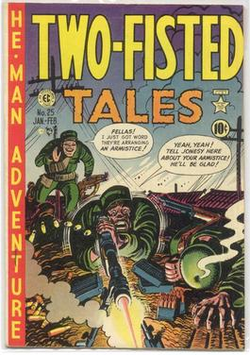
Issue 25 is the one everybody reaches for. Ten cents, January and February 1952, the words HE-MAN ADVENTURE running vertically down the left edge, and a cover showing two GIs dragging a third. One of them is saying that word has come through about an armistice. The other one tells him to go explain the armistice to the man they are carrying. Inside is "Corpse on the Imjin!", which Kurtzman wrote and drew himself, in which an American soldier drowns a North Korean with his bare hands in a river and then has to sit with what he has done while the body floats away.
The art was the best in the business. John Severin and Jack Davis carried most of the issues between them, with Wally Wood and George Evans taking the set pieces and Will Elder frequently inking Severin's pencils. Alex Toth and Joe Kubert came through as guests. Kurtzman let none of them improvise: he drew full layouts for every page and expected the finished art to follow them, panel for panel.
~ the record ~
| Born | issue 18, cover-dated November/December 1950, ten cents |
|---|---|
| Peak | 'Corpse on the Imjin!' in issue 25, dated January and February 1952 |
| Killed | issue 41, early 1955 |
| Lifespan | 24 issues over four years |
| Made by | Harvey Kurtzman for William M. Gaines at EC Comics |
| Killed by | the Korean armistice, and Mad taking its editor |
~ how kurtzman worked ~
He was slow and he was exact. An issue of Two-Fisted Tales took him about a month, where Al Feldstein was turning out EC's horror titles in a week each. The difference was research. Kurtzman spent hours in the New York Public Library checking uniforms against terrain, and his assistant Jerry DeFuccio did more of it on top, to the point of taking a trip on a submarine for a story. Kurtzman corresponded with serving GIs and went up in a rescue aircraft.
The method ran from treatment to thumbnails to a finished vellum layout, and the artist got the layout. Severin and Davis were both strong enough to resent that, and both did some of their best work inside it anyway.
Twenty-nine years sit between the last issue of this comic and my birth, on a different continent, which leaves me at the ordinary remove that everybody now alive shares. EC's war material reaches a reader like me as scholarship, or as a hardback with an essay bound in at the back. Ten cents of newsprint off a drugstore rack now costs twenty dollars and arrives with footnotes.
Critics have been careful about calling him an anti-war artist. Pete Hamill's line is that the combat stories were hard and bleak, with none of the rah-rah patriotism in them. Mitchell Brown's is that nobody could accuse Two-Fisted Tales of being wartime propaganda. But Bob Levin, writing in The Comics Journal, points out that Kurtzman was a patriot who thought Korea was a justifiable war, and that what he objected to was the lying rather than the fighting. Kurtzman himself put it flatly in 1980: nobody had done anything on the depressing aspects of war.
~ the armistice ~
The fighting in Korea stopped on 27 July 1953, and the market for it went with it. Frontline Combat, the companion title EC had given Kurtzman in 1951 on the strength of this one, ended with its fifteenth issue in January 1954, with the sales decline attributed directly to the war ending. Two-Fisted Tales took another year. Kurtzman had launched Mad in 1952 and by late 1953 it was taking his attention, so Colin Dawkins wrote most of the later stories and the covers started reading The New Two-Fisted Tales. Issue 40 was about Dien Bien Phu and issue 41 about the Mau Mau, which is a magazine casting around for a war.
Issue 41 was the last. Indexes disagree on whether it is dated February or March 1955, and nobody has an on-sale date. What matters is the sequence: it was gone before EC's New Direction line launched that March and before the Code fight came to its head. The usual EC story, Fredric Wertham and the Senate subcommittee of 1954 and Gaines testifying badly, is the story of the horror line. This title was already dying of peace.
~ what is still on the shelf ~
EC itself lasted until Incredible Science Fiction in early 1956, and then its distributor Leader News went under and Gaines was left with the one property that had escaped into magazine format. Mad had changed shape with its twenty-fourth issue in July 1955. A magazine was not a comic book and so was none of the Code's business, which is the whole reason Mad is the part of EC that anybody under sixty grew up with. Kurtzman left it in 1956 for Hugh Hefner.
Oni Press has been reviving EC since 2024. When it finally got to the war material in August 2026 it called the book Shellshock, and nothing in the solicitation reuses this title. Dark Horse puts out The EC Archives: Two-Fisted Tales as reprint volumes, the fourth of them listed again in paperback in October 2025 at $19.99 for 216 pages. Seventy years on, the words are easier to buy than they were in 1955, and there has been no new issue since number 41.
~ leave a rose ~
an anonymous tribute. one rose per visitor per day.
@}-->-- ... roses left here
~ leave a wreath ~
a rose fades by morning. a wreath stays on this grave for good, with your name on it.
paid once through stripe. payments are handled by OÜ Lakeview, the small company that keeps rip.so running. the money pays for the hosting and the nightly digging. adopt it and the headstone reads "maintained in memory by" you. the groundskeeper plants new wreaths at the next tending, usually within a day.
» one email a week: new graves and the anniversaries of the dead. subscribe
other phenomena: Vote for the Worst, ESPN The Magazine, DogeQuest, Big Brother
also died in the pre-1980s: The Pullman Company, Imlac, Busicom
~ leave a note ~
visitors before you have left these graveside notes. anonymous welcome.