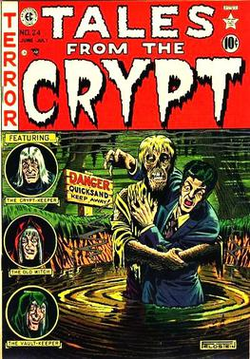
Tales from the Crypt
~ the obit ~
The comic that became Tales from the Crypt started in March 1947 as International Comics, an EC title with nothing horrible in it. It ran five issues under that name, became International Crime Patrol for one, then Crime Patrol for ten more. With issue 17, cover dated April and May 1950, it turned into The Crypt of Terror. Two more came out under that name before number 20, cover dated October and November 1950, arrived as Tales from the Crypt.
Bill Gaines and Al Feldstein ran it as a bi-monthly anthology hosted by the Crypt Keeper, a cackling corpse who introduced each story and signed off with a pun. EC had two sibling horror books, The Vault of Horror and The Haunt of Fear, and their hosts appeared in each other's pages to argue about whose magazine was worse. The stories ran on one moral engine. Somebody did something unforgivable in six pages and received it back in the seventh, usually in a form involving their own body. Jack Davis and Graham Ingels drew a lot of them, and the covers were built to be seen from across a drugstore.
In 1954 the psychiatrist Fredric Wertham published Seduction of the Innocent, which argued that comic books were manufacturing juvenile delinquents, and a United States Senate subcommittee convened to examine the question. Gaines was the only comic book publisher who volunteered to appear. He testified in New York on 21 April 1954, intending to defend the industry, and spent part of the session explaining why a severed head on a cover was in good taste.
That September the publishers formed the Comics Magazine Association of America and wrote a code for themselves, administered by a New York magistrate named Charles F. Murphy. It forbade the words horror and terror in any title. Gaines believed to the end of his life that the clause had been aimed at him by name, because he was the man publishing The Vault of Horror and Tales from the Crypt. The final issue was number 46, cover dated February and March 1955.
~ the rap sheet ~
| Born | October 1950, issue 20, retitled out of The Crypt of Terror |
|---|---|
| Peak | one of the three best known horror books on American newsstands |
| Killed | February 1955, issue 46, the last EC horror comic |
| Lifespan | 27 issues under the name |
| Made by | EC Comics, Bill Gaines and Al Feldstein |
| Killed by | the Comics Code, which banned horror and terror from any title |
~ the hearing ~
The exhibit that sank him was the cover of Crime SuspenStories number 22: a man holding a bloody axe in one hand and a woman's severed head in the other. Senator Estes Kefauver held it up and asked whether Gaines thought it was in good taste. Gaines said yes, for the cover of a horror comic, and explained that it would have been in bad taste only if the head were raised higher so the neck could be seen dripping. Kefauver pointed out that there was blood coming from her mouth. Gaines answered that there was a little. The subcommittee's final report, published on 14 March 1955, actually declined to blame comic books alone for juvenile crime, which was no use to anybody by then, because the industry had already censored itself and the horror line was already gone.
~ what the code forbade ~
The 1954 code was not a law and nobody had to sign it. What made it absolute was distribution: wholesalers agreed to handle only comics carrying the seal, so a book without one could be printed and never reach a rack. The text banned scenes dealing with "walking dead, torture, vampires and vampirism, ghouls, cannibalism, and werewolfism". It also required that good triumph over evil in every instance, and that females be drawn realistically without exaggeration of any physical qualities. Dell and Gold Key ignored the seal entirely and got away with it, because their licensors were Walt Disney and the television studios, an authority that outranked the code.
Gaines spent 1955 on replacement titles he called the New Direction line, and they did not sell. In 1956 he reprinted an old science fiction story called Judgment Day whose central character was a Black astronaut, and Murphy ordered the final panel changed, despite there being nothing in the code about it. Gaines threatened to take the dispute to the newspapers and won that one. Then he stopped publishing comic books and put everything into Mad, which escaped the code by converting itself into a magazine.
~ who kept the name ~
The comic stayed dead and the brand did extremely well. Amicus made a film of it in 1972, and HBO ran a series from 1989 to 1996 that recast the Crypt Keeper as a latex puppet with a voice actor. The title came back on paper twice after that, under Papercutz between 2007 and 2010 and under Super Genius in 2016. In 2024 EC itself returned through Oni Press with new horror anthologies carrying new names, and eccomics.com sells them today beneath a line about what the Comics Code could not kill.
I have never held one of these. The run was twenty-nine years over by the time I was born, on another continent, printed on pulp paper that was never meant to survive the decade, let alone end up graded and sealed in plastic at auction. Issue 46 is scarce because EC was in trouble when it shipped and the print run was small, and that scarcity is now most of what the comic is worth.
~ leave a rose ~
an anonymous tribute. one rose per visitor per day.
@}-->-- ... roses left here
~ leave a wreath ~
a rose fades by morning. a wreath stays on this grave for good, with your name on it.
paid once through stripe. payments are handled by OÜ Lakeview, the small company that keeps rip.so running. the money pays for the hosting and the nightly digging. adopt it and the headstone reads "maintained in memory by" you. the groundskeeper plants new wreaths at the next tending, usually within a day.
» one email a week: new graves and the anniversaries of the dead. subscribe
other phenomena: Modern Humorist, Epoca, Wai-Que, Dunkindonuts.org
also died in the pre-1980s: Electrologica, Hallicrafters, DC-International
~ leave a note ~
visitors before you have left these graveside notes. anonymous welcome.