Epoca
~ the last words ~
Epoca was launched in Milan on 14 October 1950 by Arnoldo Mondadori Editore, modeled openly on Life and Look, and it imported a whole genre into Italy in one move. The subtitle called it a political weekly of great information. What readers noticed was the paper. It was printed in rotogravure on glossy stock with new presses, in color, with page after page handed over to photo spreads, and the layout was set up by Bruno Munari. The first staff list reads like a syllabus: Cesare Zavattini, Giovanni Spadolini, Aldo Palazzeschi, and Augusto Guerriero writing international politics under the pen name Ricciardetto for the next thirty-one years.
In December 1952 the magazine ran The Old Man and the Sea in its own pages, with drawings by Ugo Marantonio, which happened because Alberto Mondadori and Hemingway were friends. In 1956 Mario De Biasi went to Budapest for it and came back with the Soviet tanks, the hanged men in the streets, all of it. Walter Bonatti joined the photographic staff in May 1965, meaning the magazine had an actual mountaineer on the payroll to shoot mountains. Sales sat near 500,000 a week and Epoca beat both of the weeklies it had been launched against.
Then television got into Italian homes and the illustrated weekly stopped being the way people saw the world. Twelve editors passed through the chair between 1970 and 1990, which is roughly one every twenty months, and between 1988 and 1990 the title itself was printed as Epoca! with an exclamation mark on it. Circulation had been 420,000 in 1955. The audited figure for 1984 was 120,046.
~ the record ~
| Born | 14 October 1950 in Milan, subtitled a political weekly of great information |
|---|---|
| Peak | around 500,000 copies a week, ahead of Tempo and L'Europeo |
| Killed | 25 January 1997, issue 2247 |
| Lifespan | 46 years |
| Made by | Arnoldo Mondadori Editore |
| Killed by | television in the 1960s, then thirty years of slow decline |
~ the first cover ~
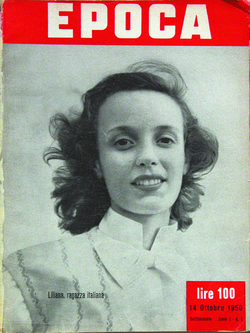
For issue one of a magazine meant to do for Italy what Life did for America, the choice was a nineteen year old who worked the Motta buffet counter in Piazza del Duomo. Her photograph fills the cover, with no statesman and no disaster anywhere on it. The caption under her chin reads Liliana, ragazza italiana. The price box says 100 lire.
It is a better statement of intent than the subtitle was. A weekly that put an ordinary girl on its first cover in close up, printed well enough that you could see her face properly, was telling its readers what they were buying: photographs of this country, at a quality the newspapers could not match.
~ the modem edition ~
In 1994 Epoca became the first Italian weekly with an electronic version, meant to be read on a computer with a modem attached, and it ran a piece explaining the idea to people who had never seen one. That was three years before it closed. I was ten that year, in Ankara, in a house with no modem in it, and by the time one turned up four years later the magazine that had got there first was already a year dead. It takes a certain amount of bad luck to predict the next medium correctly and still be killed by the current one.
~ number 2247 ~
The last editor, Remo Guerrini, held the job for two weeks in January 1997. The final issue is number 2247, dated 25 January, forty-six years and some months after Liliana. Mondadori had tried a relaunch that peaked in 1993 and then watched the sales go again.
The name did not quite stop. For a while afterwards Epoca returned as one-off monographic issues, collector numbers sold as supplements to the weekly Panorama. A title that had held a place on the newsstand for forty-six years finished as an occasional insert inside another Mondadori magazine.
~ leave a rose ~
an anonymous tribute. one rose per visitor per day.
@}-->-- ... roses left here
~ leave a wreath ~
a rose fades by morning. a wreath stays on this grave for good, with your name on it.
paid once through stripe. payments are handled by OÜ Lakeview, the small company that keeps rip.so running. the money pays for the hosting and the nightly digging. adopt it and the headstone reads "maintained in memory by" you. the groundskeeper plants new wreaths at the next tending, usually within a day.
» one email a week: new graves and the anniversaries of the dead. subscribe
other phenomena: Modern Humorist, Tales from the Crypt, WWE ThunderDome, Wai-Que
also died in the 1990s: Amiga CD32, AppleLink, Maťo
~ leave a note ~
visitors before you have left these graveside notes. anonymous welcome.