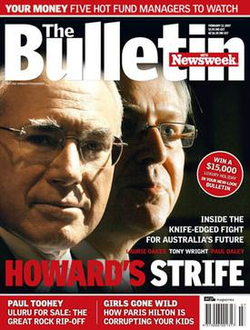
The Bulletin
» see bulletin.ninemsn.com.au as it lived, on the wayback machine
~ the obit ~
J. F. Archibald and John Haynes published the first Bulletin in Sydney on 31 January 1880. Eight folio pages at four pence, mixing political comment with sensationalized news. By the late 1880s it was the most widely read magazine in the country and it had acquired a nickname that stuck for a century: the bushman's bible.
What it actually did was manufacture a national self-image and then sell it back. The Bulletin ran the bush poets and printed a great deal of Henry Lawson and Banjo Paterson, including the argument the two of them conducted in its pages over whether rural Australia was a noble life or a miserable one. It was anti-imperialist and republican decades before either position was respectable, which is the half of its politics people still quote. The other half was a masthead slogan reading "Australia for the White Man", which stayed on the cover until Donald Horne took the editor's chair in 1961 and removed it.
Australian Consolidated Press bought it that same year, merged it with another of its titles and turned it into a news weekly. It absorbed the Australian edition of Newsweek in 1984 and became The Bulletin with Newsweek. For decades it lost money and ACP paid for it anyway, on the grounds that publishing the oldest magazine in Australia was worth something that did not appear on a balance sheet. Kerry Packer in particular wanted it kept alive. When he asked his editor-in-chief Garry Linnell what he expected from the magazine, the brief was four words long: "Son, just make 'em talk about it."
Packer died in December 2005. In 2007 his son sold control of the family media assets to the private equity firm CVC Asia Pacific, and the new owners read the circulation figures without the family history attached to them. On the morning of 24 January 2008, ACP chief executive Scott Lorson announced that The Bulletin would cease publication immediately and that the issue which had gone on sale the previous Wednesday was its last. It was seven days short of its 128th birthday.
~ the rap sheet ~
| Born | 31 January 1880, Sydney, eight pages at four pence |
|---|---|
| Peak | Australia's most popular magazine by the late 1880s, over 100,000 copies in the mid-1990s |
| Killed | 24 January 2008, announced the morning after the last issue reached shops |
| Lifespan | 128 years, the longest run of any Australian magazine |
| Made by | J. F. Archibald and John Haynes, owned by ACP from 1961 |
| Killed by | 57,039 readers and an owner with no sentimental attachment |
~ the last wednesday ~
The closure statement blamed the internet directly. Lorson said the decline was consistent with what weekly news magazines were experiencing worldwide and was somewhat symptomatic of the impact of the internet on the genre. The number underneath that sentence was 57,039 copies, the audited figure for September 2007, against highs of over 100,000 in the mid-1990s. Between 15 and 20 staff were offered redeployment inside ACP or redundancy. John Lehmann, the last editor-in-chief, had been in the job for about eighteen months and had won the magazine a Walkley in that time.
Buried in the same report is a sentence that dates the other death. A spokeswoman for PBL Media confirmed that The Bulletin's website would not continue either, and an insider explained that the site could not stand alone as a profitable enterprise. So the thing everyone agreed had killed the magazine was not considered a viable home for it. The archive of a 128-year-old title went off with the paper, and bulletin.ninemsn.com.au now exists only as Wayback captures.
~ what the magazine was for ~
Across its first eighty years The Bulletin was where Australian writing got printed first. Samuel Prior ran a novel competition out of it. The literary character held until 1961, and even after the switch to news the magazine kept breaking things: in 1974 it published a leaked ASIO paper about the deputy prime minister, and the Whitlam government answered with a Royal Commission on Intelligence and Security.
The late period was louder. Paul Keating sent Linnell a letter calling the magazine rivettingly mediocre, so Linnell printed it under a line boasting that Keating wrote for them. He then gave the former prime minister Letter of the Week, the prize for which was a year's subscription. In 2005 the magazine offered a reward of 1.25 million dollars to anyone who could produce a living Tasmanian tiger. Nobody collected.
~ the distance ~
From Turkey, none of it registered at the time. In January 2008 my reading was split between Turkish and English, and a Sydney title folding after 128 years turned up in neither. Everything here I found afterwards, in an archive.
The National Museum of Australia now files the closure among its defining moments in the national record. The last cover was dated 29 January 2008 and went on sale on the Wednesday. It was declared the final one on the Thursday morning.
~ leave a rose ~
an anonymous tribute. one rose per visitor per day.
@}-->-- ... roses left here
~ leave a wreath ~
a rose fades by morning. a wreath stays on this grave for good, with your name on it.
paid once through stripe. payments are handled by OÜ Lakeview, the small company that keeps rip.so running. the money pays for the hosting and the nightly digging. adopt it and the headstone reads "maintained in memory by" you. the groundskeeper plants new wreaths at the next tending, usually within a day.
» one email a week: new graves and the anniversaries of the dead. subscribe
other news: Reader's Digest Canada, Gettingit.com, GigaOM, Micro Cornucopia
also died in the 2000s: Sensory Sweep Studios, Windows Address Book, Gettingit.com
~ leave a note ~
visitors before you have left these graveside notes. anonymous welcome.