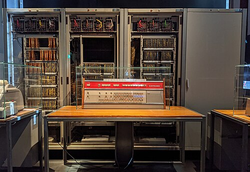
Electrologica
~ the obit ~
The Mathematisch Centrum in Amsterdam had been building computers for its own research when it decided the work was worth commercializing. N.V. Electrologica came out of that decision, started by the Centrum people who had done the building, among them Bram Loopstra and Carel Scholten, and it ran from 1956 until Philips took it over in 1968. The Dutch article carries a detail the English one leaves out: the company was a partnership between the Mathematisch Centrum and the Nillmij, an insurance company based in Den Haag, so an insurer was a partner in the first Dutch computer factory.
It began in Amsterdam and moved in 1964 to the Plaspoelpolder industrial estate in Rijswijk, into a building opened by Prince Bernhard of Lippe-Biesterfeld. That is a fair sign of how the Netherlands read the company at the time. It was not treated as a supplier of office equipment but as a national undertaking.
Two machines carried the whole business. The X1 shipped from 1958 and the X8 replaced it in the middle sixties, and the Dutch account says production of the X8 was stopped immediately after the takeover. Philips had a computer division of its own to protect.
~ the rap sheet ~
| Born | 1956, a Mathematisch Centrum spin-off backed by the Nillmij insurer |
|---|---|
| Peak | About thirty X1 machines sold in the Netherlands and abroad |
| Killed | 1968 |
| Lifespan | 12 years |
| Made by | Bram Loopstra and Carel Scholten, out of the Mathematisch Centrum |
| Killed by | Philips, which absorbed it and ended the X8 |
~ thirty machines ~
About thirty X1 systems were produced and sold, in the Netherlands and abroad. That is a small number by any later standard and a respectable one for a European machine of 1958, when the whole market was a few dozen research institutes and insurers who could justify the floor space.
The X1 was fully transistorized and used magnetic-core memory. Its word length was 27 bits. The feature worth naming is the interrupt. Among European machines the X1 was early to carry an interrupt facility, the mechanism that lets a computer stop what it is doing because something outside it needs attention. Every operating system written since depends on that idea working. The X1 also allowed conditional execution of every instruction rather than only branches.
~ the compiler and the thesis ~
The X1 is the computer Edsger W. Dijkstra wrote his doctoral dissertation about, Communication with an Automatic Computer, and it was the target of the first complete working ALGOL 60 compiler, which Dijkstra finished with Jaap Zonneveld. For a company that sold thirty machines that is an unusual return. Most hardware of that generation disappeared along with its last service contract, while the X1 stayed attached to ideas about how programs get written that are still taught.
Which is where my own line to the company runs. Sixteen years separate the closing of that factory from my own birth, so the hardware is reading for me and nothing more, but Dijkstra was assigned in Ankara the same way he is assigned everywhere. What nobody mentions in passing is that the machine behind the thesis had a Dutch insurance company paying for it.
Philips renamed its own computer arm Philips-Electrologica after the takeover, so the word stayed in use for a while on the outside of other people's machines. The company it belonged to did not.
~ leave a rose ~
an anonymous tribute. one rose per visitor per day.
@}-->-- ... roses left here
~ leave a wreath ~
a rose fades by morning. a wreath stays on this grave for good, with your name on it.
paid once through stripe. payments are handled by OÜ Lakeview, the small company that keeps rip.so running. the money pays for the hosting and the nightly digging. adopt it and the headstone reads "maintained in memory by" you. the groundskeeper plants new wreaths at the next tending, usually within a day.
» one email a week: new graves and the anniversaries of the dead. subscribe
other gadgets: Neato Robotics, Com21, Fitbit Sense, Morrow Designs
also died in the pre-1980s: Wire Recording, Tefifon, Hallicrafters
~ leave a note ~
visitors before you have left these graveside notes. anonymous welcome.